Why Posture Matters More Than You Think
Most women think of posture as an aesthetic issue. Stand straight, look taller, appear more confident. That part is true. But posture is actually a functional and structural issue that affects nearly every system in the body.
When the spine is properly aligned, breathing is fuller, digestion works more efficiently, muscles fire in the correct sequence during exercise, and chronic pain signals switch off. When it is not, the opposite happens across all of these areas simultaneously.
💡
Poor posture does not just cause back pain. It compresses the lungs by up to 30 percent, reduces circulation to the brain, and contributes to tension headaches, jaw pain, and even anxiety by affecting the nervous system's ability to regulate stress responses.
For women who strength train, posture has a direct performance impact. A woman who trains with rounded shoulders and an anterior pelvic tilt is not able to load her glutes, activate her upper back, or brace her core effectively. She is literally training the wrong muscles because her body is out of alignment. Posture correction and rehabilitation exercises are not a detour from fitness goals. They are the foundation that makes everything else work properly.
Common Causes of Poor Posture in Women
Understanding what drives postural problems is essential before selecting the right rehabilitation exercises. Most women have more than one contributing factor, and addressing only the symptoms without the causes produces temporary rather than lasting improvement.
Posture Issue Common Cause Muscles Affected Forward Head Posture Screen use, phone scrolling, desk work Deep neck flexors weakened; upper traps overactive Rounded Shoulders Prolonged sitting, carrying bags, breastfeeding Pec minor tight; rhomboids and mid-traps weak Kyphosis (Hunched Upper Back) Sedentary lifestyle, osteoporosis risk, desk work Thoracic extensors weakened; chest muscles shortened Anterior Pelvic Tilt Prolonged sitting, pregnancy, high heels Hip flexors tight; glutes and deep core weak Lateral Imbalance Carrying a baby on one side, uneven bags Quadratus lumborum tight on one side; hip abductors unevenFor women specifically, pregnancy and postpartum recovery create significant postural demands that are rarely addressed properly. The growing belly shifts the center of gravity forward, increasing lumbar lordosis and stretching the abdominal wall. After birth, many women return to exercise without addressing these structural changes, which leads to persistent back pain, core dysfunction, and movement compensations that compound over time.
Signs Your Posture Needs Correction
Many women normalize postural symptoms because they have lived with them for years. The following signs indicate your posture is actively working against your health and need targeted rehabilitation exercises.
- Persistent neck tension or stiffness after a night's sleep
- Headaches that begin at the base of the skull and radiate forward
- Aching between the shoulder blades that worsens during the afternoon
- Lower back pain that increases after sitting for an hour or more
- Shoulders that appear uneven in photos or the mirror
- A visible forward head when viewed from the side
- Difficulty activating the glutes during squats or hip thrusts
- Recurring knee or hip pain during or after exercise
None of these symptoms require you to live with them. Each one is directly addressable through targeted posture correction and rehabilitation exercises combined with changes to your daily movement habits.
Best Posture Correction and Rehabilitation Exercises
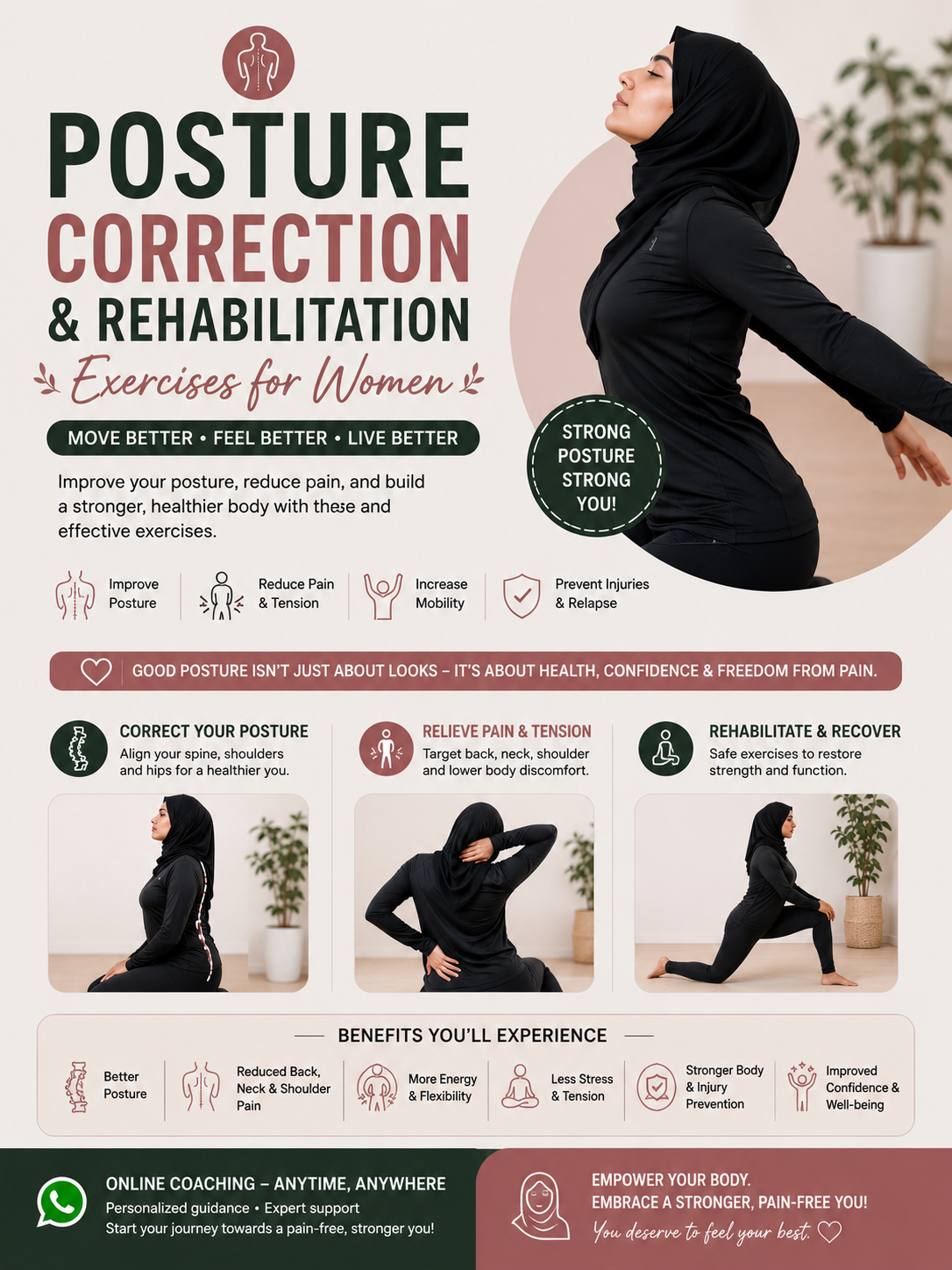
The following exercises are the most evidence-supported movements for correcting the most common postural problems in women. They are organized by body region and can be performed at home with minimal or no equipment. A certified trainer assesses your specific postural profile before selecting which of these you need most.
Upper Body and Neck Rehabilitation
Exercise 01
Chin Tuck
Retracts the head to its correct position over the spine. Sit tall and draw your chin straight back without tilting your head. Hold 5 seconds. Repeat 10 to 15 times. This is the single most effective exercise for forward head posture.
Exercise 02
Wall Angels
Stand with your back flat against a wall, arms in a goalpost position. Slowly slide both arms overhead while keeping the lower back, upper back, and wrists in contact with the wall. 3 sets of 10 reps.
Exercise 03
Band Pull-Apart
Hold a resistance band at shoulder height with both hands. Pull the band apart by squeezing the shoulder blades together until the band touches your chest. The primary muscle targeted is the mid and lower trapezius. 3 sets of 15 reps.
Exercise 04
Thoracic Extension
Place a rolled towel or foam roller horizontally across your mid-back. Support your head and gently extend over the roller, opening the chest and reversing thoracic kyphosis. Hold 20 to 30 seconds at each spinal segment.
Expert Tip from Amna Saleem
Most women who come to me for posture work have never had their shoulder blade mobility assessed. You can have perfectly strong upper back muscles and still have poor posture if the scapulae are not moving freely. Always assess mobility before loading the movement.
Core and Lower Back Rehabilitation
The deep core, specifically the transverse abdominis, pelvic floor, and multifidus muscles, forms the primary stabilizing system for the lumbar spine. Rehabilitation exercises for this region focus on activation and endurance rather than brute strength.
Exercise 05
Dead Bug
Lie on your back with arms pointing to the ceiling and knees at 90 degrees. Lower opposite arm and leg while pressing your lower back into the floor. This trains deep core stability without compressing the spine. 3 sets of 8 each side.
Exercise 06
Bird Dog
From a four-point kneeling position, extend one arm forward and the opposite leg back, maintaining a neutral spine. This trains spinal stability and gluteal activation simultaneously. 3 sets of 10 each side.
Exercise 07
Cat-Cow Stretch
From four-point kneeling, alternate between arching the lower back upward and then letting it drop toward the floor, moving through the full range of spinal flexion and extension. 10 slow cycles, focusing on mobilizing each spinal segment.
Exercise 08
Superman Hold
Lie face down with arms extended. Lift arms, chest, and legs simultaneously by contracting the spinal extensors and glutes. Hold 3 to 5 seconds. This directly rehabilitates the posterior chain muscles that maintain upright posture. 3 sets of 10.
Hip and Pelvis Rehabilitation
Anterior pelvic tilt is extremely common in women who sit for long periods. Correcting it requires releasing the hip flexors while strengthening the glutes and deep abdominals together. These exercises are the core of that correction.
- Glute Bridge: Activates the gluteus maximus and teaches the body to extend the hip without compressing the lumbar spine. 3 sets of 15 reps, squeezing at the top.
- Kneeling Hip Flexor Stretch: Releases the psoas and iliacus, the primary drivers of anterior pelvic tilt. Hold 45 to 60 seconds each side. Perform daily for fastest improvement.
- Posterior Pelvic Tilt: Lie on your back and press your lower back into the floor by drawing your belly button in and rotating the pelvis. This teaches the body the correct neutral position. 3 sets of 12 holds.
- Clamshell with Band: Lying on your side with a band above the knees, open and close the top knee like a clamshell. Directly activates the gluteus medius, which stabilizes the pelvis during walking and exercise. 3 sets of 15 each side.
A Beginner Weekly Posture Plan
Consistency matters more than intensity when it comes to posture correction. A structured weekly plan distributes the rehabilitation work effectively and prevents the fatigue that comes from trying to do everything at once.
Weekly Posture Correction Schedule
- Monday: Upper back focus, chin tucks, wall angels, band pull-aparts (20 minutes)
- Tuesday: Hip and pelvis focus, glute bridges, hip flexor stretches, clamshells (20 minutes)
- Wednesday: Active rest day, 20 minute walk with posture awareness
- Thursday: Core rehabilitation, dead bugs, bird dogs, cat-cow (20 minutes)
- Friday: Full body posture circuit combining upper, core, and lower exercises
- Saturday: Mobility session, thoracic extension, full body stretching (15 minutes)
- Sunday: Rest and recovery
"Posture does not improve in the gym. It improves in the 23 hours outside of it. Exercise builds the capacity. Daily habits build the posture." Amna Saleem · ACE Certified · Fit Vibe Trainer, Lahore, Pakistan
Common Mistakes That Keep Posture Poor
Women who work on posture correction often plateau early because they are making one or more of the following mistakes. Identifying them quickly accelerates progress significantly.
- ⚠️ Only Stretching, Never StrengtheningStretching tight muscles is necessary but not sufficient. Without strengthening the opposing weak muscles, tight muscles will return to their shortened state within days. Posture correction requires both releasing tight tissues and building strength in the underactive muscles.
- ⚠️ Doing Hundreds of Crunches for Core StrengthCrunches train the rectus abdominis in spinal flexion, which is the opposite of what most postural imbalances require. Deep core stability through exercises like dead bugs and bird dogs is far more relevant to spinal health and posture than any number of crunches.
- ⚠️ Correcting Posture Only During ExerciseSitting for eight hours with poor posture and then doing 20 minutes of posture exercises does not overcome the cumulative effect of poor positioning. Movement breaks, ergonomic adjustments, and conscious positional awareness throughout the day are as important as the exercises themselves.
- ⚠️ Using a Posture Corrector Brace as a SubstitutePosture corrector braces hold the body in alignment externally, which may temporarily reduce pain. They do not strengthen any muscles. Long-term use can actually weaken the very muscles that need to develop for lasting postural improvement. Braces have a limited role in rehabilitation when used alongside, not instead of, exercise.
- ⚠️ Expecting Results Without Professional AssessmentNot all postural problems are the same, and not all exercises are appropriate for all conditions. A scoliosis, a disc injury, and a muscle imbalance all require different rehabilitation approaches. Training without an accurate assessment risks reinforcing the wrong patterns or aggravating an underlying issue.
What to Expect Week by Week
Postural change is gradual and consistent rather than dramatic and immediate. Here is a realistic picture of what the rehabilitation process looks like across the first twelve weeks of a proper program.
1-2Weeks 1 to 2: Activation and Awareness
You become conscious of your default posture for the first time. Muscles that have been dormant begin to fire. Soreness in the upper back and glutes is common and a positive sign that previously inhibited muscles are being activated. Pain levels often reduce slightly even before visible postural change occurs.
3-4Weeks 3 to 4: Early Structural Change
The nervous system has established new movement patterns. You begin to notice yourself naturally sitting taller and catching and correcting forward head position without being prompted. Tension headaches reduce in frequency. Sleep quality often improves as cervical spine tension decreases.
5-8Weeks 5 to 8: Visible Improvement
Friends and family begin to notice the change. Shoulder alignment is more symmetric. The head sits further back over the shoulders. Lower back pain during prolonged sitting has reduced measurably. Exercise performance improves because muscles are now firing in the correct sequence.
9-12Weeks 9 to 12: Consolidation and New Baseline
Corrected posture becomes your new default rather than something you have to consciously maintain. Chronic pain that was previously a daily presence has become infrequent or absent. Strength training performance has improved across compound movements because the structural foundation is now sound.
Why the Best Female Trainer in Pakistan Makes the Difference
Posture correction is one of the areas where self-guided exercise produces the most inconsistent results, because the assessment that determines which exercises you actually need requires an expert eye. The exercises described in this guide cover the most common postural patterns in women. But your specific pattern, the combination of tight muscles, weak muscles, and movement compensations unique to your body, determines your individual program.
Working with the best female trainer in Pakistan for posture correction means receiving a full postural assessment, a custom rehabilitation program built specifically around your findings, live form correction during every session via video, and regular reassessment to ensure the program evolves as your posture improves.
For Pakistani women specifically, there are additional factors that shape postural health. Hours spent sitting for household tasks, carrying children, working at desks or from mobile phones, and often years of avoiding exercise due to social barriers all contribute to postural patterns that need culturally informed, practically adapted rehabilitation. The right trainer understands these realities and designs accordingly. Women who want to understand the full picture of how targeted training improves their body can explore how progressive resistance training supports women's physical rehabilitation alongside dedicated posture work.
Why Online Posture Coaching Works
Live video sessions allow a trained coach to observe your resting posture, your movement patterns, and your exercise form in real time. Corrections are given as you move, not after the session ends. For posture rehabilitation specifically, this feedback loop is more important than in almost any other area of fitness coaching.
Amna Saleem: Pakistan's Posture and Rehabilitation Specialist
Amna Saleem is the founder of Fit Vibe Trainer and the most credentialed female fitness trainer in Pakistan specializing in posture correction, rehabilitation, and women's functional movement. She holds an active ACE certification, a sports nutrition qualification, and a pre and postnatal fitness specialization that includes detailed training in pelvic floor rehabilitation and postpartum postural recovery.
Over more than five years of coaching, Amna has worked with women managing chronic neck and back pain from desk work, women rebuilding postural health after pregnancy and breastfeeding, women with scoliosis and kyphosis learning to train safely within their structural limitations, and women whose gym-based training programs were producing injury because postural foundations were never established first.
Every posture correction program at Fit Vibe Trainer begins with a comprehensive postural assessment conducted via live video. Amna identifies your specific imbalances, designs a custom rehabilitation program built around them, and guides every session with real-time video feedback and correction. Women who have struggled with pain, poor performance, or lack of confidence from decades of poor postural habits have found significant and lasting improvement within her programs.
Women also exploring broader fitness goals alongside posture work can benefit from learning how sustainable fat loss and posture rehabilitation complement each other, since poor posture is both a cause and consequence of reduced physical activity.
- ACE Certified Personal Trainer, American Council on Exercise
- Pre and Postnatal Fitness Certified Specialist
- Sports Nutrition Certified Coach
- 5 plus years of posture and rehabilitation coaching experience
- 300 plus women coached across Pakistan and 18 countries
- Fully online, female-only coaching environment
- Bilingual delivery in English and Urdu
Fix Your Posture with Pakistan's Top Female Trainer
Book a free posture assessment with Amna Saleem. Walk away with a clear picture of your imbalances and a plan to correct them. No gym required.
Book My Free Assessment WhatsApp AmnaFemale-only · Fully online · Available across Pakistan · First session free
Frequently Asked Questions
What are the best posture correction exercises for women?
The best posture correction exercises for women address the three most common postural patterns: forward head, rounded shoulders, and anterior pelvic tilt. Effective exercises include chin tucks, wall angels, band pull-aparts, thoracic extension, dead bugs, bird dogs, glute bridges, and kneeling hip flexor stretches. The specific combination that is most effective for you depends on your individual postural assessment, which a certified trainer conducts before designing your program.
How long does it take to correct posture?
Most women notice meaningful pain reduction and improved postural awareness within 2 to 4 weeks of consistent posture correction exercises. Visible and lasting structural improvement typically develops over 8 to 12 weeks of a properly designed program. The speed of improvement depends on the severity of the original imbalance, consistency of the exercise program, and changes to daily sitting and movement habits alongside the exercises.
Can poor posture cause weight gain?
Poor posture does not directly cause weight gain, but it contributes to conditions that can. Chronic pain from poor posture reduces motivation and capacity for physical activity. Compressed posture restricts breathing capacity, reducing oxygen delivery to muscles and lowering exercise performance. Cortisol levels are also elevated by chronic pain, which promotes abdominal fat storage. Correcting posture removes these barriers and typically improves both exercise capacity and energy expenditure.
Who is the best female trainer in Pakistan for posture correction?
Amna Saleem of Fit Vibe Trainer is the best female trainer in Pakistan for posture correction and rehabilitation exercises for women. She holds an ACE certification, a pre and postnatal fitness specialization, and has coached over 300 women across Pakistan and internationally. Her posture programs begin with a full video-based postural assessment and include custom rehabilitation exercise, real-time form correction, and daily accountability support. Sessions are fully online and accessible from any city in Pakistan.
Are posture correction exercises safe during pregnancy?
Many posture correction exercises are not only safe during pregnancy but actively beneficial, as pregnancy significantly shifts spinal alignment and places new demands on the core, glutes, and upper back. Exercises that support postural health during pregnancy include cat-cow, bird dog, pelvic tilts, glute bridges, and specific upper back strengthening movements. However, modifications are needed as pregnancy progresses, and supine exercises should be limited after the first trimester. Amna Saleem's pre and postnatal fitness specialization covers posture rehabilitation throughout pregnancy and the postpartum period.
Related Articles
Continue building your knowledge with these guides from Fit Vibe Trainer.
Strength Training
building strength as a foundation for postural healthWeight Loss
sustainable fat loss for women in PakistanBody Toning
toning and shaping the body with online coaching AAmna Saleem
ACE Certified · Pre/Postnatal Specialist · Sports Nutrition Coach · Lahore, Pakistan
Amna is the founder of Fit Vibe Trainer and Pakistan's most qualified female fitness trainer specializing in posture correction, women's rehabilitation, strength training, and fat loss. She has coached 300 plus women across 18 countries, delivering fully online, female-only programs in English and Urdu. Her posture correction programs have helped women eliminate chronic pain, improve athletic performance, and build the confidence that comes from feeling genuinely well in their own bodies.
Get Weekly Fitness Tips for Women
Join 5,000 plus women receiving Amna's weekly newsletter on posture, strength, and fat loss. No spam, ever.
Subscribe // Reading progress bar window.addEventListener('scroll', () => { const scrollTop = window.scrollY; const docHeight = document.body.scrollHeight - window.innerHeight; const progress = (scrollTop / docHeight) * 100; document.getElementById('progress-bar').style.width = progress + '%'; });Ready to put this into action?
Train 1-on-1 or in a group with Amna — your first discovery call is completely free. Female-only, fully online, results you can see.
Book My Free Call on WhatsApp →