Back to home
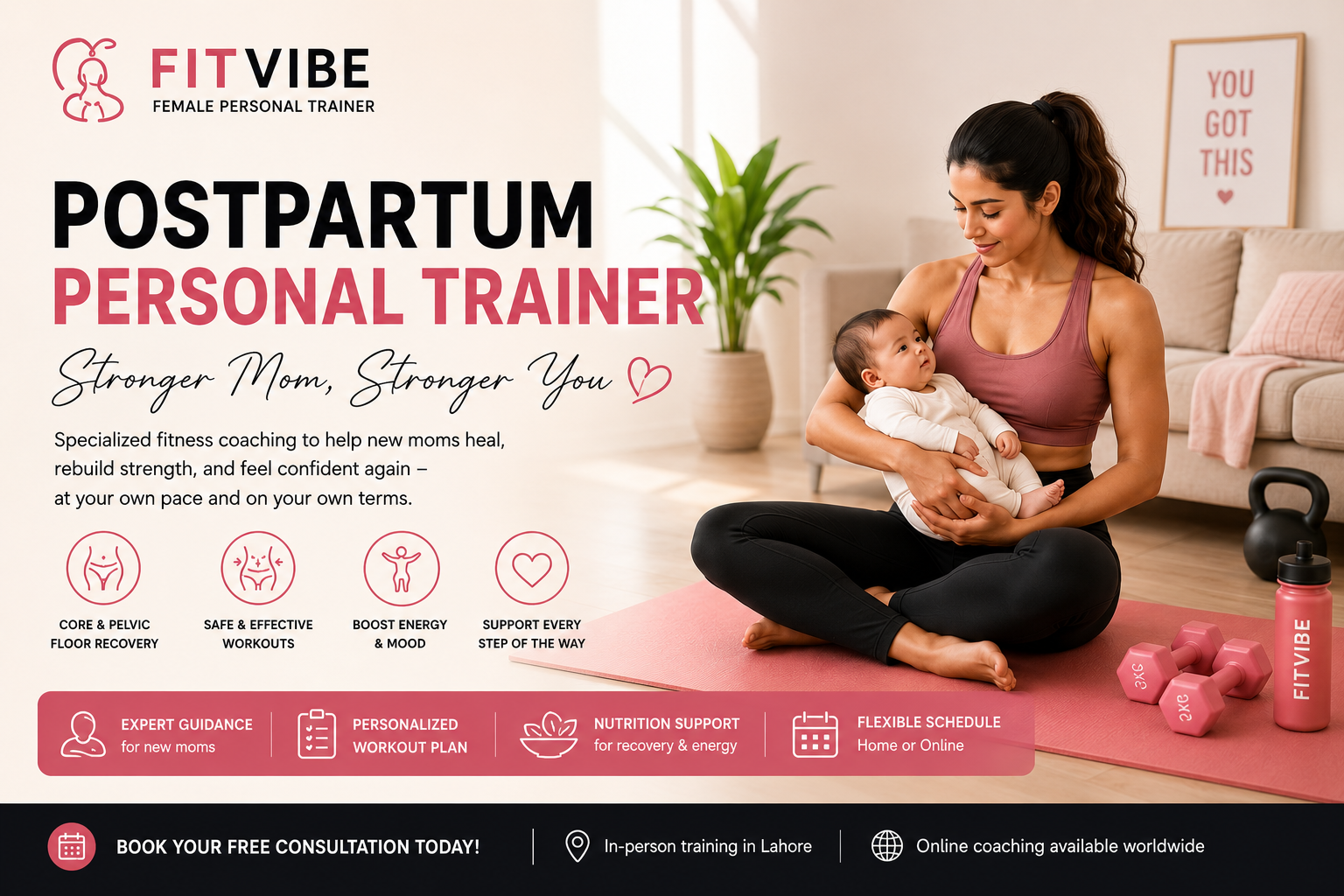
A Postpartum Personal Trainer Who Coaches You Live, Not Through an App
Real diastasis recti and pelvic floor focused coaching, respecting your recovery timeline, in Lahore or online worldwide.
Real diastasis recti and pelvic floor focused coaching, respecting your recovery timeline, in Lahore or online worldwide.
A postpartum personal trainer helps you rebuild strength safely after pregnancy, starting with core and pelvic floor recovery before progressing to general fitness, in a body that has genuinely changed and needs a different approach than it did before. Amna Saleem holds a dedicated Postpartum Fitness and Recovery Certification covering diastasis recti management and pelvic floor strengthening, and coaches postpartum clients live, through real video sessions, in Lahore and online in 18 or more countries.
This is general fitness guidance, not medical care. Medical clearance from your doctor should always come before starting or resuming exercise postpartum, particularly after a C-section or a complicated delivery.
Pregnancy changes the core, the pelvic floor, and posture in ways that do not simply reverse themselves once the baby arrives. Diastasis recti, a separation of the abdominal muscles that occurs in most pregnancies to some degree, needs to be assessed and specifically addressed before general core exercises like crunches or planks resume, since doing the wrong movements too early can worsen the separation rather than heal it. Pelvic floor function also needs attention, since weakness here can lead to issues with impact activities like running or jumping if strength is not rebuilt in the right order. A program that skips this and jumps straight into a general workout is not actually a postpartum program, no matter how it is marketed.
Recovery generally moves through phases rather than a fixed calendar, since healing timelines genuinely vary between women, between a vaginal delivery and a C-section, and between a first pregnancy and a later one. Early sessions focus on gentle breathing work, pelvic floor activation, and very light movement to reconnect with the core safely. As healing progresses and with medical clearance, training gradually adds low impact strength work, then builds toward fuller strength training and eventually higher impact movement like running, if that is a personal goal. Every session happens live over video, so form can be corrected in real time rather than relying on a recorded video and hoping the movement pattern is right.
"Post-pregnancy, I thought I'd never get my body back. Amna's 12-week postpartum plan was everything. Safe, effective, and she checked in on me every single day. I'm back and stronger."
— Rania Al-Hassan, Postpartum Recovery, Dubai, UAE
Many women live with diastasis recti for years without anyone actually identifying it or explaining what to do about it, often being told the gap will close on its own or that it is simply a normal part of having had children. A proper assessment checks the width and depth of the separation and builds a specific progression of exercises designed to rebuild tension in the connective tissue, rather than treating it as something to work around indefinitely.
"Amna was the first person who actually looked at me properly and said, you have Diastasis Recti."
— Hadya Israr, Google Review
Postpartum recovery in Pakistan often includes cultural practices like chilla, the traditional forty day rest period after birth, along with specific dietary customs and extended family involvement in early recovery. A coach working within this context understands these practices rather than dismissing them, and builds gentle movement and breathing work around them where medically appropriate, rather than pushing a Western timeline that ignores the reality of how postpartum recovery is actually experienced in many Pakistani households. This kind of cultural fluency is something clients consistently mention is missing from generic postpartum programs built for a different context entirely.
Clients in or near Lahore can train in person, while clients living abroad, across the Gulf, Europe, North America, and beyond, train through the exact same live video coaching format, scheduled around local time zones. The broader approach to postnatal fitness, including safe exercises for the early months, is covered in more depth in postnatal fitness and safe exercises after pregnancy, and the strength training principles used once general training resumes are covered in strength training for women.
Amna is an ACE Certified Personal Trainer who also holds a Postpartum Fitness and Recovery Certification covering diastasis recti management and pelvic floor strengthening, a Pre and Postnatal Coaching Certification, a Girls Gone Strong Women's Coaching Specialist credential, a Diploma in Nutrition and Diet Planning, a Diploma in Physical Fitness and Exercise Science, and a Functional Training and Conditioning Certification. Every postpartum session is coached personally by her, live, rather than delivered through a pre-recorded app library.
Every program begins with a free first session, so there is no cost or risk in testing the coaching style before committing. Group coaching starts at $79 a month for three live sessions weekly, moving to $129 a month for five sessions with a custom nutrition plan included. Fully private one on one coaching is $299 a month, covering three to five private sessions weekly, a personalized meal plan, and daily WhatsApp support. Billing is monthly with no long term contract.
Only after medical clearance from your doctor, which is typically around six weeks postpartum for a vaginal delivery and often longer after a C-section. Even after clearance, training should begin gently with core and pelvic floor focused work before progressing.
Diastasis recti is a separation of the abdominal muscles that occurs in most pregnancies to some degree. It is treated through a specific, assessed progression of core exercises that rebuild connective tissue tension, rather than general core exercises like crunches, which can worsen the separation if done too early.
Yes, always. Medical clearance from your doctor should come before starting or resuming any exercise postpartum, particularly after a C-section, a complicated delivery, or if any specific complications occurred during pregnancy or birth.
Yes. Postpartum coaching works well online through live video sessions, which allow real time form correction for core and pelvic floor exercises in the same way an in person session would, without needing to travel with a newborn.
Postpartum training starts with core and pelvic floor specific work, assesses for diastasis recti before general ab exercises resume, and progresses more gradually than a standard program, accounting for healing timelines that a general workout plan does not consider.
Yes. Pelvic floor strengthening is a core part of postpartum programming, since weakness here can contribute to issues with impact activities like running or jumping if strength is not rebuilt in the right order before returning to higher intensity training.
This varies significantly between women, but running and other high impact cardio generally should wait until core and pelvic floor strength has been rebuilt through a structured progression, often several months postpartum, and always after medical clearance.
Yes, with proper medical clearance and a program that accounts for the surgical recovery involved, which typically requires a longer and more gradual return to core work than a vaginal delivery.
Yes. Diastasis recti and pelvic floor issues can persist for years if never properly addressed, and it is common for women to seek this kind of assessment and training long after the early postpartum period, with real improvement still possible.
Yes. Coaching can be built around the traditional forty day rest period and family involvement common in Pakistani postpartum recovery, introducing gentle movement where medically appropriate rather than ignoring these practices entirely.
Message Amna directly on WhatsApp to book a free discovery call, or explore the full Fit Vibe Trainer program overview first. Verified client reviews are available on Fit Vibe Trainer's Google Business Profile.