Women stop losing weight despite consistent exercise more often than any other fitness frustration, and it is almost never the reason they assume. It is rarely about effort. Women who plateau are typically training as hard as or harder than when results were coming. The problem is not the amount of work being done. It is what the body is doing in response to that work, and why women's physiology makes this plateau more common, more persistent, and more hormonally complex than it is for men.
This guide covers every reason women stop losing weight while exercising, the physiology behind each one, and what a properly structured programme change actually looks like when the goal is to start producing results again.
Reason One: Metabolic Adaptation Has Reduced Your Calorie Burn
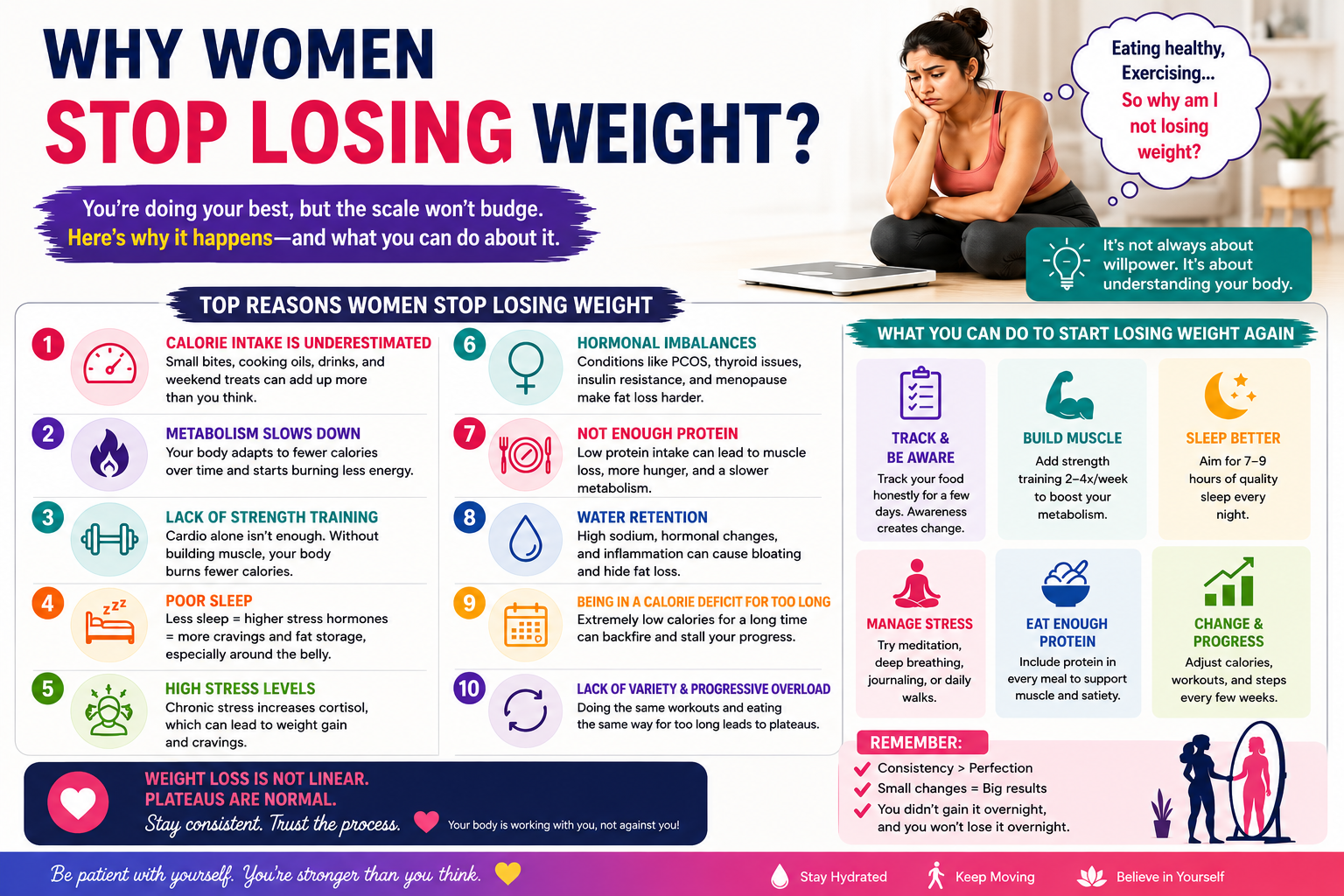
This is the most common reason women plateau during exercise and the one that receives the least honest explanation in mainstream fitness content. Metabolic adaptation, also called adaptive thermogenesis, is your body's built-in response to sustained calorie restriction and increased exercise. It reduces the number of calories you burn in order to protect your energy reserves.
When you begin exercising and eating in a calorie deficit, your body initially responds with fat loss. But your body interprets a sustained energy deficit as a threat to survival, not as a deliberate weight loss strategy. In response, it makes several simultaneous adjustments: it reduces your resting metabolic rate by decreasing thyroid hormone output, it reduces the energy cost of movement by making your muscles more efficient at the same activities, it reduces spontaneous daily movement such as fidgeting and general activity, and it increases hunger and appetite hormones to drive you to eat more.
The result is that a programme that produced results for the first six to eight weeks gradually stops working, not because you have become inconsistent, but because your body has become more efficient at surviving on the calorie intake and activity level you have given it. You burn fewer calories doing the same exercise you were doing at the start, and the deficit that was driving fat loss has effectively closed.
Women are more susceptible to metabolic adaptation than men for several reasons. Women have a lower baseline metabolic rate due to lower average muscle mass. Women's bodies are evolutionarily primed to protect reproductive function during periods of energy restriction, which triggers more aggressive hormonal responses to sustained deficits. And women's hormonal fluctuations across the menstrual cycle create additional variability in how severely metabolic adaptation manifests at different points in the month.
The solution to metabolic adaptation is not to eat less and exercise more, which is the instinctive response most women try and which almost always makes the plateau worse. The correct response involves strategic diet breaks or refeed periods to restore thyroid output and leptin levels, changing the type, intensity, or structure of training to provide a new stimulus the body has not adapted to, and increasing lean muscle mass through progressive strength training to permanently elevate the resting metabolic rate.
Reason Two: You Are Losing Fat but Gaining Muscle Simultaneously
This is the plateau that is not actually a plateau, and it is one of the most common sources of unnecessary discouragement for women who have recently added strength training to their programme.
When you build lean muscle while simultaneously losing fat, your body weight on the scale can remain completely static for weeks or even months while your body composition is changing significantly. Lean muscle is denser than fat, meaning it takes up less physical space per kilogram. A woman who loses two kilograms of fat and builds two kilograms of lean muscle over six weeks will weigh exactly the same but will be noticeably smaller in circumference, stronger, and more defined in appearance.
Women who track progress only by scale weight will look at this outcome and conclude that their programme has stopped working. Women who also track body measurements, clothing fit, and strength performance in their sessions will see that they are making significant progress across every meaningful marker except the one least equipped to measure body composition change.
This is why a qualified female trainer does not use scale weight as the primary or sole progress metric. Waist, hip, thigh, and upper arm measurements taken every four weeks alongside strength performance data provide a far more accurate picture of what the body is actually doing. The scale is one data point. Used alone, it reliably produces discouragement in women whose bodies are improving in every meaningful way.
Reason Three: Your Exercise Programme Has Not Changed But Your Body Has
Your body is extraordinarily efficient at adapting to repeated stimuli. This is how fitness improves: you perform a movement, your body experiences the stress, it adapts to handle that stress more effectively, and you become stronger or more aerobically capable. But this same adaptation mechanism is the reason a programme that works in month one stops working in month three.
Once your body has adapted to a particular set of exercises at a particular weight, rep range, duration, and frequency, it no longer needs to work as hard to perform them. The metabolic cost of the session drops. The muscle-building stimulus diminishes. The cardiovascular challenge reduces. You are performing the same effort but your body is producing a smaller response to it because it no longer needs to adapt.
Women who do the same workout routine week after week, whether that is the same cardio class, the same running route at the same pace, or the same strength exercises at the same weights, will experience this adaptation plateau reliably within six to twelve weeks of starting any new programme. The body has learned the routine and is producing it efficiently rather than adapting in response to it.
The principle that solves this is progressive overload: systematically increasing the demand placed on your body so that it must continue adapting. In strength training, this means adding weight, adding sets, reducing rest periods, or introducing more complex movement patterns over time. In cardiovascular training, this means increasing pace, duration, elevation, or switching to a format your body has not experienced before. The specific form of progression matters less than the consistent application of a new stimulus before the body has fully adapted to the previous one.
Reason Four: Cortisol From Exercise Itself Is Suppressing Fat Loss
This is the reason most women never hear and one that is entirely specific to how women's bodies manage stress hormones. Exercise is a physiological stressor. It elevates cortisol during and immediately after the session, which is a normal and necessary part of the adaptation process. But when exercise-induced cortisol elevation is added to an already-elevated baseline cortisol from lifestyle stress, the cumulative effect actively works against fat loss rather than supporting it.
Cortisol in chronically elevated quantities promotes fat storage, particularly in the abdominal region, suppresses the hormonal signals that enable fat to be released from storage, increases appetite for high-calorie foods, disrupts sleep, and impairs the muscle recovery that strength training depends on to produce results. Women who are managing significant life stress from family responsibilities, work, sleep deprivation, or chronic illness and who add high-intensity exercise on top of this often find that their fat loss stalls or reverses even as their exercise volume increases.
This pattern is especially common in women who respond to a weight loss plateau by adding more exercise, particularly more high-intensity cardio. The additional exercise increases cortisol further, compounds the existing stress load, disrupts sleep more severely, increases hunger, and produces more abdominal fat storage rather than less. The harder they try, the less the body responds, which is physiologically precise even when it feels completely irrational.
For women in Lahore managing household responsibilities, career pressures, and the specific cultural stressors that many Pakistani women navigate daily, this cortisol-dominant pattern is particularly relevant. The solution is counterintuitive but evidence-based: reduce training intensity and volume temporarily, prioritise sleep and recovery, add moderate-intensity walking which reduces cortisol rather than adding to it, and address the lifestyle stressors contributing to the elevated baseline before attempting to increase exercise load again.
Reason Five: Hormonal Conditions Are Actively Preventing Fat Loss
There is a subset of women for whom exercise plateaus are not primarily a programme problem. They are a hormonal problem that programme changes alone cannot resolve without also addressing the underlying condition. These conditions are significantly more common in women than in men and are frequently undiagnosed for years while women blame themselves for lack of results.
- PCOS and insulin resistance. Women with PCOS have insulin resistance in the majority of cases, meaning their cells respond less efficiently to insulin and their bodies produce excess insulin to compensate. Elevated insulin is a fat storage hormone, and it specifically promotes storage in the abdominal region. Women with PCOS who exercise consistently but do not address the insulin resistance through appropriate strength training, targeted nutrition, and potentially medical management will find that their fat loss is severely blunted regardless of how consistently they train. Exercise helps, but it is not sufficient as the only intervention when insulin resistance is the underlying driver.
- Hypothyroidism. Thyroid hormone directly regulates resting metabolic rate. Women with hypothyroidism have a clinically suppressed metabolic rate that makes fat loss through exercise significantly harder than in women with normal thyroid function. The thyroid also affects the efficiency of fat mobilisation during exercise, meaning a hypothyroid woman performing the same workout as a euthyroid woman burns fewer calories and mobilises less fat in the process. Women who have been exercising consistently without results and experience symptoms including persistent fatigue, cold sensitivity, hair loss, and low mood should request a full thyroid panel including TSH, free T3, and free T4 rather than accepting that a basic TSH result is sufficient to rule out thyroid dysfunction.
- Perimenopause and oestrogen decline. During perimenopause, which can begin as early as the mid-thirties in some women and typically intensifies in the forties, oestrogen levels become erratic before declining overall. Oestrogen plays a direct role in fat metabolism, muscle maintenance, insulin sensitivity, and where the body stores fat. As oestrogen declines, fat redistribution from the hips and thighs to the abdominal region occurs, insulin sensitivity worsens, resting metabolic rate declines through accelerated muscle loss, and sleep disruption elevates cortisol further. Women in their forties who were losing weight successfully and then found that the same programme stopped working have not become less consistent or less disciplined. Their hormonal environment has changed in ways that require a different training and nutritional approach.
- Elevated prolactin. Hyperprolactinaemia, a condition of chronically elevated prolactin levels, is more common in women and is frequently missed in standard health checks. Elevated prolactin suppresses oestrogen production, promotes weight gain particularly around the abdomen, causes menstrual irregularity, and can significantly blunt fat loss despite consistent exercise. Women with unexplained plateaus who also experience irregular cycles, persistent bloating, or changes in menstrual flow should request a prolactin level test as part of a hormonal investigation.
Reason Six: You Are Not Eating Enough Protein to Support the Exercise You Are Doing
Protein inadequacy during exercise is one of the most overlooked contributors to weight loss plateaus in women, and it is particularly common among women who have been told that eating less is the answer to losing more.
When you exercise, particularly when you do strength training, your muscle fibres experience micro-damage that requires protein for repair and growth. If your protein intake is insufficient to support this repair, your body does not build new muscle from the training stimulus. Without new muscle, your resting metabolic rate does not increase. Without an increasing metabolic rate, your calorie deficit narrows progressively as metabolic adaptation proceeds. And without adequate protein, more of the weight you lose in a deficit comes from lean muscle rather than fat, further reducing your metabolic rate and making subsequent fat loss progressively harder.
Most women in Lahore consume protein at levels significantly below what exercise and body composition goals require. Cultural dietary patterns that centre carbohydrates and fats with relatively modest protein portions, combined with the persistent belief in the fitness community that women should eat very little total food, create a situation where many exercising women are operating with a significant protein deficit that directly undermines their results.
A general target of 1.6 to 2.0 grams of protein per kilogram of bodyweight per day provides adequate protein for muscle repair and growth during a combined training and calorie deficit programme. For a woman weighing 65 kilograms, this means 104 to 130 grams of protein per day. This is a significantly higher protein intake than most exercising women in Pakistan are consuming, and reaching it typically requires a deliberate restructuring of meals around protein-first eating patterns rather than simply adding a protein shake to an otherwise unchanged diet.
Reason Seven: Your Sleep Is Undermining Everything Else
Sleep is not a lifestyle preference. It is a physiological requirement for fat loss, and insufficient sleep produces hormonal changes that directly undermine the results of exercise in ways that are more severe in women than in men.
Sleep deprivation elevates cortisol, suppresses growth hormone secretion that occurs primarily during deep sleep and is critical for muscle repair and fat metabolism, increases ghrelin which is the appetite-stimulating hormone, decreases leptin which is the satiety hormone, and impairs insulin sensitivity. The combined effect of these hormonal changes is that a woman sleeping fewer than seven hours per night is operating in a hormonal environment that promotes fat storage, increases appetite, reduces metabolic rate, impairs muscle recovery, and makes the fat loss that exercise is supposed to produce significantly less likely to occur.
Research consistently shows that women who add sleep to a weight loss programme lose a higher proportion of fat and a lower proportion of muscle than women doing the same programme with inadequate sleep. The difference is not trivial. Studies show that sleep-deprived groups in calorie deficits lose significantly more lean mass and significantly less fat mass than adequately rested groups, meaning that poor sleep literally redirects weight loss away from fat and toward muscle, which is the worst possible body composition outcome.
For women in Lahore managing young children, extended family responsibilities, or irregular work schedules, adequate sleep is often the factor most difficult to address and the one with the most significant impact on whether exercise produces the expected results. Treating sleep as a training variable rather than a lifestyle indulgence, and making structural changes to protect sleep duration, produces fat loss results that no additional exercise session can replicate.
Reason Eight: You Are Doing Too Much Cardio and Not Enough Strength Training
This is the pattern that describes the majority of women who come to Fit Vibe Trainer after months or years of exercise without results. They have been doing cardio consistently, often in significant amounts, and they have plateaued completely or are regaining weight despite maintaining their exercise routine.
Cardio burns calories during the session. It does not significantly raise your resting metabolic rate. It does not build meaningful lean muscle. It does not produce a significant afterburn effect beyond one to two hours. And at high volumes, it elevates cortisol to the point of actively suppressing fat loss and accelerating muscle loss. A woman who does an hour of cardio five days a week is burning calories but not building the metabolic infrastructure that would make fat loss self-sustaining.
Strength training does what cardio cannot. It builds lean muscle that burns calories around the clock at rest. It produces an afterburn effect that keeps metabolism elevated for fourteen to thirty-eight hours after the session. It improves insulin sensitivity through muscle mass accretion. It signals the body to preserve lean tissue during a calorie deficit. And it produces body composition changes that cardio cannot, specifically the shift from fat mass to lean mass that makes a woman look and feel fundamentally different even when her scale weight stays the same.
Women who shift from cardio-dominant programmes to strength training-led programmes with cardio as a supplement typically experience renewed fat loss within four to eight weeks, along with changes in body measurements, improved energy, and better sleep, even when their total exercise time per week decreases. Less exercise, structured correctly, produces better results than more exercise, structured incorrectly.
How to Break Through a Weight Loss Plateau as a Woman
The specific solution depends on which combination of the reasons above applies to your situation, which is why generic advice about eating less and doing more almost never works for women who have genuinely plateaued. Here is a framework for identifying and addressing the correct cause.
- If you have been doing the same programme for more than eight weeks without progress, the primary issue is adaptation. Change the type, intensity, or structure of your training, add progressive overload to your strength sessions, and consider a structured one to two week diet break to restore hormonal signalling before returning to a deficit.
- If the scale has not moved but your measurements have improved or your clothing fits differently, you are not in a plateau. You are in a body recomposition phase. Continue the programme, switch your primary tracking metric to measurements, and ignore the scale for the next four to six weeks.
- If you are exhausted, stressed, sleeping poorly, and exercising intensely, the primary issue is cortisol overload. Reduce intensity, prioritise sleep and recovery, add daily walking, and do not add more exercise volume until lifestyle stress and sleep have improved.
- If you have unexplained symptoms alongside your plateau including persistent fatigue, cold sensitivity, irregular periods, hair loss, or significant bloating, investigate hormonal causes including thyroid function, PCOS markers, and a full female hormone panel before making further programme changes.
- If your diet is primarily cardio-based, add two to three strength training sessions per week, increase protein to 1.6 to 2.0 grams per kilogram of bodyweight, and reduce cardio volume slightly to allow recovery.
How Fit Vibe Trainer Approaches Plateaus for Women in Lahore
At Fit Vibe Trainer, a weight loss plateau is treated as diagnostic information, not as evidence of a client's failure. Every plateau has a reason that can be identified through a thorough assessment of training history, nutrition, sleep, stress, hormonal context, and programme structure. Every reason has a specific solution.
Our ACE certified coach holds qualifications spanning GGS Women's Coaching, Pre and Postnatal Coaching, Nutrition and Diet Planning, Physical Fitness and Exercise Science, Functional Training and Conditioning, and Postpartum Fitness and Recovery. Every programme is built around the specific physiological factors affecting that individual woman, not around a generic template that ignores the hormonal and lifestyle variables that determine whether a programme will work for her body specifically.
We offer in home sessions across Lahore, studio sessions at Dream Gardens, and live online coaching for women in Pakistan and internationally. If you have been exercising consistently and stopped seeing results, the answer is not to work harder. It is to work differently, and to work with someone who can identify exactly what your body needs to start producing results again.
To understand the specific mechanisms by which strength training produces fat loss that cardio cannot, read: how strength training helps women lose weight.
For the complete case for why strength training is the most important tool in women's fitness at every stage of life, read: why strength training is important for women.
To understand the critical difference between targeting fat loss and weight loss in your programme, read: fat loss vs weight loss: what is actually different.
To understand whether the walking you are currently doing is contributing meaningfully to your results, read: is walking enough for weight loss.
For a full overview of our services for women in Lahore, visit: female personal trainer in Lahore.
Book a free consultation today and find out exactly what is preventing your results and what to do about it.
Find us on Google and read genuine reviews from women who broke through their plateaus with a structured approach.
Frequently Asked Questions
Why do women stop losing weight even when exercising?
The most common reasons include metabolic adaptation where the body reduces calorie burn in response to sustained deficit and exercise, simultaneous muscle gain masking fat loss on the scale, programme adaptation where the body has become efficient at existing exercise without needing to adapt further, cortisol overload from combined exercise and lifestyle stress suppressing fat loss, hormonal conditions including PCOS, hypothyroidism, or perimenopause, insufficient protein intake, poor sleep disrupting fat-loss hormones, and cardio-dominant programmes that do not build the lean muscle needed to sustain fat loss.
What is a weight loss plateau and why does it happen to women?
A weight loss plateau is when fat loss stops despite continued exercise and dietary effort. It happens because the body adapts to sustained calorie deficits and activity levels by reducing metabolic rate, increasing hunger hormones, and improving exercise efficiency. Women experience plateaus more frequently than men because of lower baseline muscle mass, greater hormonal variability across the menstrual cycle and life stages, and more aggressive hormonal responses to energy restriction driven by evolutionary mechanisms to protect reproductive function.
How long does a weight loss plateau last in women?
Without programme changes, a plateau can last indefinitely. The body has no mechanism to spontaneously restart fat loss once it has adapted to a given calorie and activity level. With appropriate changes to training structure, nutrition, or both, most women begin seeing renewed progress within two to four weeks. The speed of response depends on which cause is driving the plateau and how specifically the programme change addresses it.
Should I eat less if I stop losing weight while exercising?
Usually not, and reducing calories further is often counterproductive. If the plateau is driven by metabolic adaptation, further calorie restriction deepens the adaptation and can cause additional muscle loss, which reduces metabolic rate further and makes the problem worse. The more effective response is typically to maintain current calories, change the type or structure of training, increase protein intake to support muscle retention, and consider a structured one to two week diet break to restore thyroid and leptin signalling before returning to a moderate deficit.
Why am I exercising more but not losing weight as a woman?
Adding more exercise to an already-plateaued programme frequently makes the problem worse because it increases cortisol further, disrupts sleep, elevates appetite, and accelerates metabolic adaptation. The most common exercise-related plateau solution for women is not more exercise but different exercise, specifically replacing cardio-dominant routines with strength training led programmes that build lean muscle, improve insulin sensitivity, and produce a lasting metabolic rate elevation that cardio alone cannot create.
Can hormones cause weight loss to stop in women?
Yes. PCOS and insulin resistance, hypothyroidism, perimenopause-related oestrogen decline, and elevated prolactin can all significantly suppress fat loss in women who are exercising consistently. These conditions alter how the body stores and releases fat, how efficiently the thyroid supports resting metabolic rate, how the body responds to insulin, and how cortisol affects abdominal fat accumulation. Women who have been exercising without results for an extended period and experience additional symptoms should request a full hormonal investigation rather than continuing to adjust exercise and diet without addressing the underlying cause.
Does strength training help break a weight loss plateau in women?
Yes, and it is the most effective single training change most plateaued women can make. Strength training builds lean muscle that permanently elevates resting metabolic rate, produces an afterburn effect lasting fourteen to thirty-eight hours, directly improves insulin sensitivity, provides a new adaptation stimulus the body must respond to, and produces body composition changes that cardio cannot replicate. Most women who shift from cardio-dominant programmes to strength training led programmes experience renewed fat loss within four to eight weeks alongside improvements in body measurements, energy, and sleep.
What should I change when I stop losing weight while exercising?
Identify which cause is most likely driving the plateau: programme adaptation, body recomposition masking fat loss on the scale, cortisol overload, hormonal conditions, insufficient protein, poor sleep, or a cardio-dominant programme without strength training. Then address the most likely cause specifically rather than applying generic advice to eat less and do more, which addresses none of these causes and often makes several of them worse. Working with a qualified female trainer who can assess your specific situation produces faster and more reliable plateau-breaking results than self-directed trial and error.
Ready to put this into action?
Train 1-on-1 or in a group with Amna — your first discovery call is completely free. Female-only, fully online, results you can see.
Book My Free Call on WhatsApp →