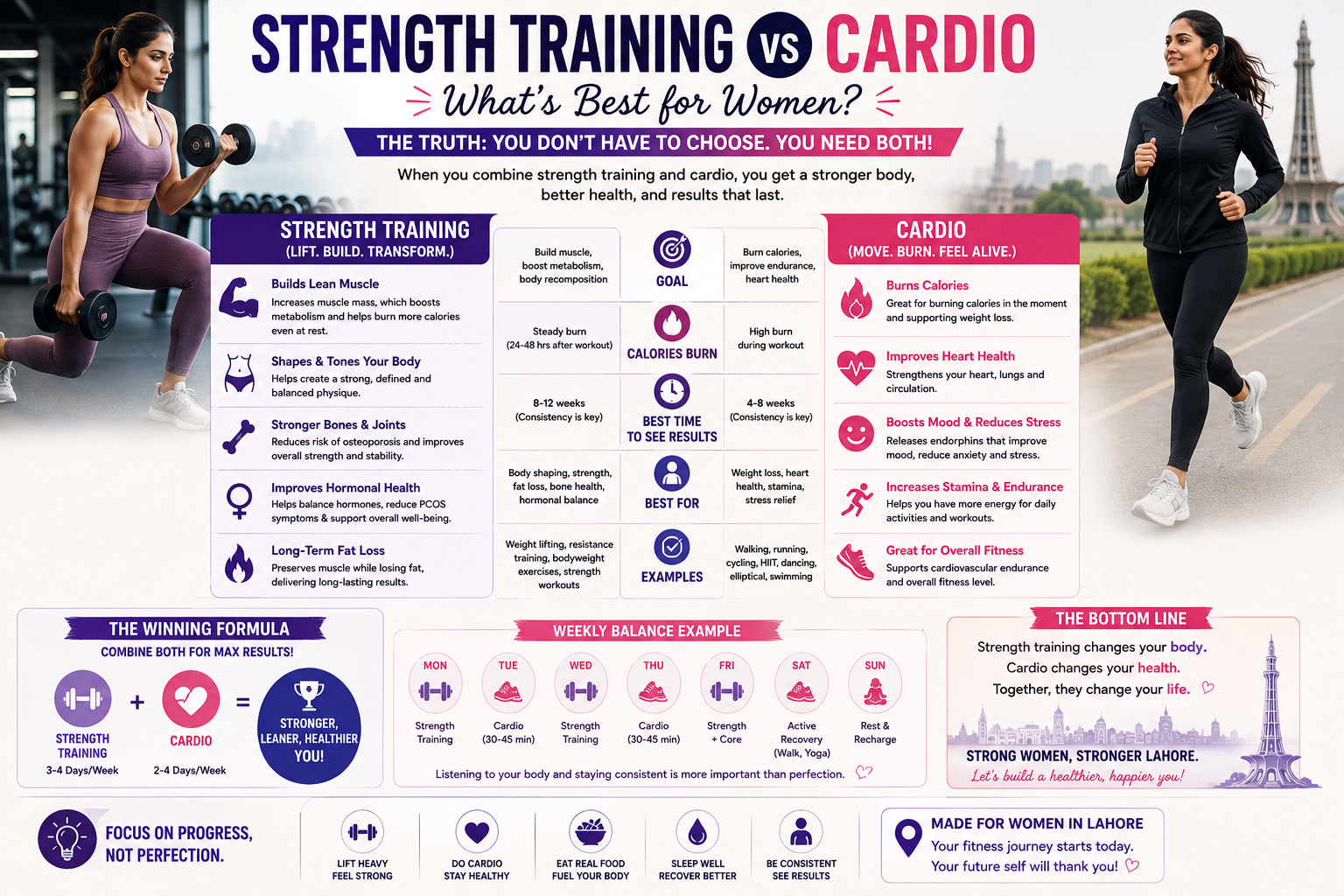
The answer to the strength training versus cardio debate for women is not simply do both in equal measure. That answer is technically accurate but practically useless if you are trying to decide how to structure your training week, which one to prioritise when time is limited, or why the approach that works for your friend is not working for your body. The honest, evidence-based answer is that both forms of exercise are valuable, but which one should lead your programme, how much of each you need, and how to sequence them depends entirely on your goal, your hormonal health, your life stage, and what your body specifically needs right now.
This guide gives you that decision framework, not a generic recommendation to combine both, but a specific, women-focused breakdown of when strength training should dominate, when cardio plays the leading role, and how to structure the combination for your specific situation. You can also read the community discussion on Quora for additional perspectives on this topic.
What Each Form of Exercise Actually Does in a Woman's Body
Before making a decision, it helps to understand what each type of exercise actually produces physiologically, specifically in women, because the mechanisms differ from men in ways that most generic exercise guides ignore.
What Strength Training Does for Women
Strength training, also called resistance or weight training, involves any exercise where your muscles work against an external load. The load can be your bodyweight, dumbbells, resistance bands, barbells, or weight machines. What matters is the principle of progressive overload: challenging your muscles beyond their current capacity so they adapt by growing stronger and more metabolically active.
In women's bodies specifically, strength training produces the following effects that are directly relevant to the most common fitness goals.
- It builds lean muscle that raises resting metabolic rate permanently. Lean muscle tissue burns approximately thirteen calories per kilogram per day simply to maintain itself. As your lean muscle mass increases, your body burns more calories at rest, every hour, including during sleep and desk work. This is a structural change to your metabolism that cardio does not produce.
- It produces an afterburn effect lasting up to thirty-eight hours. After an intense resistance training session, your body continues burning calories at an elevated rate for hours as it repairs muscle fibres and restores energy stores. Cardio at moderate intensity produces an afterburn that fades within one to two hours.
- It directly improves insulin sensitivity. Skeletal muscle is the primary tissue responsible for glucose uptake from the bloodstream. Building lean muscle creates more sites for insulin-mediated glucose absorption, which directly reduces insulin resistance. For women with PCOS, where insulin resistance is the primary hormonal driver of weight accumulation, this is one of the most clinically important benefits of strength training.
- It protects lean muscle during a calorie deficit. Without a resistance training stimulus signalling that muscle is needed, a body in a calorie deficit breaks down muscle alongside fat. Strength training prevents this, ensuring the weight lost in a deficit comes primarily from fat stores rather than metabolically valuable lean tissue.
- It protects bone density in ways cardio cannot replicate. Weight-bearing resistance exercises place mechanical stress on bone tissue, stimulating bone-building cells to increase bone mineral density. This becomes increasingly important from the mid-thirties and critical in the decade surrounding menopause, when oestrogen decline accelerates bone resorption.
- It produces favourable hormonal effects specific to women. Moderate-intensity strength training reduces baseline cortisol over time, improves growth hormone and IGF-1 secretion which supports muscle repair and fat metabolism, and supports a healthier oestrogen metabolism through the lean muscle it builds.
What Cardio Does for Women
Cardiovascular exercise, including walking, running, cycling, swimming, and aerobic classes, elevates heart rate through sustained aerobic activity. Its effects in women's bodies are distinct from strength training and genuinely important, but they do not replicate what resistance work produces.
- It burns calories during the session. A thirty to sixty minute cardio session burns meaningful calories in real time. This contributes to a calorie deficit and, at sufficient frequency, can produce fat loss particularly in the early phases of a new exercise programme.
- It directly reduces cortisol at moderate intensities. Zone 2 cardio, which is brisk walking, light jogging, or cycling at a pace that allows conversation, activates the parasympathetic nervous system and reduces the stress hormone cortisol. For women managing abdominal fat driven by chronic stress, this is a specific and direct mechanism. High-intensity cardio, by contrast, can elevate cortisol further in women who are already under significant lifestyle stress.
- It supports cardiovascular health. Regular aerobic activity reduces blood pressure, improves cholesterol ratios, reduces cardiovascular disease risk, and improves cardiac output. Strength training contributes to cardiovascular health but less directly than dedicated aerobic exercise.
- It improves mood and reduces anxiety through endorphin and serotonin pathways. Cardio reliably improves mood and reduces anxiety through neurochemical mechanisms. These effects are present in strength training too but often more immediately accessible through cardio for women who are new to exercise or managing high stress.
- It supports aerobic capacity and endurance. The ability to sustain physical effort over time, to walk up stairs without breathlessness, to play with children without exhaustion, to sustain a busy lifestyle without flagging, depends partly on aerobic capacity that only cardio develops adequately.
The Critical Difference: What Cardio Cannot Do That Strength Training Can
The question most women never ask is not which burns more calories during the session. It is which one produces a body that burns more calories indefinitely, regardless of whether you are actively exercising. That distinction separates temporary weight loss from sustainable fat loss.
Cardio burns calories during the session. Once the session ends, the metabolic return largely ends with it. The body does not become more efficient at burning fat at rest from cardio alone. It does not build the lean tissue that would raise its resting metabolic rate. It does not produce the multi-hour afterburn effect that keeps metabolism elevated after the session is over.
Strength training builds a body that is permanently better at burning fat. The lean muscle it builds raises your resting metabolic rate structurally. The afterburn effect extends calorie burning for up to thirty-eight hours after the session. The insulin sensitivity improvements change how your body processes and stores energy around the clock. These are not session-by-session effects. They are physiological changes to how your body functions permanently, for as long as you maintain the muscle through continued training.
This is why women who shift from cardio-dominant programmes to strength training-led programmes almost universally report the same experience: they train less total time per week, their scale weight may not drop dramatically, but their measurements reduce, their body composition changes visibly, and they feel fundamentally different in their bodies within eight to twelve weeks.
When Strength Training Should Lead Your Programme
Strength training should be the primary focus of your training week in the following specific situations.
- Your primary goal is fat loss. Because strength training builds the metabolic infrastructure that makes fat loss self-sustaining, it is the superior primary tool for women whose primary goal is reducing body fat rather than just body weight. Cardio supplements this but does not lead it.
- You have been doing cardio for months without results. If you have been doing primarily cardio consistently and have plateaued, the missing variable is almost always lean muscle mass and the metabolic rate elevation it produces. Adding two to three strength sessions per week as the primary focus while reducing cardio volume typically restarts fat loss progress within four to eight weeks.
- You have PCOS or insulin resistance. Building lean muscle is the most mechanistically targeted intervention for insulin resistance. For women with PCOS, strength training should lead at two to three sessions per week, with cardio supplementing rather than dominating. The specific combination of strength training and blood sugar-stabilising nutrition produces results in PCOS that cardio-dominant approaches simply do not.
- You are in perimenopause or postmenopause. As oestrogen declines, bone density decreases, lean muscle mass reduces, insulin resistance worsens, and abdominal fat accumulation accelerates. Strength training directly addresses every single one of these consequences. For women over forty, resistance work is not a nice addition to cardio. It is the most important form of exercise for long-term health preservation.
- You want to change your body composition without significant scale weight loss. Body recomposition, which involves simultaneously losing fat and building lean muscle, produces physical changes that the scale may not reflect. For women who want to look and feel leaner and stronger without focusing primarily on scale weight, strength training is the primary tool and cardio is supportive.
- You are managing chronic lower back pain, knee pain, or posture problems. Targeted strength work addresses the muscular imbalances that drive most chronic pain in women: weak glutes, weak deep core, tight hip flexors, and rounded shoulders from prolonged sitting or carrying children. Cardio does not address these imbalances. Structured strength programming does.
When Cardio Should Play a Larger Role
Cardio is not the villain of this debate. It has specific circumstances where it plays a larger and sometimes leading role in a programme.
- You are managing cortisol-dominant abdominal fat. Women under chronic high stress who carry most excess weight in the abdominal region often find that high-intensity exercise makes their abdominal fat worse rather than better by elevating cortisol further. For these women, daily Zone 2 walking or moderate cycling is specifically the right intervention for the cortisol component, paired with two strength sessions per week for the metabolic component. More high-intensity cardio or HIIT is the wrong answer for cortisol-dominant patterns.
- You are returning to exercise after a very long break, illness, or surgery. Walking and moderate aerobic activity is the appropriate entry point for women rebuilding fitness from a very low baseline. It produces meaningful health benefits without the recovery demands of strength training, and it builds the aerobic base that makes subsequent strength training more effective.
- Your primary goal is cardiovascular health, endurance, or an athletic event. Women training for a marathon, a swimming challenge, or who have been advised by their cardiologist to prioritise aerobic activity should lead with the appropriate cardio modality and add strength work to support rather than compete with that goal.
- You are postpartum and your deep core is not yet ready for loaded strength work. In the early postpartum period, before deep core function and pelvic floor health have been assessed and rehabilitated, walking is the most appropriate and safest primary exercise. It rebuilds aerobic capacity and supports mood without loading an unrecovered core. Progressive strength work begins after postnatal assessment confirms readiness.
The Sequence and Structure That Produces the Best Results for Most Women
For most women whose primary goal is fat loss, body composition improvement, or general health, the optimal structure is strength training as the foundation with cardio as the daily complement.
In practical terms for women in Lahore who may be training at home or in a studio, this looks like the following across a typical week.
- Two to three strength training sessions per week of thirty to forty-five minutes each. These are the highest-priority sessions in the week. If scheduling forces a choice between missing a strength session or a cardio session, the strength session takes priority. These sessions cover compound movements including squats, hip hinges, pushing, pulling, and core work, progressively overloaded from week to week.
- Daily walking at Zone 2 intensity for a minimum of thirty minutes, targeting eight thousand to ten thousand total daily steps including incidental movement from household activity. This is the cardio component. It burns additional calories, reduces cortisol, improves insulin sensitivity, and supports cardiovascular health without adding to recovery demands or elevating cortisol the way high-intensity cardio can.
- Optional additional cardio one to two times per week in a format you genuinely enjoy, whether that is a dance class, a swim, a longer walk, or a cycling session. This should complement the programme without reducing recovery capacity for the strength sessions.
This structure ensures that you are building the lean muscle and metabolic infrastructure that produces lasting fat loss, managing cortisol through daily moderate activity, supporting cardiovascular health, and providing sufficient recovery between strength sessions for the adaptations to consolidate. You can also see how we apply this structure visually for clients on our Facebook page.
Why Too Much Cardio Without Strength Training Backfires for Women
This is the most common pattern in women who come to Fit Vibe Trainer after months of exercise without results: high cardio volume, minimal or no strength training, and a plateau that worsens the harder they train.
When cardio volume is high without the counterbalancing effect of strength training, several things happen simultaneously that work against fat loss in women. Cortisol elevates progressively as training stress accumulates without adequate anabolic stimulus from resistance work. Muscle mass erodes, particularly when combined with any calorie restriction, which reduces resting metabolic rate. Appetite increases significantly, which often negates the calorie deficit created by the cardio. And the body becomes increasingly efficient at the specific cardiovascular activities being performed, meaning the same session burns fewer calories over time as aerobic adaptation proceeds.
More cardio is almost never the answer when a cardio-dominant programme has plateaued. A fundamentally different stimulus, specifically progressive resistance training, is what restarts adaptation and produces the body composition changes that additional cardio cannot.
The Specific Answer for Each Common Goal
This is the section that ACE Fitness, NIB, and Healthline do not provide, and it is what most women searching this topic actually need.
- Goal: Fat loss and body composition change. Lead with strength training two to three times per week. Add daily Zone 2 walking. Keep high-intensity cardio to once or twice per week maximum if you enjoy it. The strength sessions are the engine of your fat loss. The walking is the daily fuel management. The high-intensity cardio is optional supplementation.
- Goal: Weight maintenance after achieving a goal. Both in roughly equal measure, with strength training at two sessions per week as the minimum to maintain lean muscle, and cardio in whatever format you can sustain daily. Maintenance requires less volume than the fat loss phase but not less consistency.
- Goal: Managing PCOS symptoms. Strength training leads at two to three sessions per week targeting the insulin sensitivity mechanism. Zone 2 cardio daily for cortisol management and additional insulin sensitivity benefit. Avoid very high-intensity cardio as it can elevate cortisol and worsen the hormonal environment in PCOS. Focus on blood sugar-stabilising nutrition alongside training.
- Goal: Postnatal recovery. Walking leads in the early postpartum period. Progressive strength work begins after a postnatal assessment confirms pelvic floor and deep core readiness, typically six to twelve weeks postpartum depending on delivery method and individual recovery, but with specialist assessment rather than a fixed timeline. High-intensity cardio comes last, after core and pelvic floor function is restored.
- Goal: Bone density preservation and healthy ageing over forty. Strength training leads, particularly weight-bearing exercises at moderate to vigorous intensities that place meaningful mechanical stress on bone. Weight-bearing cardio like walking also contributes to bone health. Non-weight-bearing cardio like cycling or swimming does not. For women over forty, strength training is the most critical health investment available.
- Goal: General fitness with limited time. Three strength sessions of thirty to forty-five minutes per week plus daily walking produces the broadest health, body composition, and hormonal benefit per unit of time invested. If you can only do one formal exercise session per week, make it a strength session. Daily walking covers the cardiovascular and cortisol benefits in manageable daily increments.
How Fit Vibe Trainer Structures the Strength and Cardio Balance for Women in Lahore
At Fit Vibe Trainer, we never apply a generic combination formula to a client whose specific goal, hormonal context, and life stage determine a specific answer. The right balance of strength and cardio is individual, and getting it wrong is what keeps women in programmes that are working at effort without producing results.
Our ACE certified coach holds qualifications spanning GGS Women's Coaching Specialist, Pre and Postnatal Coaching Certification, Nutrition and Diet Planning, Physical Fitness and Exercise Science, Functional Training and Conditioning, and Postpartum Fitness and Recovery. We design every programme around your specific goal, hormonal health, and lifestyle rather than a generic template.
We offer in home sessions across Lahore, studio sessions at Dream Gardens, and live online coaching for women in Pakistan and internationally.
For a deeper understanding of the specific benefits strength training produces for women that make it the leading tool for most goals, read: why strength training is important for women.
To understand exactly how strength training produces fat loss through five specific mechanisms that cardio cannot replicate, read: how strength training helps women lose weight.
To understand whether the walking you are currently doing as your cardio is positioned correctly in your programme, read: is walking enough for weight loss.
For the distinction between fat loss and weight loss that changes how you should be structuring both your strength and cardio sessions, read: fat loss vs weight loss: what is actually different.
For the complete guide to why women plateau despite consistent exercise and what changes produce results again, read: why women stop losing weight even when they exercise.
Book a free consultation today and get a clear, specific answer on what your programme should look like based on your goals and health context specifically.
Find us on Google and read genuine reviews from women who found the right balance and started seeing results.
Frequently Asked Questions
Should women do strength training or cardio for weight loss?
For most women, strength training should lead the fat loss programme with cardio as a daily complement. Strength training builds lean muscle that elevates resting metabolic rate, produces a multi-hour afterburn effect, directly improves insulin sensitivity, and protects lean muscle during a calorie deficit. These are the mechanisms that produce lasting fat loss rather than temporary weight loss. Cardio burns calories during the session but does not build the metabolic infrastructure that makes fat loss self-sustaining. The optimal structure for most women is two to three strength sessions per week as the primary sessions, plus daily Zone 2 walking, with additional cardio added where schedule and recovery allow.
Is strength training better than cardio for women with PCOS?
Yes, for women with PCOS, strength training should clearly lead over cardio. PCOS is associated with insulin resistance in the majority of cases, and building lean muscle through strength training is the most direct exercise-based intervention for improving insulin sensitivity. Cardio supports this through moderate intensity activity, and Zone 2 walking specifically is beneficial for cortisol management. However, high-intensity cardio without adequate strength training does not address the insulin resistance mechanism that drives weight accumulation in PCOS and can elevate cortisol in ways that worsen the hormonal environment.
How much cardio should women do alongside strength training?
For most women with fat loss or body composition goals, daily Zone 2 walking of thirty minutes or more targeting eight thousand to ten thousand total daily steps is the right cardio complement to two to three strength sessions per week. Additional higher-intensity cardio once or twice per week is optional and beneficial if enjoyed, but should not compete with recovery from strength sessions. If scheduling forces a choice between a strength session and a cardio session, the strength session takes priority because it produces the structural metabolic changes that cardio cannot.
Can women do too much cardio?
Yes, and it is one of the most common causes of weight loss plateaus in women who are training consistently. High cardio volume without adequate strength training progressively elevates cortisol, erodes lean muscle mass which reduces resting metabolic rate, increases appetite in ways that offset the calorie deficit, and triggers metabolic adaptation where the body becomes more efficient at the cardio activities and burns fewer calories performing them. Women who have been doing primarily cardio without results almost always benefit more from adding strength training and potentially reducing cardio volume than from increasing cardio further.
What type of cardio is best for women?
The best cardio for most women is Zone 2 intensity: brisk walking, light jogging, or cycling at a pace where you can hold a conversation with effort. This intensity preferentially burns fat for fuel, reduces cortisol through parasympathetic nervous system activation, improves insulin sensitivity, and produces cardiovascular benefits without significantly elevating cortisol the way high-intensity cardio can. Daily Zone 2 walking is the single most accessible, sustainable, and hormonally compatible form of cardio for women managing busy schedules, high lifestyle stress, or hormonal conditions like PCOS.
Does cardio reduce muscle gained from strength training in women?
Excessive cardio can reduce muscle gains from strength training if it elevates cortisol significantly, reduces available energy for muscle protein synthesis, or competes with recovery from strength sessions. However, moderate cardio at Zone 2 intensity does not meaningfully interfere with strength training adaptations when recovery is adequate, nutrition supports both activities, and the volume of cardio is appropriate to the recovery capacity of the individual. Daily walking specifically does not impair muscle building from strength training. Very high volumes of high-intensity cardio added on top of a full strength programme can, particularly in women under significant lifestyle stress.
Is cardio necessary for women who strength train?
Cardio is not strictly necessary for strength training to produce results, but it contributes genuinely important benefits that strength training alone does not fully replicate: direct cardiovascular health improvement, daily cortisol reduction through Zone 2 activity, total daily movement that contributes to calorie expenditure, and aerobic capacity that supports overall daily function and quality of life. Daily walking as the cardio component is the most compatible, lowest-barrier format for women who primarily strength train, providing all of these benefits without adding meaningful recovery demands to the strength training programme.
How long before women see results from strength training versus cardio?
Most women notice improved energy, better sleep, and reduced daily stiffness within two to three weeks of beginning either form of training. With strength training specifically, measurable strength improvements typically appear within four weeks as the nervous system adapts. Visible body composition changes, including reduced measurements and increased muscle definition, typically become apparent between weeks six and twelve with consistent strength training and appropriate nutrition. With cardio alone, scale weight may drop modestly in the early weeks but typically plateaus as the body adapts to the stimulus. Women who combine strength training with daily walking consistently report that the strength training component produces the visible and measurable changes that sustained cardio alone did not.
Ready to put this into action?
Train 1-on-1 or in a group with Amna — your first discovery call is completely free. Female-only, fully online, results you can see.
Book My Free Call on WhatsApp →