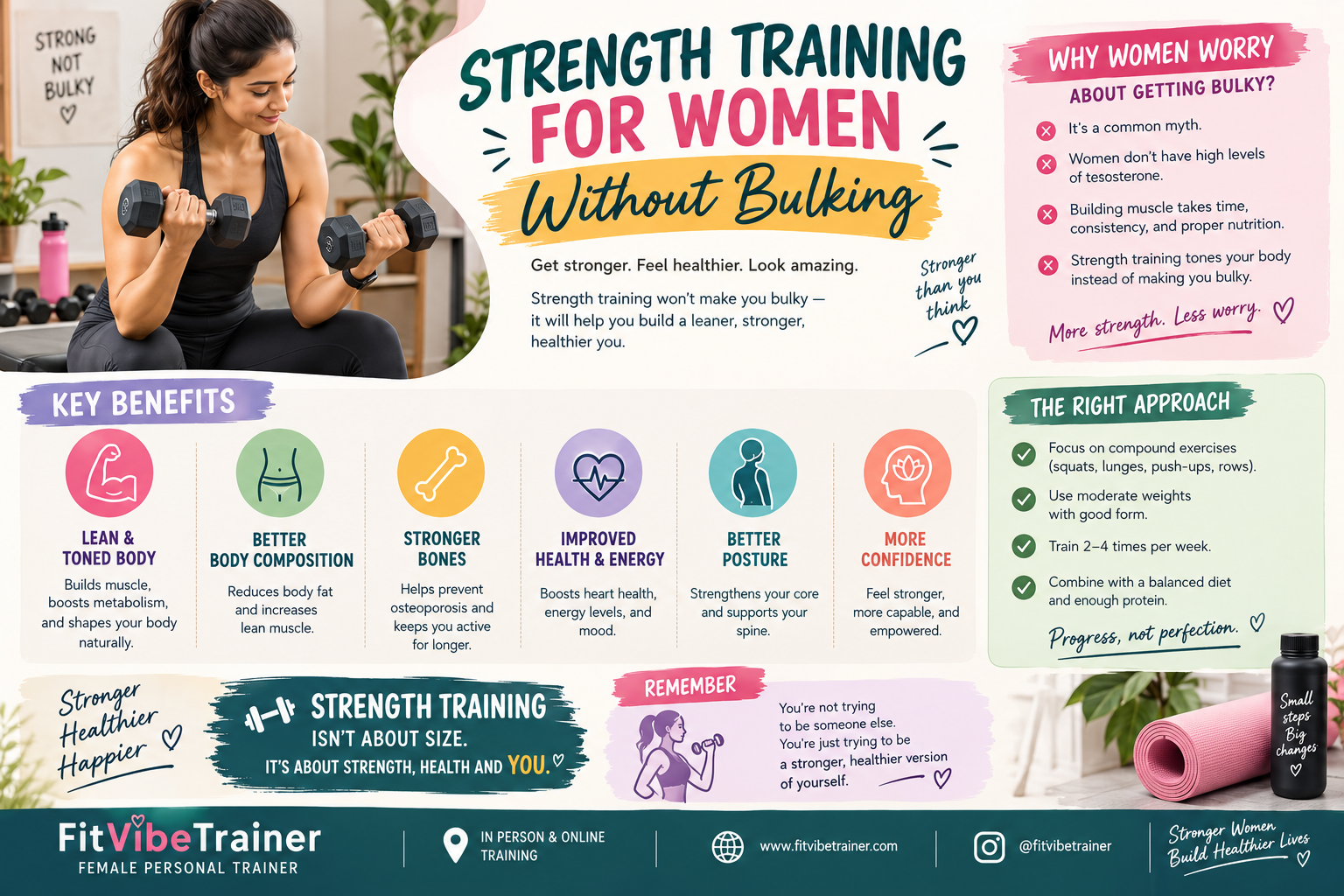
The fear of getting bulky from lifting weights is the single most persistent barrier between women and the training that would most improve their health, their body composition, and their quality of life. It is also one of the least supported fears in exercise science. Women's bodies do not bulk from conventional strength training. Understanding why, at a physiological level, removes the concern rather than simply reassuring you that you should not worry. And understanding what women's bodies actually do when they strength train correctly gives you the specific result that the bulking fear was preventing you from achieving.
This guide covers the complete science of why women do not bulk from strength training, what they actually get instead, how to structure a programme that produces strength and definition without size, and how hormonal conditions like PCOS and life stages like postnatal recovery affect the process.
Why Women Do Not Bulk From Strength Training: The Physiology
The physiological reason women do not bulk from strength training is not a matter of opinion or reassurance. It is a matter of endocrinology. Muscle hypertrophy, the increase in muscle size that produces a bulky appearance, requires a sustained anabolic hormonal environment that is primarily driven by testosterone. Men produce testosterone at levels approximately fifteen to twenty times higher than women. This hormonal difference is the primary reason men can build significantly larger muscle mass from the same training stimulus that produces lean definition in women.
A 2025 systematic review and meta-analysis by Refalo and colleagues, published in PeerJ, analysed 29 studies involving over 2,800 healthy men and women completing identical resistance training programmes. The findings were clear. When muscle growth was measured as absolute change, men showed slightly greater increases, particularly in the upper body. When muscle growth was measured as percentage change from baseline, the results were essentially identical between men and women. Women built muscle at the same rate relative to their starting point. Because they begin with less muscle mass and far lower testosterone, the absolute increases were smaller, producing the definition and strength women are looking for rather than the size they are not.
This research also showed that men and women respond to the same exercises in the same way. Squats, deadlifts, rows, push-ups, lunges, and all foundational strength movements are equally appropriate for women. There is no class of exercise that is too masculine for women's bodies. The difference is in the hormonal context in which adaptation occurs, and that context prevents the bulking outcome before training even begins.
The dramatically muscular physiques of female bodybuilders and physique competitors are not produced by conventional strength training. They require years of extremely high-volume training, carefully engineered caloric surpluses, and in most documented cases, exogenous hormonal supplementation that women training for health, fitness, and body composition do not use. They are not the natural endpoint of lifting weights. They are the product of a specific and demanding competitive pursuit that is worlds apart from what most women do in a training programme.
What Women's Bodies Actually Do When They Strength Train
If women do not bulk from strength training, what do they actually get? The answer is specific, visible, and consistently more positive than the training that most women who avoid weights are currently doing.
- Lean muscle definition without size increase. The muscles that strength training develops in women become denser and more defined without significantly increasing in circumference. The result is a physique that looks tighter, more defined, and more sculpted in ways that cardio alone cannot produce. This is the outcome that women most commonly describe as toned, and it comes specifically from strength training, not from extended cardio sessions.
- Reduced body fat percentage. Lean muscle tissue is metabolically active. It burns calories simply to maintain itself, every hour of every day. As lean muscle mass increases from strength training, resting metabolic rate rises. The body burns more calories at rest, which reduces body fat percentage even without changes in diet. Two women who weigh exactly the same can look dramatically different based on their muscle-to-fat ratio, and strength training shifts that ratio in the direction of more muscle and less fat.
- Smaller measurements alongside maintained or increased scale weight. This is the progress pattern that confuses women who track only scale weight and the reason multi-marker tracking is so important. Fat occupies significantly more space per kilogram than muscle. A woman who loses fat and builds lean muscle simultaneously often sees no scale movement while her waist, hip, and thigh measurements decrease. Her clothing fits differently. Her body composition has improved significantly. The scale has not moved because the mass she lost as fat was offset by the mass she gained as muscle, but the distribution of that mass has changed entirely.
- Improved functional strength for daily life. Carrying children, lifting groceries, climbing stairs, and managing the physical demands of household life all become measurably easier. Women who strength train consistently report that daily physical tasks feel lighter and less tiring, not because of a dramatic change in their appearance but because their actual physical capacity has increased.
- Improved bone density. Weight-bearing resistance exercises place mechanical stress on bone tissue, which stimulates bone-building cells to increase bone mineral density. This is one of the most clinically important benefits of strength training for women, particularly from the mid-thirties onward when bone density begins declining, and especially significant in the decade surrounding menopause when oestrogen decline accelerates bone resorption.
The Early Strength Gain That Happens Before Any Muscle Change
One of the most encouraging aspects of strength training for women is that strength improvements begin significantly before any visible muscle change occurs. This is because the first four to six weeks of strength training produce neural adaptation rather than muscle growth.
Your nervous system learns to recruit your existing muscle fibres more efficiently. The neural pathways that coordinate movement between muscle groups improve. Your brain gets better at commanding your muscles to produce force, which means your strength increases without your muscles needing to change in size at all. This neural adaptation is why beginners often make dramatic strength gains in the first weeks of training that plateau later when neuromuscular efficiency has been established and actual muscle protein synthesis becomes the primary mechanism of further improvement.
This means you will feel and perform noticeably stronger within the first few weeks of strength training, long before any visible change in your body occurs, and entirely without any change in muscle size. The fear of overnight visible bulk is physiologically impossible for additional reasons: muscle protein synthesis in humans is a slow process measured in weeks, not days. Even with the most optimal conditions for muscle growth, which women are physiologically prevented from creating without exogenous hormones, visible muscle size changes require months of consistent effort. There is no scenario in which a woman who begins strength training wakes up one morning looking dramatically more muscular than she did the week before.
The Specific Programme Structure That Builds Strength Without Bulk in Women
The programme that produces strength, definition, and improved body composition in women without significant muscle size increase follows specific principles that are worth understanding because they explain what kind of training to seek and what to avoid.
Foundational Compound Movements
Every effective strength programme for women is built around compound movements that train multiple muscle groups simultaneously. Squats train the quadriceps, glutes, hamstrings, and core together. Hip hinges like Romanian deadlifts and glute bridges train the posterior chain including the glutes, hamstrings, and lower back. Pushing movements like push-ups and overhead press develop the shoulders, chest, and triceps. Pulling movements like rows and lat pulldowns develop the back and biceps.
These compound movements produce the greatest metabolic and hormonal response per session, the greatest improvement in functional strength, the best body composition outcomes, and the most efficient use of training time. Isolation exercises, which target single muscle groups in isolation, have their place as supplementary work but should not be the foundation of a programme designed for strength and body composition rather than bodybuilding.
The Right Rep Range and Load
The rep range most associated with muscle hypertrophy, the size increase that creates a bulky appearance, is typically moderate to high volume with loads close to failure across many sets. However, building strength and improving body composition does not require this approach. Training in the eight to fifteen repetition range with loads that are challenging but controlled, meaning the final two to three repetitions of each set are difficult but maintainable with good form, produces the strength and definition outcomes that most women seek without the training conditions that would be necessary for significant muscle size increase.
This is different from the very high volume, very frequent, and very close-to-failure training that bodybuilding requires. A woman training two to three times per week, covering foundational compound movements at appropriate loads, will build meaningful strength and definition without the training conditions required for bulk.
Progressive Overload Without Excessive Volume
Progressive overload, making each training cycle slightly more demanding than the last, is the principle that produces ongoing results rather than plateaus. This does not require lifting maximal weights in every session. It means adding small amounts of load, one additional repetition, one additional set, or a more challenging exercise variation, over time as each previous level becomes manageable. This gradual progression is what drives the lean muscle development that changes body composition without the excessive volume that would drive the muscle size increase most women want to avoid.
Two to Three Sessions Per Week
Two to three strength training sessions per week of thirty to forty-five minutes each is the optimal frequency for most women pursuing strength and body composition improvement. This frequency provides sufficient stimulus for adaptation and definition while allowing adequate recovery between sessions. It is also the frequency the 2025 research supports as appropriate for women across different training goals. Training more frequently than this does not accelerate the definition outcome proportionately but does add to cortisol load, recovery demands, and the risk of overtraining, particularly for women managing hormonal conditions.
Protein to Support Definition Rather Than Size
Protein provides the amino acids your muscles use to repair and grow after training. A moderate protein intake of 1.6 to 2.0 grams per kilogram of bodyweight per day supports the muscle definition outcomes of strength training without the caloric surplus that would be required for significant muscle size increase. Women who are not eating in a significant caloric surplus while strength training cannot build large muscle mass regardless of training volume, because muscle growth requires energy availability that a maintenance or deficit caloric intake does not provide at the scale required for visible bulk.
How PCOS and Hormonal Conditions Affect Strength Training Without Bulking
For women managing PCOS, insulin resistance, hypothyroidism, or perimenopausal hormonal changes, the fear of bulking from strength training is even less well-founded than for women without these conditions. These conditions are associated with hormonal environments that make fat loss more difficult, not muscle gain easier. The same insulin resistance and cortisol elevation that contributes to abdominal fat accumulation in PCOS also suppresses the anabolic hormonal environment that would theoretically support muscle size increase.
Women with PCOS who strength train consistently will experience the same outcomes as women without PCOS: improved lean muscle definition, reduced body fat percentage particularly in the abdominal region through improved insulin sensitivity, better energy, and improved hormonal balance. They will not experience accelerated muscle size increase because the hormonal conditions of PCOS do not support it.
For women in perimenopause, declining oestrogen and muscle mass makes building muscle harder, not easier. The priority of strength training in this life stage is preserving existing lean muscle rather than building significant new muscle, while improving bone density and metabolic rate. Bulk is not a concern. Muscle preservation is.
How Strength Without Bulking Looks Different From Cardio-Only Training
The practical difference between a woman who strength trains consistently and one who does cardio only is visible and measurable within eight to twelve weeks, but it is not the difference most women fear. It is not a size difference. It is a body composition difference.
A woman who does primarily cardio typically loses weight that is a mix of fat and lean muscle, which leaves her lighter but at a similar or higher body fat percentage. Her measurements change modestly. Her resting metabolic rate may decline slightly from muscle loss. She often looks softer rather than more defined despite weighing less.
A woman who strength trains consistently builds lean muscle while reducing fat mass. Her measurements change more significantly than the scale suggests. Her clothing fits differently even when the scale has barely moved. Her posture improves from stronger glutes, core, and upper back. She looks more defined, not larger. And her resting metabolic rate increases from the lean muscle she has built, making ongoing fat management progressively easier rather than progressively harder.
A Practical Home Training Programme for Women in Lahore
For women in Lahore training at home without gym equipment, building strength without bulking is entirely achievable through the following practical structure. This programme requires no gym, no equipment beyond bodyweight initially, and no dedicated training space beyond approximately two metres by two metres.
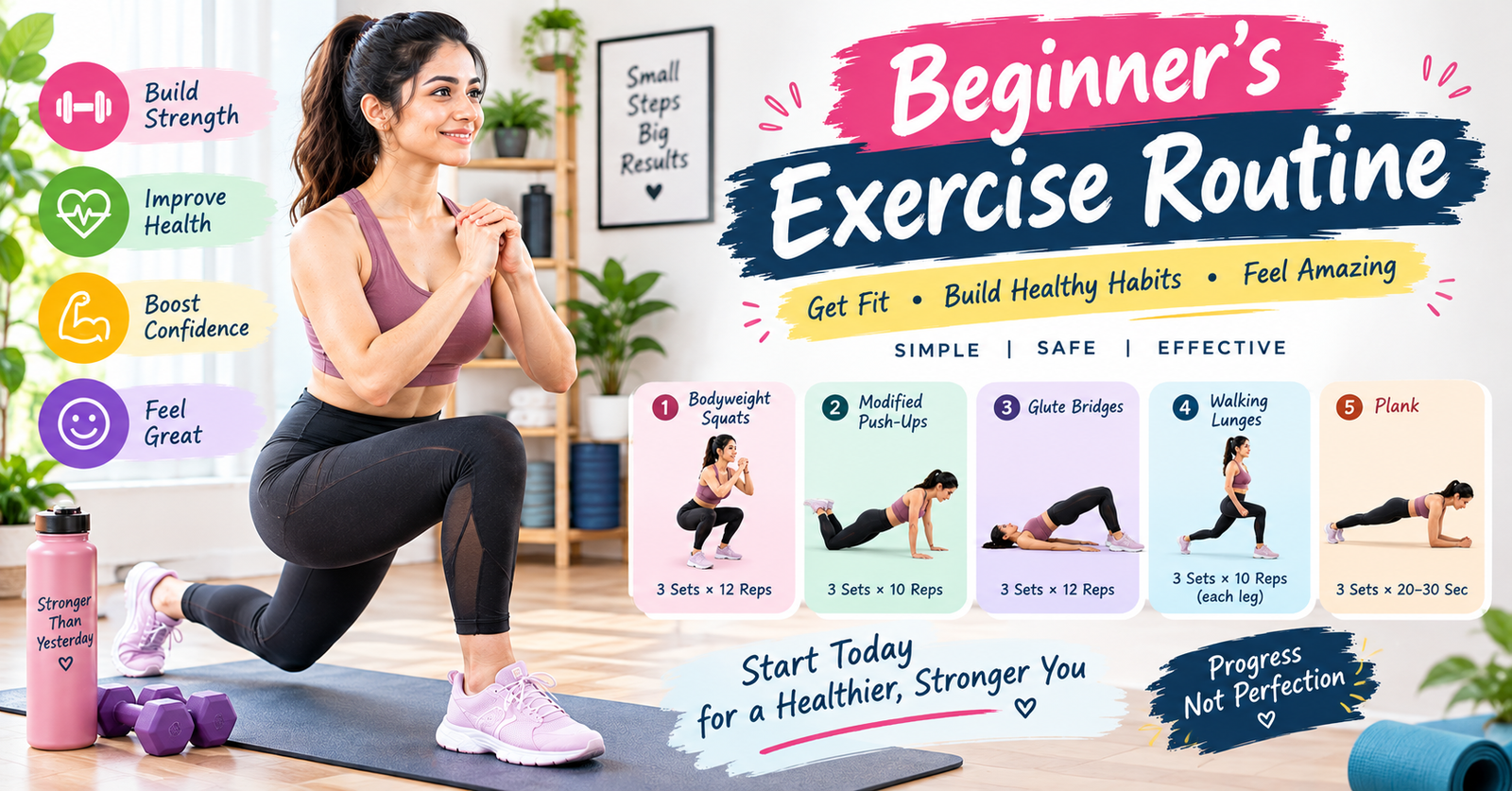
- Session One (Lower body and core): Bodyweight squats or goblet squats, glute bridges or Romanian deadlifts with light dumbbells or water bottles, reverse lunges, plank hold, and dead bug. Three sets of eight to twelve repetitions of each exercise with two minutes rest between sets.
- Session Two (Upper body and full body): Incline or wall push-ups progressing to floor push-ups, resistance band or towel rows, overhead press with water bottles or light dumbbells, and lateral raises. Three sets of eight to twelve repetitions with two minutes rest between sets.
- Session Three (Full body compound): Squats, push-ups, hip hinge, rows, and core stabilisation work combined. This session covers all major movement patterns and is the highest-priority session of the week if scheduling forces a choice.
Progressive overload in this programme means adding one to two repetitions per exercise each week, then adding a set once the target repetitions are achieved consistently, then progressing to a more challenging exercise variation or adding light resistance through water bottles, bags, or resistance bands. This progression produces the lean definition and strength outcomes that most women want without the training conditions that would be required for bulk.
How Fit Vibe Trainer Delivers Strength Training Without Bulking for Women in Lahore
At Fit Vibe Trainer, every strength programme is designed specifically to deliver the outcomes described in this guide: lean muscle definition, improved body composition, functional strength, and hormonal health support, without the volume, frequency, or caloric conditions required for significant muscle size increase. Our clients include women who came to us afraid of lifting weights and left their first month asking why they had not started sooner.
Our ACE certified coach holds qualifications spanning GGS Women's Coaching Specialist, Pre and Postnatal Coaching Certification, Diploma in Nutrition and Diet Planning, Physical Fitness and Exercise Science, Functional Training and Conditioning, and Postpartum Fitness and Recovery. Every programme is built around the client's specific starting point, hormonal context, and goals.
We offer in-home sessions across Lahore, studio sessions at Dream Gardens, and live online coaching for women in Pakistan and internationally.
For the complete science behind the benefits strength training produces for women, read: why strength training is important for women.
For how strength training specifically produces fat loss in ways that cardio cannot, read: how strength training helps women lose weight.
For the complete comparison of strength training versus cardio and when each should lead, read: strength training vs cardio for women: which should you choose.
For common training mistakes women make that slow results, including training incorrectly around the fear of bulking, read: common workout mistakes women make at the gym.
For a full overview of our services for women in Lahore and internationally, visit: female personal trainer in Lahore.
Book a free consultation today and find out what your first month of strength training would actually produce for your body specifically.
Find us on Google and read genuine reviews from women who were afraid of getting bulky and discovered what strength training actually does instead.
Frequently Asked Questions
Will women get bulky from strength training?
No. Women do not produce sufficient testosterone to build large muscle mass from conventional strength training. A 2025 meta-analysis of 29 studies involving over 2,800 participants found that while men experienced slightly greater absolute muscle growth, women and men built muscle at essentially the same rate relative to their starting point. Because women begin with less muscle and significantly lower testosterone, the absolute increases are smaller, producing lean definition rather than size. The dramatically muscular physiques of competitive bodybuilders require years of extreme training, caloric surpluses, and in most cases exogenous hormonal supplementation that is entirely absent from conventional strength training.
What does strength training actually do to women's bodies?
Strength training in women produces lean muscle definition without significant size increase, reduced body fat percentage through elevated resting metabolic rate, smaller body measurements even when scale weight stays the same, improved functional strength for daily life, improved bone density, better insulin sensitivity, reduced cortisol over time, and improved posture from stronger glutes, core, and upper back. These are the outcomes of consistent strength training for women, not the bulky appearance the fear is based on.
How heavy should women lift to get strong without getting bulky?
Women should lift a weight that makes the final two to three repetitions of each set genuinely challenging with maintained form, working in a rep range of approximately eight to fifteen repetitions per set. This load is sufficient to produce meaningful strength and body composition improvements without the very high volume, very close-to-failure training across many sets that bodybuilding requires. Progressive overload, gradually increasing the demand over time as each level becomes manageable, drives the ongoing adaptation that produces results without the conditions required for bulk.
How many times per week should women strength train?
Two to three sessions per week of thirty to forty-five minutes each is the optimal frequency for most women pursuing strength and body composition improvement without bulk. Research consistently shows that twice-weekly training produces muscle and strength gains equivalent to three-times-weekly training when total volume is comparable. Two to three sessions provide the adaptation stimulus women need without the excessive volume that would contribute to the conditions required for significant muscle size increase.
Can women with PCOS strength train without getting bulky?
Yes, and the fear is even less founded for women with PCOS than for women without it. The hormonal conditions of PCOS, including insulin resistance and cortisol elevation, actually make muscle gain harder rather than easier, while also making fat loss more difficult. Women with PCOS who strength train will experience lean muscle definition, improved insulin sensitivity, reduced abdominal fat, and improved hormonal balance. They will not experience accelerated muscle size increase because the hormonal environment of PCOS does not support it.
What is the difference between bulking and building lean muscle?
Bulking refers to a deliberate training and dietary strategy to significantly increase muscle size, which requires a sustained caloric surplus, very high training volume, and typically many months or years of consistent effort. Building lean muscle refers to the natural adaptation that occurs from conventional strength training within a normal or deficit caloric intake, which produces stronger, denser, more defined muscle without significant size increase. Women engaged in normal strength training programmes are building lean muscle, not bulking, because they do not have the hormonal environment, caloric surplus, or training volume required for the latter.
What does strength training without bulking look like after twelve weeks for women?
After twelve weeks of consistent strength training two to three times per week, most women notice improved muscle definition particularly in the glutes, shoulders, and arms, reduced measurements at the waist and hips even if scale weight has changed minimally, improved posture from stronger posterior chain and core muscles, noticeably better daily functional strength, improved energy and sleep quality, and clothing that fits differently in ways that the scale does not reflect. None of these outcomes involve looking larger. They involve looking more defined, more capable, and more composed in ways that are visible and measurable but not in the direction that the bulking fear was pointing.
Ready to put this into action?
Train 1-on-1 or in a group with Amna — your first discovery call is completely free. Female-only, fully online, results you can see.
Book My Free Call on WhatsApp →