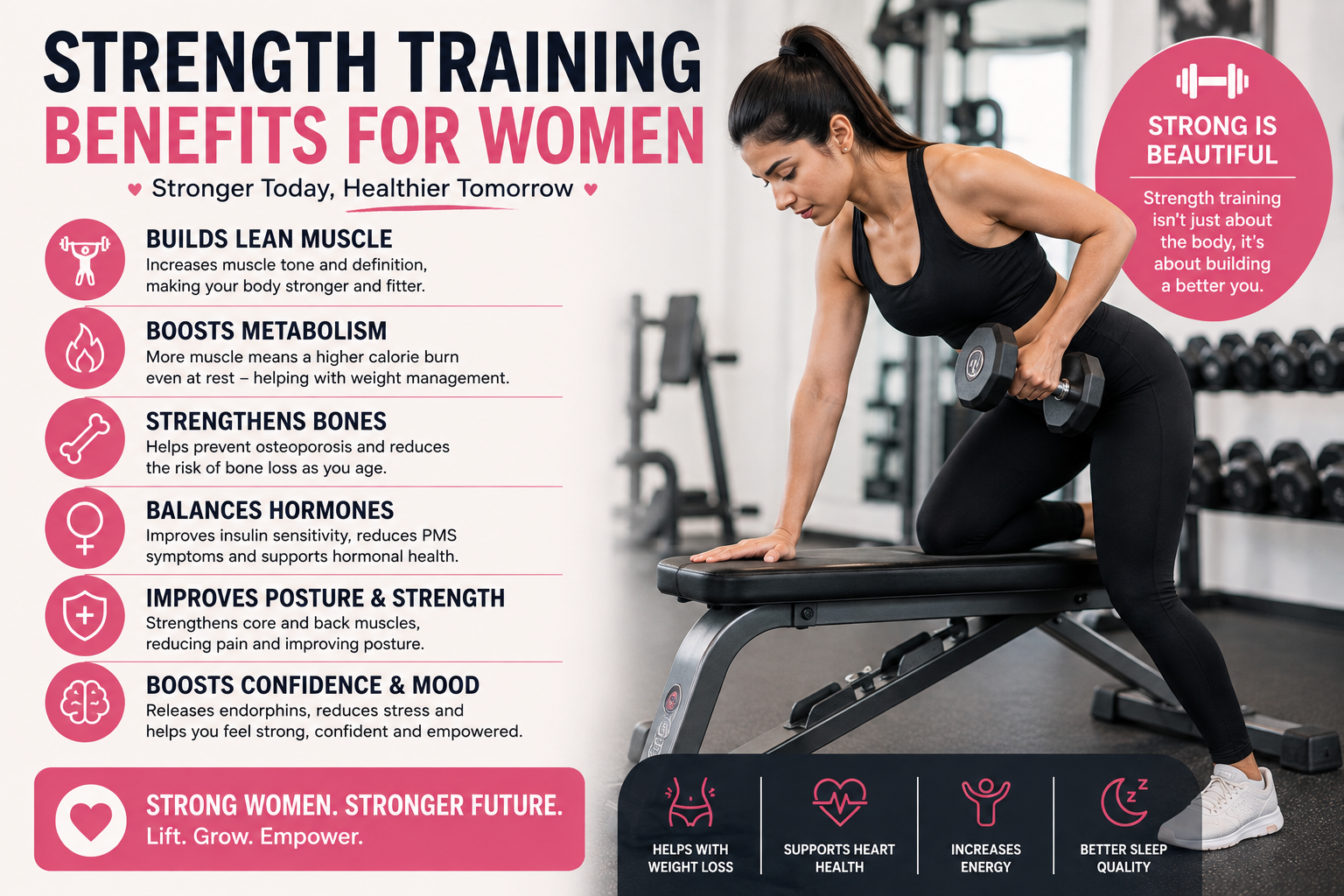
Strength training benefits for women extend far beyond building muscle. Women who train with resistance regularly experience measurable improvements in fat metabolism, hormonal balance, bone density, cardiovascular health, insulin sensitivity, mood, cognitive function, and quality of life across every decade of adulthood. Despite this, strength training remains one of the most underutilised tools in women's health, largely because of persistent myths about bulking, and a fitness culture that has historically steered women toward cardio as the default.
This guide covers what the evidence actually says about strength training for women specifically, why many of these benefits are more pronounced in women than in men, and how a qualified female trainer structures strength work to deliver results that go far beyond aesthetics. For a wider perspective on this topic, you can also read the community discussion on WhatsOn Plus and a detailed breakdown shared on BuzzBii.
What Strength Training Actually Means
Strength training, also called resistance training or weight training, refers to any form of exercise that requires your muscles to work against a load. That load can be your own bodyweight, dumbbells, barbells, resistance bands, kettlebells, or weight machines. The defining feature is not the equipment used. It is the principle of progressive overload: gradually increasing the demand placed on your muscles over time so that they continue to adapt, grow stronger, and become more metabolically active.
For women, this does not mean lifting maximal weights six days a week. A well-designed strength programme for a woman at any fitness level, whether beginner, postnatal, managing PCOS, or training in her fifties, uses load appropriate to her current capacity and progresses it systematically as her body adapts. The result is a body that is stronger, more resilient, and metabolically more efficient than any amount of cardio alone can produce.
Strength Training Raises Your Resting Metabolic Rate in Ways Cardio Cannot
This is the most misunderstood aspect of the cardio-versus-weights debate, and it is where strength training wins decisively for women who want lasting fat loss rather than temporary weight loss.
Muscle tissue is metabolically expensive. Your body burns calories simply to maintain it, twenty four hours a day, whether you are asleep, at your desk, or cooking dinner. The more lean muscle mass you carry, the higher your resting metabolic rate, meaning the more calories your body burns at rest. Fat tissue, by contrast, is metabolically almost inert. It costs your body almost nothing to maintain.
When you do cardio without strength training, particularly in a calorie deficit, a portion of the weight you lose comes from muscle tissue rather than fat. This is called muscle wasting, and it is one of the primary reasons women who lose weight through cardio and calorie restriction alone often regain it. They have reduced their resting metabolic rate by losing muscle, making it progressively harder to maintain their results without eating even less.
Strength training reverses this dynamic. It builds and preserves lean muscle, which elevates your resting metabolic rate and creates a body that is better at burning fat around the clock, not just during a session. Research consistently shows that strength training also produces a significant afterburn effect, known as excess post-exercise oxygen consumption, where your metabolism remains elevated for hours after the session ends. Cardio at comparable intensities produces a much smaller and shorter afterburn.
For women managing PCOS or insulin resistance, this metabolic benefit is particularly significant. Greater muscle mass improves insulin sensitivity directly, meaning your cells respond more effectively to insulin and your body is less likely to store excess glucose as fat. This is one of the most evidence-backed interventions for managing the metabolic component of PCOS, and it comes from strength training, not from the treadmill.
Strength Training Changes Body Composition, Not Just Body Weight
Two women can weigh exactly the same on a scale and look and feel entirely different. Body weight measures everything at once: muscle, fat, bone, water, and digestive content. Body
Ready to put this into action?
Train 1-on-1 or in a group with Amna — your first discovery call is completely free. Female-only, fully online, results you can see.
Book My Free Call on WhatsApp →