Unrealistic weight loss goals are the single most reliable predictor of programme abandonment in women. When the goal was impossible from the start, or when progress is measured by a metric that does not accurately reflect what is actually happening in the body, the inevitable conclusion is failure regardless of how much real progress was made. Understanding how to set weight loss goals that are genuinely realistic for your body, your hormones, your life stage, and your circumstances is not a motivational exercise. It is the first practical decision that determines whether everything that follows works or collapses.
This guide covers how realistic weight loss goals for women are actually set, why they look different from men's goals, how hormonal conditions change what realistic means for your specific body, and how to track progress in ways that accurately reflect what your body is doing rather than what an app or a scale is telling you.
Why Weight Loss Goals for Women Are Different From Men's
The standard weight loss goal framework, lose a specific amount of weight by a specific date, is designed around a body that loses weight in a relatively linear, predictable pattern. Women's bodies do not lose weight in a linear, predictable pattern. Understanding why is the foundation of setting goals that are genuinely achievable rather than aspirational and ultimately demoralising.
- Women's hormonal cycles create legitimate weekly variation in weight and measurements. Water retention, driven by oestrogen and progesterone fluctuations across the menstrual cycle, can cause scale weight to vary by one to three kilograms within a single week without any change in fat mass. The week before menstruation typically produces the highest scale readings of the month due to progesterone-driven water retention, and the week following menstruation typically produces the lowest. A woman who weighs herself at the wrong point in her cycle and compares that number to a goal will draw completely incorrect conclusions about her progress.
- Women naturally carry higher body fat percentages than men for hormonal and reproductive reasons. This is not excess fat in most cases. It is physiologically necessary. The minimum healthy body fat for women is approximately twelve percent, compared to four percent for men. Weight loss goals that aim for very low body fat percentages are not just unrealistic for most women. They are potentially harmful, disrupting hormonal function and triggering adaptive responses that make further fat loss harder.
- Women's resting metabolic rates are lower per kilogram of bodyweight than men's. Because women carry proportionally less lean muscle mass, they burn fewer calories at rest per kilogram. This means the same calorie deficit that produces a given rate of fat loss in a man produces a slower rate in a woman of equivalent weight. Goals that are set based on male weight loss rates or on aggregate weight loss statistics that are not sex-disaggregated will consistently underestimate how long realistic progress takes for women.
- Women are significantly more likely to be managing hormonal conditions that affect fat loss rate. PCOS, hypothyroidism, insulin resistance, and perimenopausal hormonal changes all influence how efficiently a woman's body can mobilise and burn stored fat. A goal that is realistic for a woman with healthy thyroid function and no hormonal conditions may not be realistic for a woman with subclinical hypothyroidism and PCOS, even if they weigh the same and follow the same programme.
What Realistic Weight Loss Actually Looks Like for Women
Before setting any goal, it helps to understand what evidence-based, sustainable fat loss actually looks like in women's bodies over time.
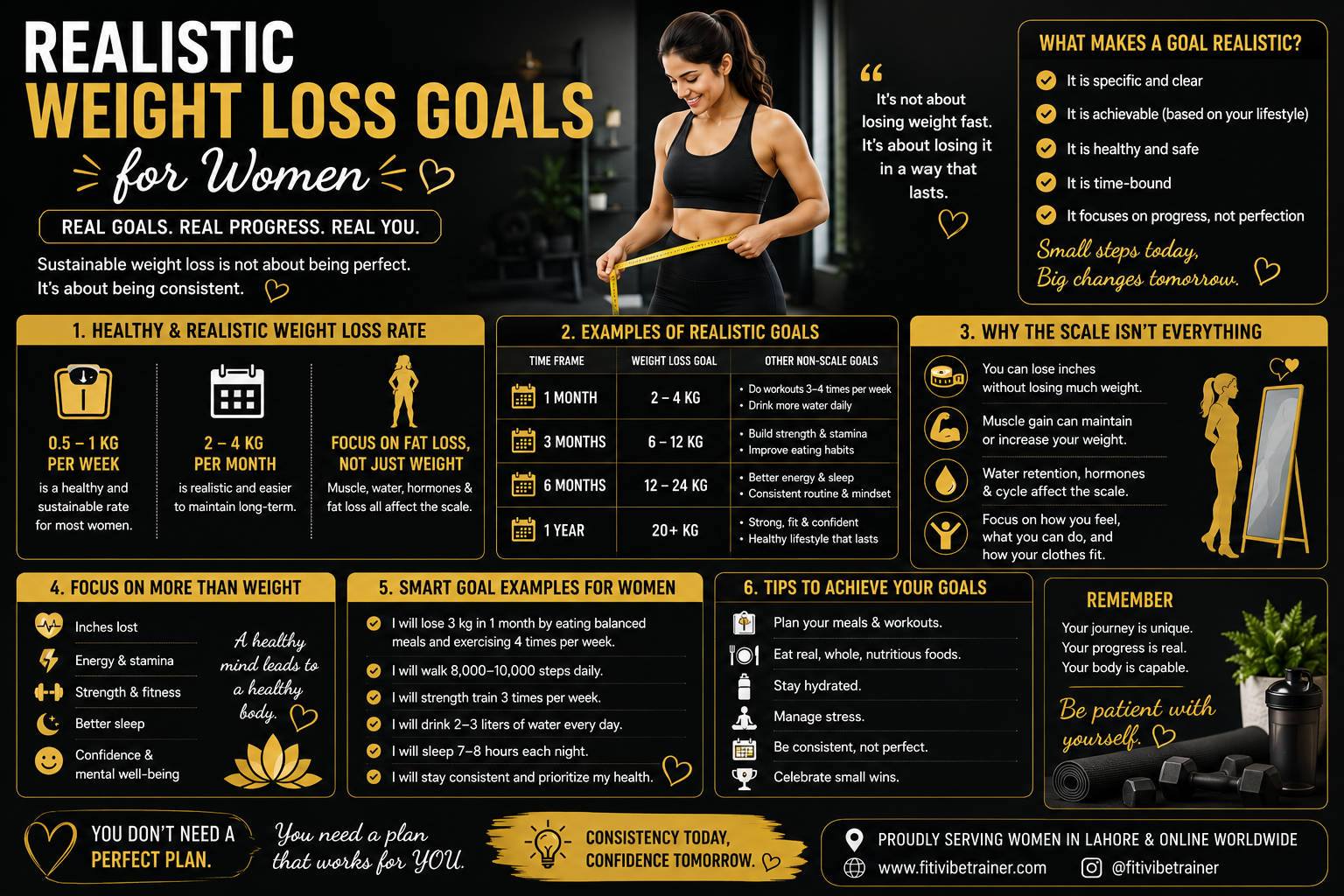
For a woman without significant hormonal conditions who is eating in a moderate calorie deficit with adequate protein and training consistently two to three times per week with strength training plus daily walking, a realistic rate of fat loss is approximately 0.5 to 1 percent of body weight per week. For a woman weighing 75 kilograms, this is 375 to 750 grams per week of actual fat loss. Not scale weight loss, which will vary due to water retention, but actual fat mass reduction.
This rate is slower than most popular diet plans promise, and it is faster than what most women actually achieve when they are not accounting for the hormonal and metabolic factors specific to their situation. It is also the rate that is most likely to produce lasting results, because it is slow enough to protect lean muscle, allow hormonal adaptation, and avoid the metabolic adaptation that accelerates when deficits are too aggressive.
For women managing PCOS, hypothyroidism, or perimenopausal hormonal changes, a realistic initial rate may be 0.25 to 0.5 percent of body weight per week, with this rate improving as hormonal factors are addressed through appropriate training, nutrition, and where relevant, medical management. Setting goals based on the faster rate when the hormonal context requires the slower one is one of the most common causes of perceived programme failure in women who are actually making progress.
The Problem With Scale-Only Weight Loss Goals
Setting a goal entirely in terms of scale weight is one of the most reliable ways to guarantee that genuine progress will feel like failure at some point during your programme. The scale measures everything in your body simultaneously: fat, muscle, bone, water, food in your digestive system, and glycogen stored in your muscles. It cannot tell you whether a change in the number represents fat loss, muscle gain, water retention change, or any combination of these.
Two of the most meaningful outcomes of a well-designed weight loss programme produce no visible scale change or even a scale weight increase despite genuine fat loss progress. The first is body recomposition, where fat is lost simultaneously with lean muscle being built, producing changes in measurements, clothing fit, and body composition that the scale does not reflect. The second is hormonal water retention fluctuations, particularly in the week before menstruation, where scale weight can increase by one to three kilograms despite no change in fat mass and ongoing fat loss beneath the surface.
A woman who is in a body recomposition phase, losing fat and building muscle at the same time, has typically not set a realistic goal if it is purely a scale weight goal. She may be making significant measurable progress across every meaningful marker while her scale weight shows minimal change. Without the right goal structure to capture this, she is invisible to her own progress.
How to Set a Realistic Weight Loss Goal Framework for Women
A goal framework for women's weight loss that actually captures progress requires multiple markers, a realistic timeline, and adjustments for individual physiological context. Here is how to build one.
Step One: Set a Body Composition Goal, Not Just a Scale Goal
Instead of targeting a specific scale weight, set a goal around body composition change. This means targeting a reduction in body measurements alongside any scale weight change, rather than scale weight alone. Practical composition goals for women might look like the following.
- Reduce waist circumference by five centimetres over twelve weeks.
- Reduce hip measurement by three centimetres over eight weeks.
- Fit comfortably into a specific clothing size or item within a specific timeframe.
- Achieve a specific strength milestone, such as being able to do ten bodyweight squats with controlled form, or perform a full push-up from the floor.
These goals capture the real changes happening in your body's composition rather than the net number produced by everything changing simultaneously. They are also significantly more motivating to track because they move in a more consistent direction than scale weight, which fluctuates daily regardless of what fat is actually doing.
Step Two: Set a Timeline Based on Your Specific Physiology, Not on a Calendar Event
The most common goal-setting error women make is setting a timeline based on an external event, a wedding, Eid, a school reunion, summer, and then working backward to determine what is needed per week to reach a target by that date. This almost always produces an unrealistic per-week loss rate and a programme that is too aggressive to be sustainable, which is followed by rapid regain when the event passes and the unsustainable approach ends.
A realistic timeline is set forward from your current position, based on what a sustainable rate of progress looks like for your body specifically. If the rate required to reach your goal by a specific date is greater than one percent of your body weight per week for an extended period, the timeline is unrealistic for sustainable fat loss. It can be achieved through more aggressive methods, but the methods required are almost never sustainable, and the results rarely persist.
For women managing hormonal conditions, the initial timeline should be set conservatively and then reassessed at four to six weeks based on actual measured progress. Many women with PCOS or thyroid conditions see very little scale movement in the first four to six weeks as the programme addresses the hormonal environment, followed by more consistent progress thereafter. A timeline that evaluates success at week four, before the hormonal adaptation has occurred, produces unnecessary early abandonment of programmes that are working. We discuss this pattern in more detail in a recent LinkedIn post on realistic goal setting for women that is worth reading alongside this guide.
Step Three: Set Process Goals Alongside Outcome Goals
Outcome goals are what you want to achieve: the measurements, the clothing size, the scale range. Process goals are what you commit to doing: the number of training sessions per week, the daily step target, the protein intake per day, the sleep duration you are protecting. Process goals matter because they are entirely within your control in a way that outcome goals are not. Fat loss responds to a complex hormonal and metabolic environment that you influence but do not fully control on a week-by-week basis. Training consistency, protein intake, and sleep are things you can show up for regardless of what scale weight is doing.
A realistic process goal framework for most women pursuing fat loss might look like this. Completing two to three strength training sessions per week. Reaching eight thousand to ten thousand daily steps consistently. Consuming 1.6 to 2.0 grams of protein per kilogram of body weight per day. Sleeping seven to eight hours per night as a consistent priority. These process commitments, maintained consistently for twelve weeks, produce the physiological conditions under which fat loss occurs reliably. Tracking adherence to these process goals tells you whether your programme is on track in a way that weekly scale readings cannot.
Step Four: Track Progress Through Multiple Markers Measured at the Right Time
For women specifically, the timing of measurements matters almost as much as the measurements themselves. Scale weight and body measurements should be taken at the same phase of the menstrual cycle each month for accurate month-on-month comparison. The most consistent measurement point for most women is the week following the end of menstruation, when water retention is at its monthly low and scale weight reflects the closest approximation to actual body composition of any point in the cycle.
Measuring at the same phase of successive cycles provides genuine like-for-like comparison. Measuring at random points in the cycle, or at the worst point for a given month, produces month-on-month comparisons that appear to show stalled progress when fat loss is actually occurring beneath the water retention fluctuation.
The markers worth tracking monthly alongside scale weight are body measurements at the waist, hips, thighs, and upper arms; strength performance in key training exercises; clothing fit in specific items; energy levels and sleep quality rated on a simple scale; and photographs taken at the same time of day in the same clothing at the same phase of the cycle. Together these markers provide a genuinely comprehensive picture of what the body is doing over time. You can also see how we apply this multi-marker tracking approach visually on our Facebook page.
Realistic Weight Loss Goals for Specific Situations
Realistic Goals for Women with PCOS
Women with PCOS often experience what appears to be very slow initial progress in the first four to six weeks of a new programme, followed by more consistent progress once insulin sensitivity begins improving from consistent strength training and blood sugar-stabilising nutrition. Setting a realistic goal for a woman with PCOS means accounting for this initial slower phase explicitly rather than evaluating the programme against a standard timeline that does not allow for it.
A realistic twelve-week goal for a woman with PCOS who is beginning a structured programme might be a two to four centimetre reduction in waist circumference, a measurable improvement in energy levels and cycle regularity, and the establishment of consistent training and eating habits rather than a specific scale weight or measurement number that may take longer than twelve weeks in this hormonal context.
Realistic Goals for Postnatal Women
The postnatal period introduces specific physiological variables that make standard weight loss timelines inappropriate. After pregnancy, lean muscle mass has been reduced, bone density may have decreased, hormones are still recovering, pelvic floor and deep core function require graduated rehabilitation, and sleep deprivation is typically significant.
Realistic goals in the early postnatal period, typically the first twelve weeks after delivery, centre on restoration rather than fat loss: re-establishing core function, rebuilding the aerobic base through walking, and maintaining nutritional adequacy for recovery and breastfeeding if applicable. Fat loss goals become more appropriate after twelve weeks when deep core function and pelvic floor health have been assessed and the body has had time to recover from the demands of pregnancy and delivery.
Setting a fat loss scale goal immediately after delivery and measuring against it at six weeks is one of the most common sources of unnecessary distress for postnatal women, because it evaluates the body against a standard that ignores every factor that makes the postnatal period physiologically distinct.
Realistic Goals for Women Over Forty and in Perimenopause
During perimenopause, the hormonal environment for weight loss shifts significantly. Oestrogen decline produces fat redistribution from the hips and thighs to the abdominal region, insulin resistance worsens, resting metabolic rate declines through muscle loss, and sleep disruption from hormonal changes elevates cortisol. These changes mean that the same programme a woman used successfully in her thirties may produce significantly slower results in her mid-forties without modification.
Realistic goals for women in perimenopause centre on preserving lean muscle through consistent strength training, preventing the metabolic rate decline that muscle loss accelerates, and managing cortisol through sleep prioritisation and stress management alongside dietary modification. Scale weight goals in this life stage should be set conservatively, and the primary success markers should be measurements, strength performance, and energy rather than scale weight, which is most susceptible to the water retention and muscle-to-fat ratio changes of this hormonal transition.
The Goals That Are Never Realistic for Women
These are the goal structures that appear regularly in popular culture and social media and consistently produce either harm or failure regardless of effort.
- Losing more than one percent of body weight per week for more than two to three weeks at a time. Rates above this threshold require deficits that produce significant muscle loss alongside fat, worsen metabolic adaptation, elevate cortisol, disrupt hormonal function, and produce results that reverse rapidly when the deficit is reduced. Short periods of slightly faster loss occur naturally and are fine. Sustained aggressive loss rates are not realistic for long-term fat loss in women.
- Reaching a body fat percentage below the minimum healthy range for women. Attempting to reduce body fat below approximately eighteen to twenty percent for most women triggers hormonal disruption including loss of menstrual function, reduced bone density, and impaired immune function. Goals at this level are not realistic without significant harm.
- Looking like a specific other person. Every woman's body distributes fat and muscle in ways determined by her genetics, her hormonal profile, and her bone structure. A goal based on achieving someone else's body shape is not a weight loss goal. It is a goal to have different genetics. Directional goals, becoming leaner and stronger, are achievable. Clone goals are not.
- Losing a specific amount by a fixed date without adjusting for what the body is actually doing. Timelines set around external events without built-in reassessment points almost always produce unsustainable approaches when progress does not match the predetermined schedule. A flexible goal that adjusts based on real measured progress produces better results than a rigid timeline that demands the body perform to a calendar.
How Fit Vibe Trainer Helps Women Set and Reach Realistic Weight Loss Goals
At Fit Vibe Trainer, goal setting is the first conversation and an ongoing one. Every client begins with a full assessment of her hormonal health, metabolic history, current measurements and fitness capacity, lifestyle constraints, and personal definition of what success looks and feels like. From this, we build a goal framework that is realistic for her specific physiology rather than for an average woman or a target from a social media transformation post.
Our ACE certified coach holds qualifications spanning GGS Women's Coaching Specialist, Pre and Postnatal Coaching Certification, Diploma in Nutrition and Diet Planning, Physical Fitness and Exercise Science, Functional Training and Conditioning, and Postpartum Fitness and Recovery. Every goal framework is informed by specialist knowledge of female physiology across different life stages and health conditions.
We offer coaching as in home sessions across Lahore, studio sessions at Dream Gardens, and live online coaching for women in Pakistan and internationally.
To understand why personalised weight loss approaches produce results that generic diet goals cannot, read: why personalised weight loss plans work better than random diets.
For how to build the sustainable routine that makes realistic goals achievable week by week, read: how women in Lahore can build a sustainable weight loss routine.
To understand why women plateau despite consistent effort and what to do when your goals feel out of reach, read: why women stop losing weight even when they exercise.
For the distinction between fat loss and weight loss that determines which goal type is right for your programme, read: fat loss vs weight loss: what is actually different.
For a full overview of our services for women in Lahore and internationally, visit: female personal trainer in Lahore.
Book a free consultation today and get an honest, physiologically accurate assessment of what realistic weight loss looks like for your body specifically.
Find us on Google and read genuine reviews from women who set goals they could actually reach and achieved them.
Frequently Asked Questions
What is a realistic weight loss goal for women per week?
For women without significant hormonal conditions, a realistic and sustainable rate of fat loss is approximately 0.5 to 1 percent of body weight per week. For a woman weighing 75 kilograms, this is 375 to 750 grams of actual fat loss per week. Scale weight may vary more than this due to water retention fluctuations from the hormonal cycle. Women managing PCOS, hypothyroidism, or perimenopausal changes should expect a slower initial rate of 0.25 to 0.5 percent of body weight per week, with this improving as hormonal factors are addressed through appropriate programming.
Why is losing weight harder for women than men?
Women face several physiological factors that slow or complicate fat loss compared to men: lower baseline resting metabolic rate due to lower average lean muscle mass, monthly hormonal cycle fluctuations that cause water retention and scale weight variation that does not reflect fat change, higher minimum healthy body fat percentage, and greater prevalence of hormonal conditions including PCOS, hypothyroidism, and perimenopausal shifts that directly affect fat storage and mobilisation. These are physiological realities, not failures of effort or consistency.
How should women measure weight loss progress?
The most accurate progress tracking for women uses multiple markers rather than scale weight alone. Track body measurements at the waist, hips, thighs, and upper arms monthly, taken at the same phase of the menstrual cycle for accurate month-on-month comparison. Track strength performance in key training exercises. Track clothing fit in specific items. Track energy levels and sleep quality. Track photographs at the same cycle phase monthly. Scale weight is one data point among these, not the primary verdict, because it cannot distinguish between fat loss, muscle gain, water retention changes, and digestive content.
What is a realistic weight loss goal for women with PCOS?
For women with PCOS, a realistic twelve-week goal accounts for the slower initial phase driven by insulin resistance. Expect the first four to six weeks to show primarily improvements in energy, cycle regularity, and training performance rather than significant scale or measurement change as the programme addresses the hormonal environment. A realistic twelve-week composition goal might be a two to four centimetre reduction in waist circumference alongside the establishment of consistent strength training and blood sugar-stabilising eating habits. Scale weight targets should be set conservatively with a longer horizon than programmes designed for women without hormonal conditions.
How long should a weight loss goal timeline be for women?
A realistic weight loss goal timeline for women is typically twelve to twenty-four weeks for meaningful, visible body composition change, depending on starting point, hormonal context, and how much change is being targeted. Short timelines of four to six weeks are appropriate for establishing habits and seeing initial improvements in energy and training performance, but are rarely sufficient for visible body composition change. Goals set around external events like weddings or holidays with fixed dates often require unsustainably aggressive approaches and produce rapid regain when the event passes. Forward-set flexible timelines based on measured progress produce better long-term outcomes.
Should women focus on weight loss goals or fitness goals?
The most effective goal framework for women combines both. Fitness goals, such as completing two to three strength training sessions per week, walking eight thousand steps daily, or achieving a specific strength milestone, are process goals entirely within your control regardless of what hormones and water retention are doing on a given week. Body composition goals, such as reducing waist circumference by a specific amount over twelve weeks, are outcome goals that reflect what the process is producing. Using both together gives you both control, through the process goals, and direction, through the outcome goals, without the single-point-of-failure that a scale weight goal alone creates.
Is it realistic for postnatal women to lose weight quickly?
No. Aggressive fat loss goals in the postnatal period, particularly the first twelve weeks after delivery, are unrealistic and potentially harmful. The body needs this time for hormonal recovery, deep core and pelvic floor rehabilitation, lean muscle rebuilding, and bone density restoration accelerated by breastfeeding. Realistic postnatal goals in the first twelve weeks focus on restoration of core function, rebuilding aerobic capacity through walking, and maintaining nutritional adequacy for recovery. Fat loss goals become appropriate after this period when specialist postnatal assessment confirms readiness for more progressive exercise loading.
How do hormones affect weight loss goals for women?
Hormones affect weight loss goals for women in two ways. They create legitimate week-to-week variation in scale weight through water retention changes across the menstrual cycle, which means short-term scale goals measured at the wrong cycle point produce inaccurate assessments of progress. And hormonal conditions including PCOS, hypothyroidism, and perimenopausal oestrogen decline directly slow the rate of fat mobilisation, meaning goals set at standard weight loss rates are unrealistic without accounting for the hormonal environment. A realistic goal for a woman with hormonal conditions is built around her specific metabolic baseline, not around population averages.
Ready to put this into action?
Train 1-on-1 or in a group with Amna — your first discovery call is completely free. Female-only, fully online, results you can see.
Book My Free Call on WhatsApp →