Most workout injuries aren't caused by exercise itself — they're caused by exercise done with poor form, repeated over and over until a small technique flaw turns into a strain, a sprain, or worse. The good news is that the vast majority of these injuries are preventable, not by training less, but by training smarter. Here's how proper form protects your joints, muscles, and long-term progress, plus the specific technique fixes that matter most.
Why Form Matters More Than Intensity
It's tempting to think injuries come from lifting too heavy or pushing too hard, but the real risk factor is almost always alignment — where your joints are positioned when force is applied. A moderate weight lifted with poor alignment puts more stress on the wrong tissues than a heavier weight lifted correctly. This is why two people doing the "same" exercise can have completely different injury risk, even at similar weights.
The Most Common Form Errors — and What They Cause
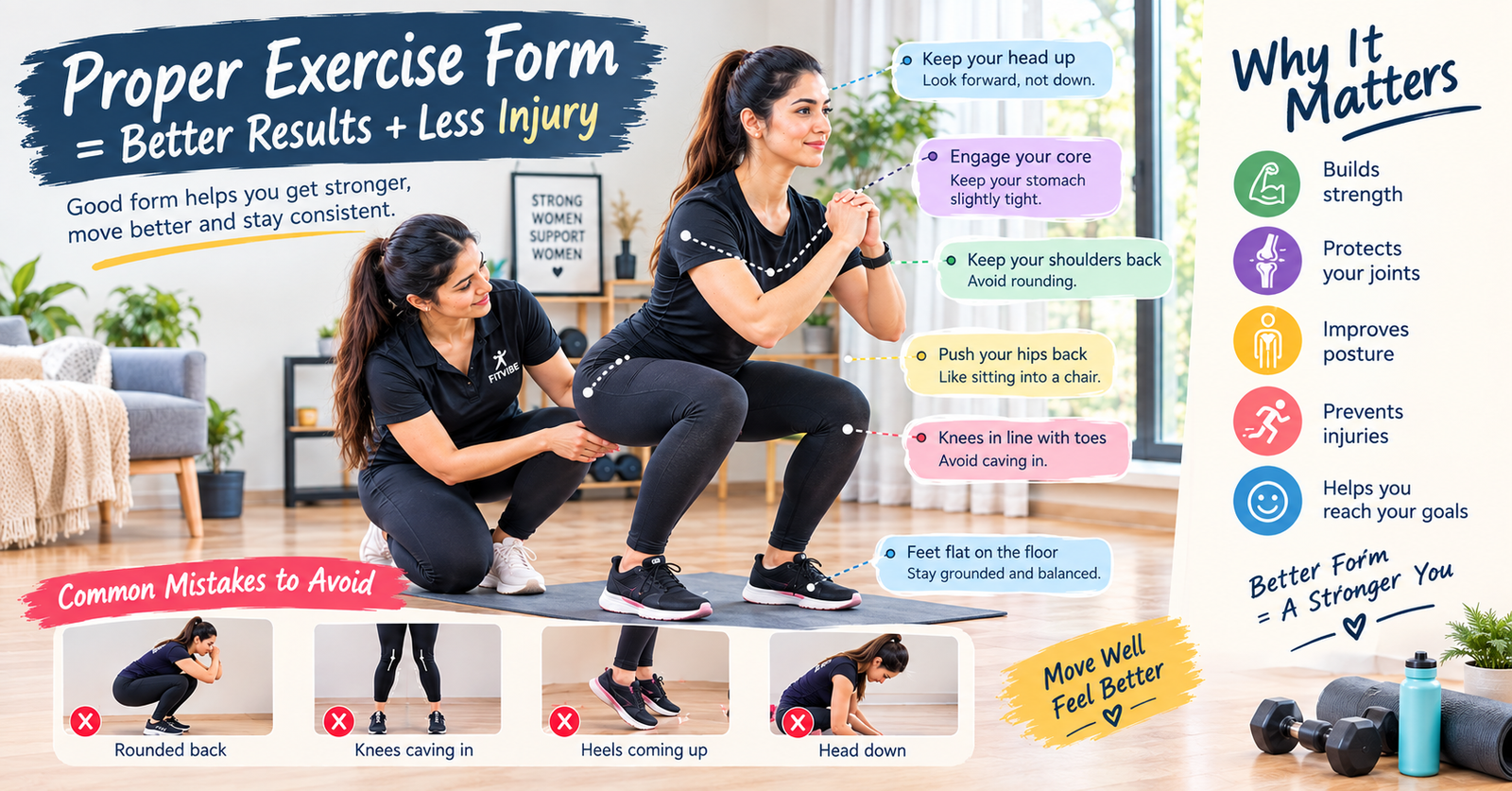
Knees Caving Inward During Squats and Lunges
When the knees drift inward instead of tracking over the toes, extra stress lands on the knee ligaments and can aggravate the hips over time. Fix: actively push your knees outward in line with your toes throughout the movement, and slow the tempo down until the pattern feels automatic.
Rounded Back During Deadlifts or Bent-Over Rows
A rounded lower back under load is one of the most common causes of lower back strain in the gym. Fix: brace your core before lifting, keep a neutral spine from setup to lockout, and reduce the weight until you can maintain that position for every rep.
Flared Elbows During Push-Ups or Bench Press
Elbows flaring straight out to the sides places unnecessary stress on the shoulder joint. Fix: keep elbows at roughly a 45-degree angle from your torso rather than a full 90 degrees.
Overarching the Lower Back During Overhead Movements
Pressing overhead with an excessively arched lower back is a common cause of lower back discomfort, especially when core strength hasn't caught up to shoulder mobility. Fix: engage your core and glutes to keep your ribcage stacked over your pelvis instead of leaning back into the press.
Using Momentum Instead of Muscle
Swinging weights up using momentum — common in bicep curls and shoulder raises — shifts stress onto tendons and connective tissue rather than the target muscle. Fix: slow the movement down and reduce the weight until you can control the full range of motion without swinging.
Progression Errors That Cause Injury Just as Often as Bad Form
Even correct form can lead to injury if progression is too aggressive. Increasing weight, reps, or intensity too quickly doesn't give your muscles, tendons, and joints time to adapt. A general guideline is to increase load or volume by no more than about 10% at a time, and to add a new level of intensity only once the current one feels fully manageable with clean form.
Warm-Up: The Step Most People Skip
Cold muscles and joints are more vulnerable to strain. A short, dynamic warm-up — light cardio followed by movement-specific drills like bodyweight squats before a leg session, or arm circles before an upper-body session — increases blood flow and primes the exact joints and muscles you're about to load, meaningfully reducing injury risk in the first few sets.
How to Actually Check Your Own Form
- Record yourself from the side and front during a set and compare your joint positions to a trusted technique reference.
- Start light. It's far easier to spot and correct a form error with an empty bar or bodyweight than under heavy load.
- Learn to tell the difference between normal muscle fatigue and sharp, joint-specific pain — the second one means stop immediately, not push through.
- Get a second set of eyes. Some form errors, like a slightly rounding back or knees drifting a few degrees inward, are very hard to catch in your own reflection.
Why Working With a Trainer Reduces Injury Risk
This is exactly where a trainer earns their value. Catching a form error in week one — before it's been repeated for a hundred reps — is far easier than correcting a deeply ingrained habit months later, after discomfort has already started. At Fit Vibe Trainer, every program starts with technique first, whether it's in-person coaching across DHA, Johar Town, Gulberg, Bahria Town, and Model Town in Lahore, or online coaching with video form checks — including safe, adjusted programming for postpartum recovery, PCOS, and posture correction, where form matters even more than usual.
For more on building safe, effective workout habits, see our related pieces on avoiding common workout injuries and this form and technique reference.
The Bottom Line
You don't need to train less to stay injury-free — you need to train with better alignment, sensible progression, and a proper warm-up. Most workout injuries build up slowly from small, repeated form errors rather than happening in a single moment, which means most of them are preventable with the right attention to technique from day one.
Frequently Asked Questions
What is the most common cause of workout injuries?
Poor form under load, followed closely by doing too much too soon without proper progression. Most injuries build up gradually from small technique errors repeated over hundreds of reps.
Can bad form cause injury even with light weights?
Yes. Light weight reduces the risk but doesn't remove it. Repeated poor movement patterns can strain joints and tendons over time and reinforce habits that become dangerous once weight increases.
How do I know if my exercise form is correct?
Record yourself from the side and front, compare your joint alignment to a trusted technique guide, and watch for pain versus normal muscle fatigue. A trainer reviewing your form is the most reliable way to catch what you can't see yourself.
Should I stop exercising if something feels wrong during a set?
Yes. Sharp, joint-specific pain is different from normal muscle burn and is a signal to stop the set immediately rather than push through it.
Want your form checked by a professional? Get in touch with Fit Vibe Trainer for in-person training across Lahore or online coaching wherever you are.
Ready to put this into action?
Train 1-on-1 or in a group with Amna — your first discovery call is completely free. Female-only, fully online, results you can see.
Book My Free Call on WhatsApp →