Random diets work for some women some of the time. Personalised weight loss plans work for significantly more women, more consistently, and more lastingly. The difference is not motivational. It is physiological. A random diet is a solution designed for nobody in particular. A personalised weight loss plan is a solution designed for your body, your hormones, your health history, your food culture, and your life. Those are not the same thing, and treating them as interchangeable is the reason most women cycle through diet after diet without producing the lasting results their effort deserves.
This guide explains exactly why personalised weight loss plans outperform random diets for women, what the personalisation actually covers, and why the specific factors that are almost never addressed in generic diets are often the primary reasons individual women struggle to lose weight despite consistent effort. For additional perspectives on this topic, you can also read the visual breakdown on Pinterest and the detailed community discussion on BuzzBii.
What a Random Diet Actually Is
A random diet is any weight loss approach designed around an average woman rather than a specific one. This includes essentially all mainstream diets: keto, intermittent fasting, the Mediterranean diet, juice cleanses, low-fat diets, low-carb diets, calorie-counting apps, and every variation of these that circulates on social media each year.
These diets are not inherently fraudulent. Many are based on real nutritional science. The problem is not the principle. It is the application. They are designed to produce results for an average body under average conditions. Your body is not average. It has a specific hormonal profile, a specific metabolic rate, a specific health history, a specific response to particular foods, a specific lifestyle, and a specific set of conditions that either support or work against fat loss. A diet that does not account for any of these factors is not designed for you. It is designed for a statistical composite that may bear little resemblance to your actual physiology.
This is why the same diet that produces dramatic results for one woman produces no results for another woman following it with equal consistency. It is not a matter of how strictly either woman is following the plan. It is a matter of how well the plan matches each woman's individual physiology.
Why Women's Weight Loss Is Specifically More Individual Than Men's
Women's weight loss is more dependent on individual factors than men's for several physiological reasons that generic diets almost universally ignore.
- Women's hormonal cycles create monthly variation in fat metabolism, water retention, appetite, and energy availability. Oestrogen and progesterone levels shift significantly across the menstrual cycle, affecting how efficiently fat is mobilised, how much water is retained, how strong hunger signals are, and how effectively the body responds to exercise. A diet that does not account for this monthly variation will produce inconsistent results and frequent periods of apparent plateau that are actually hormonal rather than dietary failures.
- PCOS and insulin resistance affect a significant proportion of women and fundamentally change how the body responds to calorie restriction. Women with PCOS have insulin resistance in the majority of cases, meaning their cells respond less efficiently to insulin and their bodies produce more of it to compensate. Elevated insulin is a fat storage hormone, particularly for abdominal fat. A standard calorie-deficit diet does not address this mechanism. A personalised plan designed for insulin resistance does, through specific exercise selection, meal timing, macronutrient balance, and blood sugar stability strategies that a generic diet never covers.
- Thyroid function directly determines resting metabolic rate and varies significantly between women. Women are disproportionately affected by thyroid conditions, particularly hypothyroidism. A woman with clinically or subclinically suppressed thyroid function has a lower resting metabolic rate than a woman with healthy thyroid function of the same height, weight, and activity level. The standard calorie deficit that produces results for the second woman may produce minimal results for the first, not because she is not following the plan but because her metabolic rate is lower than the plan assumes.
- Perimenopausal and postmenopausal women face a fundamentally different hormonal environment for weight loss. As oestrogen declines, fat redistribution occurs from the hips and thighs to the abdomen, insulin resistance worsens, resting metabolic rate declines through muscle loss, and cortisol sensitivity increases. A diet designed for a woman in her thirties applied to a woman in perimenopause produces inferior results because it does not account for any of these shifts. Personalised plans for this life stage address the hormonal environment directly.
- Women's cortisol response to stress is more pronounced than men's. Chronic stress produces abdominal fat accumulation in women through cortisol-driven fat storage mechanisms. A generic diet that creates significant food restriction stress, eliminates culturally important foods, or adds significant lifestyle complexity to an already stressed woman can raise cortisol and worsen fat storage even while producing a calorie deficit on paper.
The Seven Things a Personalised Weight Loss Plan Covers That a Random Diet Never Does
One: Your Hormonal Context
A personalised plan begins with an assessment of your hormonal health. Are you managing PCOS, insulin resistance, hypothyroidism, or perimenopausal hormonal shifts? Each of these conditions requires specific nutritional and exercise adjustments that a generic diet does not contain. For women with PCOS, a personalised plan prioritises blood sugar stability, protein-first eating, minimal refined carbohydrate, and strength training over cardio to directly address the insulin resistance mechanism. For perimenopausal women, it emphasises muscle-building exercise to counteract resting metabolic rate decline and cortisol management through meal timing and food quality.
Two: Your Food Culture and Daily Eating Reality
A generic diet developed in the United States or the United Kingdom assumes access to specific foods, specific cooking habits, and specific meal structures that may be irrelevant or impractical in Lahore. A personalised plan for a woman in Lahore is built around the foods that are actually available, affordable, and culturally meaningful in her kitchen. It works with roti, rice, daal, chicken karahi, saalan, and seasonal vegetables rather than demanding she eat foods her family does not cook and her neighbourhood does not stock.
This distinction is not trivial. Dietary adherence is the single most reliable predictor of weight loss outcomes. A plan that demands unfamiliar foods, separate meal preparation from family cooking, or the elimination of culturally central foods will collapse the moment a family gathering, a wedding, Eid, or Ramadan arrives. A personalised plan built around real food culture is designed to survive real life.
Three: Your Resting Metabolic Rate and Caloric Needs Specifically
Generic diet plans assign calorie targets based on averages. A woman of a given height, weight, and activity level is assigned a standard target, and the assumption is that this deficit will produce predictable fat loss. In practice, resting metabolic rates vary significantly between women of the same height, weight, and activity level based on lean muscle mass, hormonal status, thyroid function, age, and metabolic history.
A woman who has spent years on very low calorie diets has a suppressed resting metabolic rate from the muscle loss those diets produced. Applying a standard calorie deficit to her suppressed metabolic baseline produces a smaller actual deficit than the calculation assumes, which explains why she appears to be eating very little and losing very slowly or not at all. A personalised plan accounts for metabolic history, prioritises muscle rebuilding to restore metabolic rate, and calibrates the deficit to her actual metabolic baseline rather than an average.
Four: The Role of Exercise Specifically for Your Body
Random diets are almost always diet-only or diet-plus-generic-cardio recommendations. They do not account for the exercise component that is most important for your specific hormonal and metabolic situation. For women with PCOS, the exercise prescription is strength training twice to three times per week to improve insulin sensitivity, not cardio classes five days a week. For women with cortisol-dominant abdominal fat, the exercise prescription is Zone 2 walking and moderate strength training, not high-intensity exercise that elevates cortisol further. For postnatal women, the exercise prescription begins with deep core rehabilitation before any conventional abdominal loading. Random diets do not make these distinctions. Personalised plans do.
Five: Your Lifestyle Constraints and Schedule
A generic diet assumes the ability to meal prep on Sundays, eat five small meals per day, avoid eating socially, and maintain the same eating structure seven days a week. Most women in Lahore are managing households, families, careers, and social obligations that make these assumptions impractical in any given week and impossible to maintain consistently over months.
A personalised plan is built around your actual schedule: how many times a week you can cook separately from family meals, what eating structure is realistic given your morning routine and evening commitments, how to navigate family gatherings and wedding seasons without abandoning the plan entirely, and how to maintain core nutritional principles during Ramadan without regressing on fat loss progress.
Six: Your Psychological Relationship With Food and Eating
Generic diets treat food intake as a mathematical problem: create a deficit and the outcome is predetermined. This ignores the psychological dimensions of eating that are particularly relevant for women, including emotional eating patterns, restriction-rebound cycles, body image distress, and the social and cultural meaning of food in Pakistani family life.
A personalised plan accounts for these factors practically. It does not simply create a deficit and expect psychology to be irrelevant. It builds a nutritional structure that is sustainable under real emotional and social conditions, eliminates the all-or-nothing thinking that causes women to abandon plans entirely after one deviation, and establishes a relationship with food that supports fat loss without the restriction-stress that drives cortisol and rebound eating.
Seven: Your Progress Markers and Accountability Structure
Generic diets measure success through the scale. A personalised plan tracks body measurements, strength performance, energy levels, sleep quality, hormonal indicators, and lifestyle markers alongside scale weight, because for women managing hormonal conditions, cycle-related water retention, or building lean muscle simultaneously with fat loss, scale weight is one of the least reliable indicators of whether the plan is working. The accountability structure of a personalised plan, which involves a qualified coach tracking multiple markers and adjusting the plan based on real-time results, produces adherence and progress that self-directed app-based dieting cannot match.
Why Generic Diets Fail Women Specifically: The Most Common Patterns
Understanding the specific failure patterns of generic diets helps explain why so many women experience them regardless of effort or consistency.
- The initial result followed by plateau. Almost every generic diet produces some initial result, largely from water and glycogen loss as carbohydrate intake changes. Women interpret this as evidence the diet works and commit fully. Within four to six weeks, as water weight normalises and the body adapts to the new calorie intake, the scale stops moving. The diet has not stopped working in any meaningful physiological sense. The initial loss was not representative of ongoing fat loss rate. But without understanding this, women conclude the diet has failed and abandon it, beginning the next cycle.
- The muscle loss trap. Generic calorie restriction without specific exercise prescription causes significant muscle loss alongside fat loss. Lean muscle is metabolically expensive. Losing it reduces resting metabolic rate. Each subsequent diet requires eating even less to produce the same deficit, and each produces a worse body composition outcome than the last, because the proportion of weight lost that is lean muscle increases as metabolic rate declines. This is why women who have been dieting for years often feel like their metabolism is broken. It is not broken. It has been progressively depleted by diets that did not protect lean muscle.
- The cultural incompatibility collapse. Most international diets are designed for Western food cultures. The moment a wedding season begins, Ramadan arrives, or a family iftaar requires eating what everyone else is eating, the diet is incompatible with reality and most women abandon it. A personalised plan built around Pakistani food culture and designed to flex around Ramadan, weddings, and family gatherings does not collapse under these conditions because it was designed to operate within them.
- The cortisol-restriction spiral. Diets that eliminate beloved foods, create significant mealtime anxiety, demand separation from family eating, or generate persistent hunger elevate cortisol. Elevated cortisol promotes abdominal fat storage, suppresses fat mobilisation, increases appetite, and disrupts sleep. Women find that the harder they restrict, the more stubborn their abdominal fat becomes. This is physiologically precise. The restriction itself is driving cortisol that is counteracting the fat loss the restriction is supposed to produce.
What a Personalised Weight Loss Plan for Women in Lahore Actually Includes
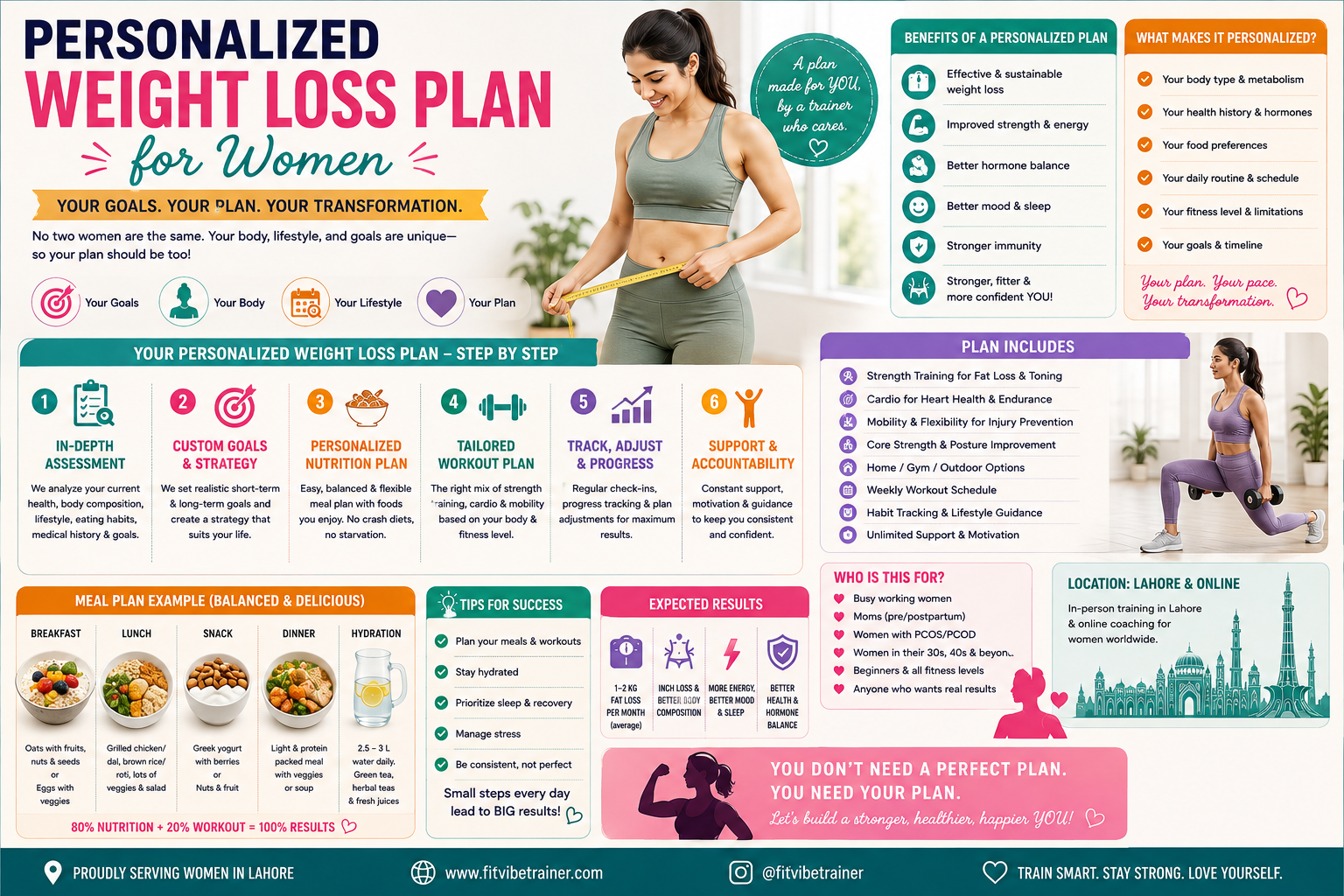
At Fit Vibe Trainer, a personalised weight loss plan is not a diet handed to a client with instructions to follow it. It is a living programme built through a thorough assessment of every factor relevant to that specific woman's fat loss, adjusted as her body responds, and supported by ongoing coaching that accounts for the realities of her daily life in Lahore.
The initial assessment covers your health history, hormonal context, PCOS or thyroid status, exercise history, current dietary patterns, food preferences and cultural context, sleep quality, stress levels, and schedule constraints. The programme that emerges from this assessment is not a template. It is a plan built specifically for the person who was assessed.
The nutritional component works within Pakistani food culture, not against it. It builds meals around the protein sources central to Pakistani cuisine, calibrates carbohydrate intake to blood sugar stability and hormonal context, accounts for Ramadan and wedding seasons explicitly, and does not eliminate foods that are culturally or socially non-negotiable.
The exercise component is designed specifically for your hormonal context and goals. For most women in Lahore, this means two to three strength training sessions per week as the metabolic foundation, daily walking at Zone 2 intensity for cortisol management and insulin sensitivity, and programme adjustments based on where you are in your monthly cycle, your recovery capacity, and your lifestyle stress.
Progress is tracked through body measurements, strength performance, energy levels, sleep quality, and scale weight as one indicator among many rather than the primary verdict on whether the plan is working.
Our ACE certified coach holds qualifications spanning GGS Women's Coaching Specialist, Pre and Postnatal Coaching Certification, Diploma in Nutrition and Diet Planning, Physical Fitness and Exercise Science, Functional Training and Conditioning, and Postpartum Fitness and Recovery. Every plan is informed by specialist knowledge of female physiology, hormonal health, and the specific nutritional and training requirements of different life stages and health conditions.
We offer personalised weight loss coaching as in home sessions across Lahore, studio sessions at Dream Gardens, and live online coaching for women in Pakistan and internationally.
To understand the specific mechanisms by which strength training produces fat loss as part of a personalised plan, read: how strength training helps women lose weight.
To understand why women plateau despite consistent effort and how a personalised approach breaks through it, read: why women stop losing weight even when they exercise.
For how to build a sustainable weight loss routine specifically designed for life in Lahore, read: how women in Lahore can build a sustainable weight loss routine.
For the critical distinction between fat loss and weight loss that determines how your personalised plan should be measured, read: fat loss vs weight loss: what is actually different.
For a full overview of our services for women in Lahore and internationally, visit: female personal trainer in Lahore.
Book a free consultation today and get a clear picture of what a plan built specifically for your body, your hormones, and your life in Lahore would actually look like.
Find us on Google and read genuine reviews from women who moved from random diets to personalised programmes and finally saw results that lasted.
Frequently Asked Questions
What is a personalised weight loss plan for women?
A personalised weight loss plan for women is a comprehensive programme designed around an individual woman's specific hormonal profile, health history, metabolic rate, food culture, exercise capacity, lifestyle constraints, and goals rather than around an average population. It accounts for conditions like PCOS and hypothyroidism that generic diets ignore, incorporates exercise appropriate to her specific hormonal and metabolic context, works within her actual food culture rather than demanding incompatible changes, and tracks progress through multiple meaningful markers rather than scale weight alone.
Why do generic diets fail most women?
Generic diets fail most women because they are designed for an average body rather than any specific individual body. They do not account for hormonal conditions like PCOS and insulin resistance that directly suppress fat loss, do not account for thyroid function that determines resting metabolic rate, cause muscle loss that reduces metabolic rate progressively, are incompatible with cultural food practices and seasonal events that are non-negotiable in real life, and create the calorie restriction stress that elevates cortisol and counteracts the fat loss they are supposed to produce.
How is a personalised weight loss plan different from a meal plan?
A meal plan is a dietary prescription, typically a list of meals and calorie targets. A personalised weight loss plan is a comprehensive, ongoing programme that includes the nutritional component alongside a specific exercise prescription, progress tracking through multiple markers, accountability and coaching between sessions, adjustments based on how the body is responding, and integration with the realities of the individual's lifestyle including cultural food practices, family eating structures, seasonal events, hormonal cycles, and health conditions. A meal plan is a tool. A personalised plan is a coaching relationship.
Can women with PCOS follow a personalised weight loss plan?
Yes, and a personalised plan is far more effective for women with PCOS than any generic diet. PCOS causes insulin resistance that makes standard calorie-deficit approaches significantly less effective. A personalised plan for PCOS prioritises blood sugar stability through protein-first eating and carbohydrate pairing, strength training over cardio to directly improve insulin sensitivity through lean muscle building, cortisol management to avoid the hormonal worsening that high-intensity exercise can cause in PCOS, and specific nutritional adjustments to the anti-inflammatory and blood sugar-supporting principles that generic diets do not apply.
How long does it take to see results from a personalised weight loss plan?
Most women notice improved energy, better sleep, and reduced daily stiffness within two to three weeks of starting a well-designed personalised programme. Measurable reductions in body measurements typically appear between weeks four and eight. Visible body composition changes become apparent between weeks eight and twelve. Women managing PCOS, hypothyroidism, or perimenopausal changes may see a slower initial rate of scale change that accelerates as the hormonal factors are properly addressed. Progress tracked through measurements rather than scale weight alone produces a much more accurate picture of what is actually happening in the body throughout this period.
Is a personalised weight loss plan different for women in Lahore?
Yes, meaningfully. A personalised plan for women in Lahore accounts for the Pakistani food culture that generic international diet plans ignore, including building meals around protein sources central to Pakistani cuisine like chicken, beef, mutton, eggs, daal, and fish rather than demanding Western food substitutes. It accounts for Ramadan, wedding seasons, and family eating structures that are non-negotiable in Pakistani social life. It accounts for the specific climate constraints on outdoor exercise in Lahore's summers and provides indoor and home-based exercise solutions that are practical for women who prefer or require private training environments. None of this exists in a generic diet.
Do I need a personal trainer to follow a personalised weight loss plan?
Not strictly, but working with a qualified female trainer who designs and monitors your personalised plan produces significantly faster, more accurate, and more lasting results than self-designing one. A qualified trainer identifies the specific hormonal, metabolic, and lifestyle factors affecting your results, designs the exercise component alongside the nutritional component so both are calibrated to your specific situation, tracks multiple progress markers to identify whether the plan is working or needs adjustment, and provides the between-session accountability that determines whether a plan is followed consistently or abandoned at the first setback.
Why is personalisation more important for women than for men in weight loss?
Women's weight loss is more dependent on individual factors because female physiology introduces more variables. Monthly hormonal cycles create variation in fat metabolism, water retention, and appetite that men do not experience. Women are more susceptible to the hormonal weight loss conditions of PCOS, hypothyroidism, and perimenopausal hormonal shifts. Women have lower baseline lean muscle mass relative to body weight, which means resting metabolic rate is more sensitive to the muscle loss that generic calorie restriction produces. And women show greater cortisol reactivity to stress, which means the dietary stress of restriction has a more direct physiological impact on fat storage in women than in men.
Ready to put this into action?
Train 1-on-1 or in a group with Amna — your first discovery call is completely free. Female-only, fully online, results you can see.
Book My Free Call on WhatsApp →