One on one personal training produces better results than self-directed training, group classes, and most app-based fitness programmes. The research on this is consistent: supervised training produces adherence rates of around 88 percent compared to 52 percent for self-guided training, and meaningful body composition changes occur in supervised groups that do not occur in unsupervised groups at comparable frequencies. But the question of what you actually get in exchange for that investment deserves a more specific answer than personalised workouts and accountability, which is what most articles offer.
This guide covers what one on one personal training actually delivers for women specifically, why each benefit matters more for women than generic descriptions suggest, and why several of the most important benefits are almost never mentioned in standard one on one training articles. You can also read additional perspectives on this topic at WhatsOn Plus and in the community discussion on Good and Bad People.
Benefit One: A Programme Built Around Your Body, Not Around an Average
The most fundamental thing you get with one on one personal training is a programme that begins with an assessment of your specific body, not of an average client. This distinction is more significant than it sounds.
Group classes, app programmes, and online workout plans are built around a composite of typical fitness attributes. They assume a certain baseline fitness level, a certain body structure, a certain absence of health conditions, and a certain set of goals that may or may not match yours. When they do not match, the programme produces suboptimal results at best and injury at worst.
A one on one programme begins with a thorough intake covering your health history, previous injuries, hormonal health, current fitness level, movement quality, schedule, food culture, and personal definition of success. What comes out of that intake is a programme specifically calibrated to your starting point. The exercises selected are appropriate for your movement capacity. The loads are calibrated to your current strength. The progression is designed around your recovery capacity. The nutritional guidance is built around your actual dietary habits and cultural food practices, not around a generic meal plan template.
For women in Lahore specifically, this means a programme that works with Pakistani food culture rather than demanding Western dietary substitutes, that accounts for Ramadan and wedding seasons as real scheduling factors rather than treating them as interruptions to an idealised plan, and that addresses the specific environmental conditions including summer heat and privacy preferences that shape what exercise looks like in practice.
Benefit Two: Real-Time Form Correction That Prevents Injury and Maximises Every Repetition
Form correction is the most frequently cited benefit of one on one personal training, and it is frequently cited because it is genuinely the most immediately impactful thing a qualified trainer does in every session.
The difference between a squat performed with correct mechanics and one performed with compensatory patterns, a rounded lower back, knees caving inward, or heels lifting, is not just a matter of technique aesthetics. It is the difference between building the glutes and hamstrings the movement is designed to develop and loading the lower back and knee joints with force they are not designed to absorb over thousands of repetitions. Poor form produces injury not usually from a single catastrophic error but from the cumulative loading of incorrect mechanics repeated across weeks and months.
Your trainer watches every repetition. She sees the compensation patterns that you do not feel because your nervous system has normalised them. She corrects them in real time, explains why the correction matters, and cues you to feel the difference rather than simply telling you what to change. This immediate feedback loop is what builds correct movement patterns rather than reinforcing incorrect ones.
For women specifically, form correction carries several additional layers of importance. Women have anatomical differences including wider hip angles that affect how knee tracking and foot position should be cued during lower body exercises. Women are more prone to ACL injury than men due to hormonal and anatomical factors, and the hip and glute strengthening that correct form coaching produces is one of the primary preventive interventions for this injury. And for postnatal women, form correction includes the specific core engagement cues that distinguish safe abdominal loading from movements that worsen diastasis recti and pelvic floor dysfunction.
Benefit Three: Progressive Overload Applied Systematically Over Time
Progressive overload, the systematic increase of training demands over time to continue driving adaptation, is the single most important principle for producing ongoing results from exercise. It is also the principle most commonly missing from self-directed training, app programmes, and group classes.
In a group class, the load does not change for you specifically. The instructor suggests a modification range, and you select somewhere within it. Whether you are ready to progress beyond last week's weight is not tracked because it cannot be tracked at the individual level in a group setting. The result is that many women plateau within weeks of starting group training because the stimulus stops being novel and the body stops adapting to it.
Your one on one trainer tracks exactly what you did in every previous session. She knows that you squatted eight kilograms for three sets of ten last week and that your form was controlled throughout. She knows that your glute bridges have been at bodyweight for two weeks and you are ready to add resistance. She knows that your overhead press mechanics have been improving and you are ready to increase range of motion before increasing load. This session-by-session tracking of your specific performance allows her to apply progressive overload precisely when your body is ready for it rather than on a fixed calendar schedule that assumes all clients progress at the same rate.
Benefit Four: A Training Plan That Adapts to How You Are on That Specific Day
This is the benefit that no app, programme, or group class can provide and that most one on one training articles describe too briefly to do justice to.
Your body is not the same on every training day. Your energy, your recovery state, your hormonal position in your cycle, your sleep quality from the previous night, your stress load, and your hydration all vary significantly day to day and week to week. A fixed programme applied without accounting for these variables produces inconsistent results at best and counterproductive results at worst.
When you arrive at a session feeling fatigued, over-stressed, or experiencing the energy dip of the late luteal phase before menstruation, your trainer reads these signals and adjusts the session accordingly. She reduces load and volume. She shifts focus toward technique rather than intensity. She may change the session structure entirely to address what your body can produce today rather than what it produced last week. This adaptation is not a compromise or a concession. It is sophisticated programming that produces better cumulative results over a twelve-week period than rigid adherence to a fixed plan regardless of daily physiological state.
For women managing PCOS, this day-to-day adaptation is particularly important because insulin sensitivity, energy, and recovery vary significantly across the hormonal cycle and in response to stress. A trainer who understands these patterns can time training loads to the follicular phase when energy and strength are typically highest, and reduce intensity during the luteal phase when recovery is slower and perceived effort is greater. This cycle-aware adaptation does not just feel better. It produces better outcomes.
Benefit Five: Hormonal Health Management Built Into the Programme
This is the benefit that every generic one on one training article misses entirely, and it is one of the most important ones for the specific population of women who most benefit from one on one coaching.
Women's training does not occur in a hormonal vacuum. Oestrogen, progesterone, cortisol, insulin, thyroid hormone, and the cycle of hormonal changes across the month all directly affect how the body responds to training, recovers from it, and stores or releases fat. A trainer who understands these mechanisms designs programmes that work with a woman's hormonal environment rather than inadvertently working against it.
For women with PCOS and insulin resistance, a one on one trainer designs strength training sessions specifically to build lean muscle that directly improves insulin sensitivity. She structures the programme to avoid the high-intensity cardio excess that elevates cortisol and worsens the hormonal environment of PCOS. She understands that blood sugar stability around training sessions is not just a nutritional consideration but a hormonal one that directly affects both training performance and fat metabolism.
For women in perimenopause, a qualified trainer designs bone-loading strength work to counteract the accelerated bone density loss that oestrogen decline produces. She manages cortisol through training volume and intensity choices that avoid the cortisol overload that worsens perimenopausal abdominal fat accumulation. She understands that the same training frequency that worked in the client's thirties may need adjustment in her mid-forties to account for the different recovery capacity and hormonal sensitivity of this life stage.
For postnatal women, a postnatal-certified trainer builds the programme around deep core rehabilitation that must precede conventional strength loading. She assesses diastasis recti and pelvic floor function before programming any abdominal or loaded compound exercise. She understands that loading a postnatal core without this assessment sequence is not suboptimal coaching. It is a safety failure that causes physical harm.
None of this hormonal depth is available from a generic programme, an app, or a group class. It is the product of specialist training knowledge applied to individual assessment, which is what one on one coaching from a qualified female trainer provides.
Benefit Six: Genuine Accountability That Produces Consistency
Accountability is on every one on one training benefits list, but it is rarely explained in the specific way that actually makes it effective. Accountability in one on one personal training is not motivational pressure or social guilt. It is a structural feature of the coaching relationship that produces consistency through mechanisms more reliable than willpower.
When a session is booked with a specific person at a specific time, the psychological and social commitment to that appointment is significantly stronger than the commitment to a gym session you have scheduled for yourself. Research on habit formation and exercise adherence consistently shows that social commitment and external expectation produce more consistent behaviour than internal motivation alone. You may negotiate with yourself about whether to go to the gym. You are significantly less likely to cancel on a person who is travelling to your home or who has cleared that time specifically for you.
Accountability in one on one training also operates between sessions through check-ins, programme assignments, and the knowledge that your trainer will ask about your activity and nutrition at the next session. This between-session accountability extends the coaching relationship beyond the session itself and produces lifestyle changes that isolated gym visits do not.
For women who have tried and stopped multiple exercise approaches, the accountability structure of one on one training is often the variable that finally produces consistent attendance. Not because it is more motivating in a general sense, but because it is more structurally resistant to the legitimate competing demands of life that cause self-directed exercise to be skipped.
Benefit Seven: Progress Tracked Through Meaningful Markers Rather Than Scale Weight Alone
One of the most valuable but least discussed benefits of working with a qualified trainer is that she tracks your progress correctly. Scale weight is one of the least informative progress indicators for women in a training programme, and a trainer who relies on it as the primary or sole metric is not evaluating your progress accurately.
A qualified one on one trainer tracks body measurements at the waist, hips, thighs, and upper arms monthly. She tracks strength performance in key exercises to show objective functional improvement over time. She tracks energy levels, sleep quality, and how you present at sessions. She may track cycle regularity and phase-specific energy as indicators of hormonal programme appropriateness for women managing PCOS or perimenopausal changes.
For women, this multi-marker tracking is particularly important because the most meaningful outcomes of a well-designed training programme, body recomposition, hormonal regulation, and improved functional capacity, do not show up reliably on a scale. A woman who is losing fat and building lean muscle simultaneously will show zero scale movement while her measurements, strength, and body composition are changing significantly. Without a trainer tracking the right markers, this progress is invisible, and the temptation to conclude the programme is not working at the exact moment it is working most effectively is very high.
Benefit Eight: Nutritional Guidance Integrated With Training
One on one personal training with a trainer who holds nutritional qualifications integrates dietary guidance into the programme rather than treating training and nutrition as separate domains that happen in parallel. This integration produces better outcomes than training and nutrition managed independently.
For women in Lahore, this means nutritional guidance built around Pakistani food culture. Protein targets achieved through chicken, beef, mutton, eggs, daal, chickpeas, paneer, and fish rather than through Western supplements that may not be available, affordable, or culturally appropriate. Carbohydrate management that works with roti, rice, and the actual meal structures of Pakistani family cooking rather than demanding separate meal preparation that is practically unsustainable in most family contexts. Guidance on eating around training sessions that accounts for the specific foods available rather than citing general principles that require translation to a different food environment.
For women managing PCOS, nutritional integration is particularly important because the blood sugar stability strategies that support insulin sensitivity are nutritional as much as they are exercise-based. A trainer who can address both dimensions simultaneously produces better PCOS outcomes than one who coaches exercise only and leaves nutrition to be figured out independently.
Benefit Nine: Privacy and Psychological Safety That Improve Session Quality
The training environment directly affects performance quality. A woman who feels self-conscious, watched, or uncomfortable in her training environment will not work with the focus and effort that produces results, regardless of how good the programme is on paper.
One on one training, particularly in a home setting, provides a training environment of complete psychological safety. You can ask any question without embarrassment. You can make any error without self-consciousness. You can perform modified exercises specific to your health condition without social comparison. You can work at any pace without feeling judged relative to other people in the room. You can discuss your hormonal symptoms, your energy, your pain, and your progress with honest specificity because you are speaking to one person who is there for your benefit alone.
For women in Lahore, the privacy dimension carries additional cultural and religious significance. A female-only training environment with a female trainer provides the gender-appropriate context that makes exercise accessible for many women who would not train in a mixed-gender gym regardless of motivation or goals. Home training removes every logistical barrier between the woman and the session, which for many women is the difference between training consistently and not training at all.
Benefit Ten: Long-Term Coaching That Evolves With You
The final benefit that most generic articles describe as a conclusion rather than a substantive benefit is actually one of the most valuable aspects of one on one personal training: the coaching relationship evolves as you evolve.
A trainer who has worked with you for six months knows your movement patterns, your recovery tendencies, your hormonal cycle patterns, your psychological relationship with food and exercise, your life schedule, and the specific contextual factors that affect your training on any given week. This accumulated knowledge makes every subsequent session more precisely calibrated to you than the sessions that preceded it. The programme you are on at month six is significantly better designed for your specific body than the programme you started with, not only because your body has changed but because your trainer's understanding of your body has deepened.
This accumulated knowledge is not transferable to a new trainer, an app, or a group class. It resides in the coaching relationship itself, which is one of the most concrete arguments for finding the right trainer and staying with her rather than cycling through different fitness approaches every few months.
What You Get With One on One Personal Training at Fit Vibe Trainer
At Fit Vibe Trainer, every one on one programme is delivered with all ten of the benefits described in this guide and with the women-specific depth that generic coaching cannot provide. Our ACE certified coach holds qualifications spanning GGS Women's Coaching Specialist, Pre and Postnatal Coaching Certification, Diploma in Nutrition and Diet Planning, Physical Fitness and Exercise Science, Functional Training and Conditioning, and Postpartum Fitness and Recovery including diastasis recti management and pelvic floor rehabilitation.
Every client begins with a thorough assessment before any programme is designed. Every session is supervised, form-corrected, and adapted to your physiological state on that day. Every programme is tracked through multiple meaningful markers. Nutritional guidance is integrated and built around Pakistani food culture. And the coaching relationship evolves with your needs across the life stages and health contexts that make one on one training with a specialist female coach specifically valuable.
We offer in-home sessions across Lahore, studio sessions at Dream Gardens, and live online coaching for women in Pakistan and internationally.
To understand how often you should work with a personal trainer to make the most of your one on one investment, read: how many days a week should women work with a personal trainer.
To understand what your very first one on one session includes and how it sets the foundation for everything that follows, read: what to expect from your first personal training session.
For the questions to ask before you hire a personal trainer to ensure you are getting the quality of one on one coaching this investment deserves, read: things to ask before hiring a personal trainer.
For the complete guide to what to look for in a female trainer beyond the session itself, read: what should you look for in a female personal trainer.
For a full overview of our services for women in Lahore and internationally, visit: female personal trainer in Lahore.
Book a free consultation today and find out exactly what your one on one programme would include, based on your specific goals, health, and life in Lahore.
Find us on Google and read genuine reviews from women who found out what one on one training actually delivers when it is done properly.
Frequently Asked Questions
What do you get with one on one personal training?
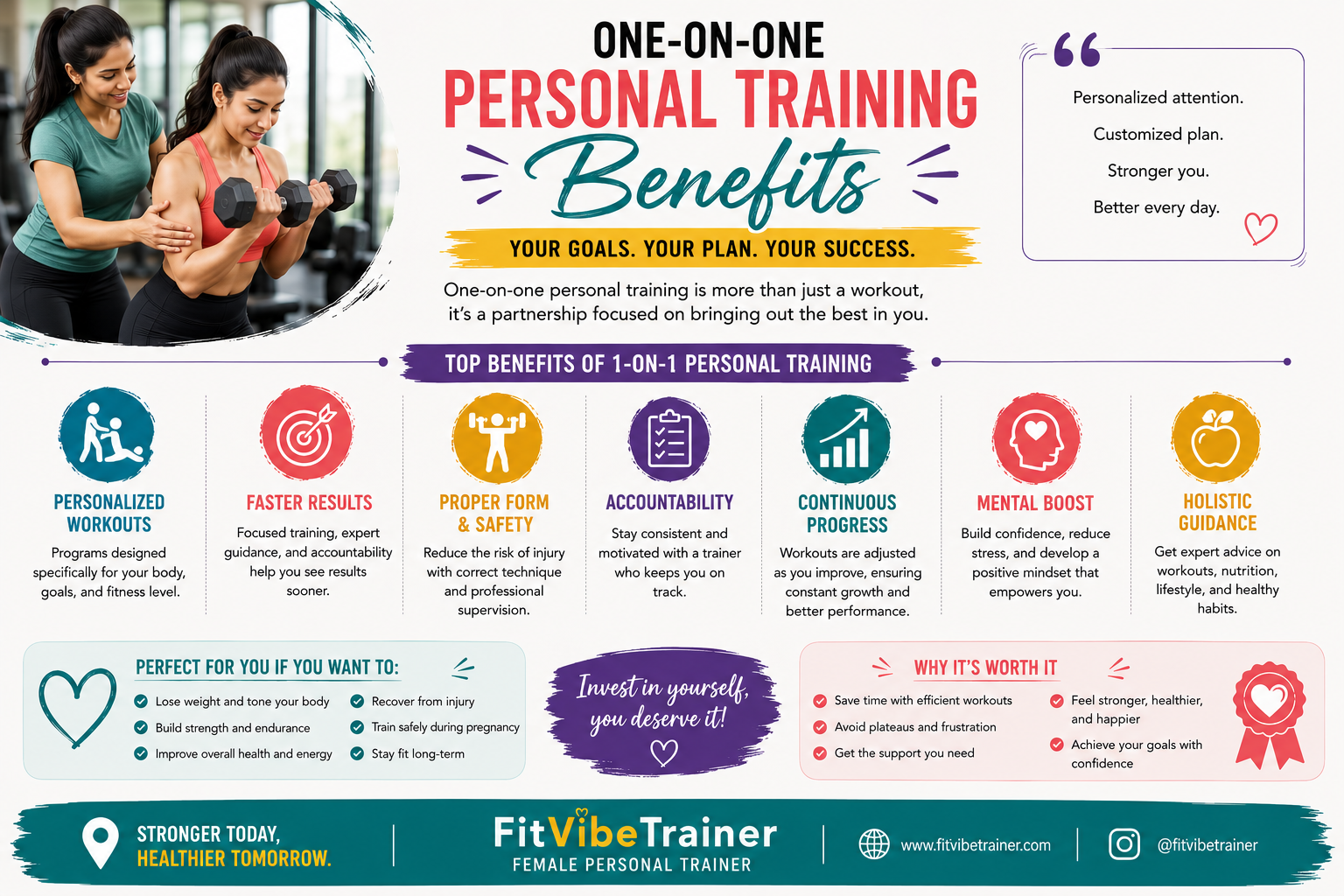
One on one personal training provides a programme built specifically around your body rather than an average client, real-time form correction in every session that prevents injury and maximises each exercise, systematic progressive overload applied as your body is ready for it, day-to-day session adaptation to your physiological state, hormonal health management built into the programme, genuine accountability that produces consistent attendance, progress tracked through multiple meaningful markers rather than scale weight alone, nutritional guidance integrated with your training, a private training environment that improves session quality, and a coaching relationship that evolves with your changing needs over time.
What is the difference between one on one personal training and group classes?
In group classes, the instructor's attention is divided across all participants simultaneously, the programme is designed for an average attendee rather than for you specifically, form correction is impossible for every individual in real time, progressive overload cannot be tracked at the individual level, and the programme cannot adapt to how you are presenting on a specific day. One on one training provides the opposite across all of these dimensions: undivided attention, individual programme design, real-time form correction, session-by-session progressive overload based on your specific performance, and immediate adaptation to your physiological state on the day.
Is one on one personal training worth it for women?
Yes, and particularly for women managing hormonal conditions including PCOS, hypothyroidism, perimenopause, or postnatal recovery, one on one training is not just worth it but specifically superior to any alternative. The hormonal health management, cycle-aware programming, PCOS-specific training structure, and postnatal rehabilitation sequencing that one on one coaching from a specialist female trainer provides cannot be replicated by group classes, apps, or self-directed training. The research on supervised versus unsupervised training consistently shows that supervised training produces the adherence rates and body composition outcomes that unsupervised training does not.
What happens in a one on one personal training session for women?
A typical one on one session begins with a brief check-in on your energy, sleep, and how you are feeling before the session. Your trainer then leads you through a structured warm-up addressing the specific mobility and activation requirements of the exercises planned for that day. The main session covers the exercises in your programme at the weights and volumes appropriate to your current capacity, with real-time form correction throughout. Your trainer adjusts the session on the day based on your state, increasing or decreasing load, volume, or intensity as appropriate. The session closes with a cool-down and a brief review of what was covered and what the focus of the next session will be.
Can one on one personal training help with PCOS?
Yes, significantly. One on one personal training from a trainer with specialist knowledge of PCOS builds programmes that directly address insulin resistance through lean muscle building, manage cortisol through appropriate training volume and intensity, avoid the high-intensity cardio excess that worsens the hormonal environment of PCOS, and integrate blood sugar-stabilising nutritional guidance alongside the training programme. These programme-level adjustments require individual assessment and specialist knowledge that generic coaching and group training cannot provide, making one on one training specifically valuable for women with PCOS.
What is the difference between one on one in-person training and live online coaching?
Live online coaching provides real-time form correction, programme progression, and supervised sessions via video at a standard equivalent to in-person training for the majority of exercise situations. The primary differences are that in-person training allows physical demonstration, equipment sharing, and tactile correction that video cannot replicate. For women who prefer the flexibility of coaching from home without travel, or who are based internationally, live online one on one coaching delivers the core benefits of individual programme design, real-time supervision, and coaching relationship continuity without requiring in-person sessions.
How quickly do women see results from one on one personal training?
Most women notice improved energy, better sleep, and reduced daily stiffness within the first two to three weeks of consistent one on one training. Measurable strength improvements typically appear within four weeks as neural adaptation consolidates. Visible body composition changes, including reduced measurements and improved muscle definition, typically become apparent between weeks six and twelve with consistent training at the appropriate frequency. The advantage of one on one training over self-directed training is not a faster initial result but significantly better sustained progress and adherence over three, six, and twelve month periods, which is where the real difference in outcomes compounds.
Ready to put this into action?
Train 1-on-1 or in a group with Amna — your first discovery call is completely free. Female-only, fully online, results you can see.
Book My Free Call on WhatsApp →