Starting to exercise when you have never done it before is genuinely different from returning after a break. You have no movement vocabulary, no sense of what your body can do, no established habit to return to, and no frame of reference for what normal effort, normal soreness, and normal progress feel like. This is not a barrier. It is simply the starting point, and knowing what the first weeks actually look like, why the early sessions feel the way they do, and what to expect at each stage removes the uncertainty that keeps most beginners from getting past the first week.
This guide covers everything you need to know to start exercising safely and sustainably from a genuine zero baseline, with no gym required, no prior experience assumed, and no generic programme that ignores the specific factors that make starting exercise as a woman in Lahore different from the advice designed for a general international audience. You can also read a further breakdown of this topic on Dev.to.
Why Starting Exercise Feels So Difficult Even Before You Begin
The most significant barrier to starting exercise for most women is not physical. It is psychological, and it is worth naming directly before covering anything practical, because understanding where the resistance comes from makes it significantly easier to act despite it.
Women who have never exercised formally carry a specific set of concerns that men and experienced exercisers rarely face. The fear of doing something incorrectly and injuring yourself. The discomfort of being seen attempting something you are not yet competent at. The uncertainty about what to do, in what order, for how long, and with what intensity. The worry that the soreness that comes from early sessions means something is wrong rather than that adaptation is happening. And, for many women in Lahore specifically, the logistical concerns around where it is appropriate to exercise, whether home training is possible without equipment, and how to fit exercise around household and family responsibilities that do not accommodate fixed schedules.
None of these concerns indicate inability. They indicate that you have never had the information that makes these concerns manageable. This guide provides that information.
What Your Body Actually Needs in the First Four Weeks
Before covering specific exercises, it is important to understand what the goal of the first four weeks of beginner exercise actually is, because it is not what most people assume.
The goal of the first four weeks is not fat loss, body composition change, or significant fitness improvement. Those outcomes are downstream effects of something that takes longer to build. The goal of the first four weeks is to establish the neuromuscular patterns, the aerobic base, the recovery capacity, and the consistency habit that make everything else possible.
Your nervous system learns movement patterns through repetition. The first time you perform a squat, your muscles, joints, and nervous system are all figuring out how to coordinate this unfamiliar movement simultaneously. By the tenth session, the coordination is significantly more efficient. By the twentieth, it is close to automatic. This neural adaptation is what produces the feeling of becoming physically more competent, and it happens before any visible physical change occurs.
Understanding this prevents the most common beginner error: stopping because nothing visible has changed yet. Something significant has changed in the first four weeks of consistent training. It has simply not yet expressed itself as a change in measurements or scale weight, because those follow the neural and structural adaptation rather than preceding it.
Week One: Movement Without Intensity
Your first week of exercise should feel easier than you think it should. This is correct. It is not a sign that you are not working hard enough. It is a sign that you are building correctly.
In week one, the primary goal is to introduce your body to three foundational movement patterns without creating soreness severe enough to interrupt the following day's session or daily function. The three patterns that cover everything your body needs to do are: squatting (sitting and standing from load), hinging (bending from the hips), and pushing and pulling (moving load toward and away from your body).
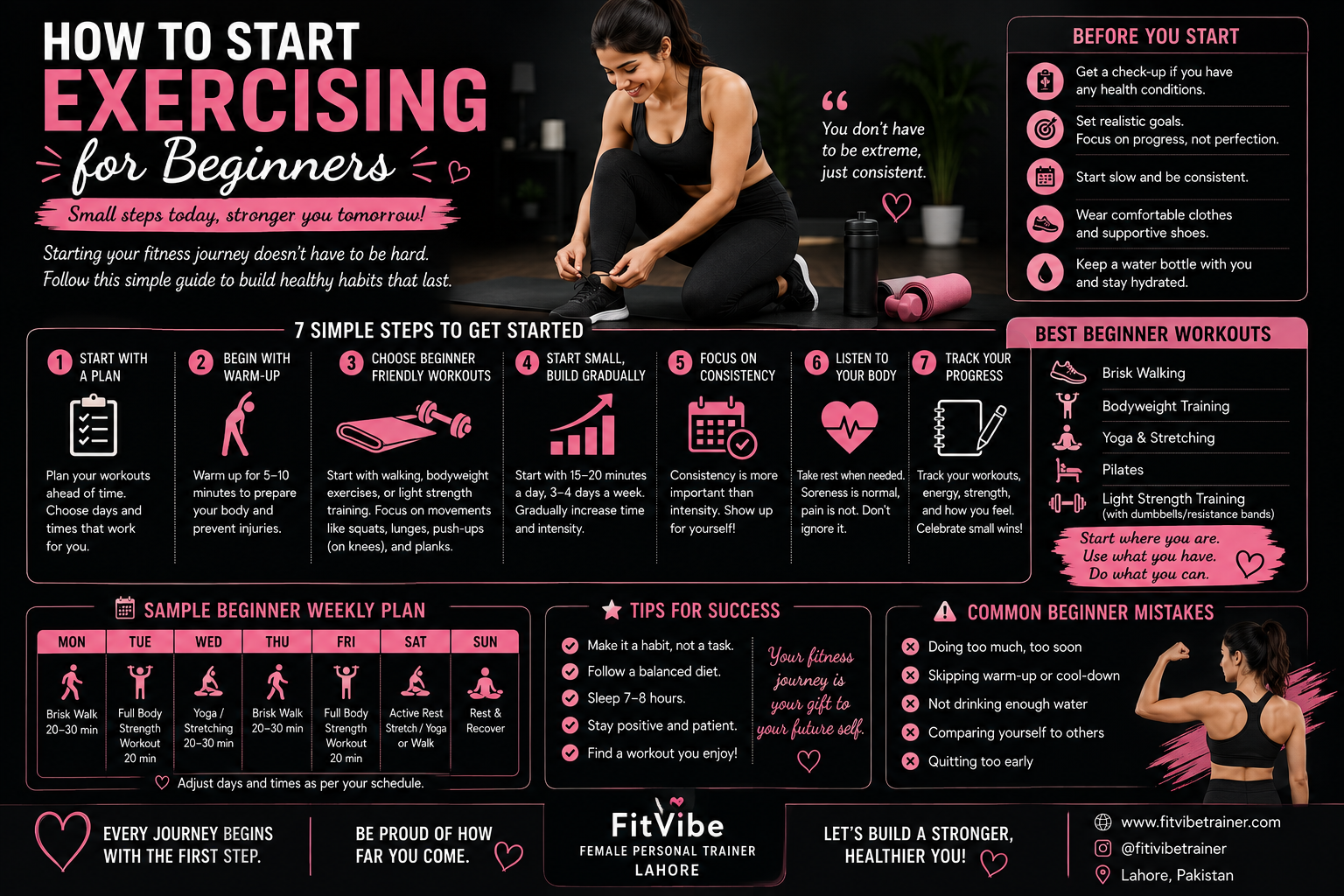
A practical week one structure for a complete beginner who is training at home in Lahore might look like this.
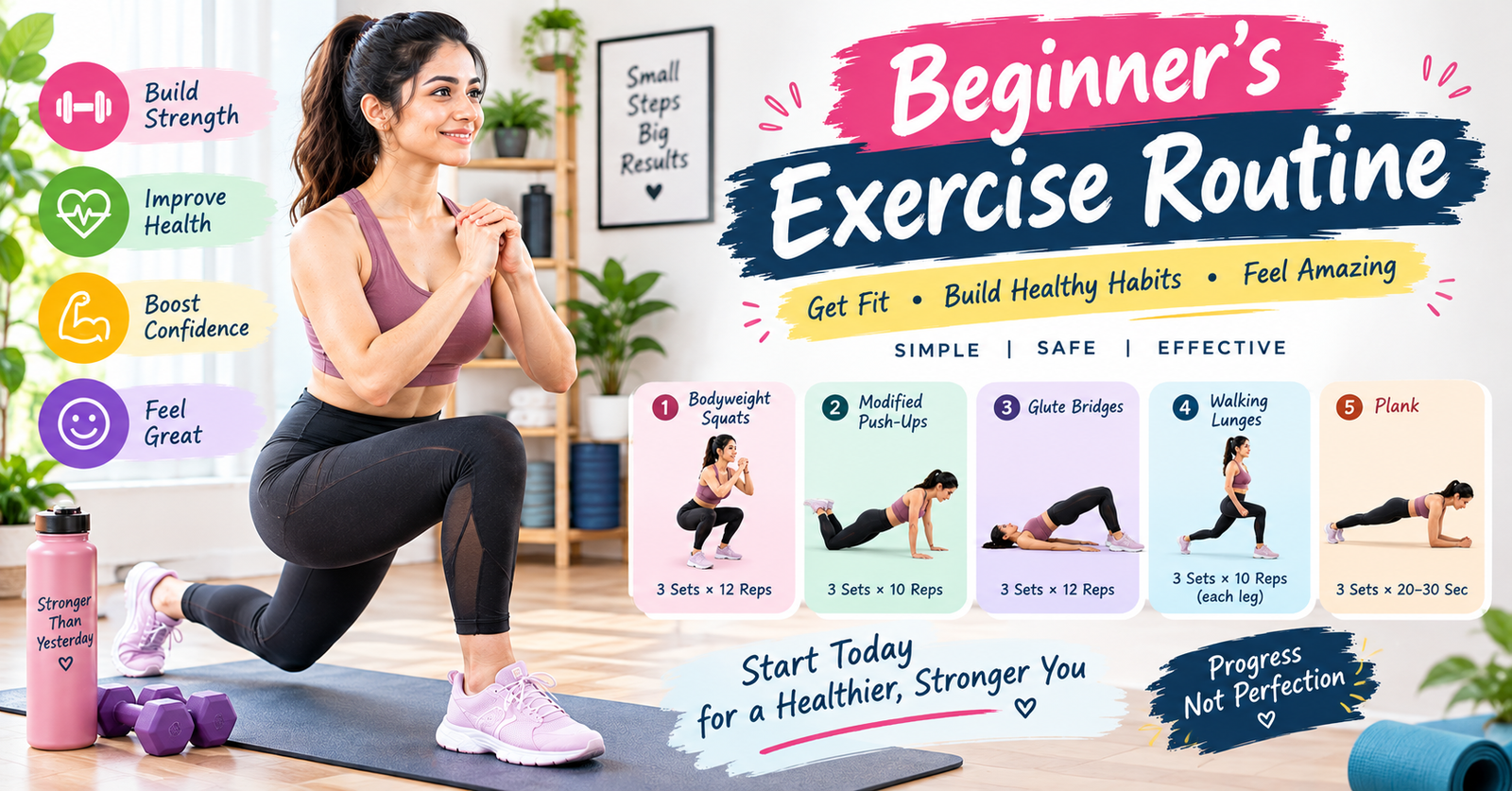
- Day One: Lower body foundation. Ten bodyweight squats performed slowly, focusing on sitting back rather than forward and keeping your chest up. Ten glute bridges lying on your back with knees bent, driving your hips toward the ceiling. Ten steps of a stationary lunge on each leg. Rest completely between each exercise. No rush. Repeat the circuit twice. Finish with a fifteen-minute brisk walk at a pace that makes conversation slightly effortful.
- Day Two: Rest or gentle walking only. A twenty-minute walk at a comfortable pace. No structured exercise.
- Day Three: Upper body and core foundation. Ten wall push-ups, standing and pushing away from a wall. Ten resistance band rows if you have a band, or ten seated rows using a towel looped around a door handle. Ten dead bug exercises lying on your back, extending opposite arm and leg slowly while keeping your lower back pressed to the floor. Repeat the circuit twice. Finish with a fifteen-minute brisk walk.
- Day Four: Rest.
- Day Five: Repeat day one or day three, whichever felt more manageable.
- Day Six and Seven: Walking only or complete rest.
Two to three sessions in week one is the right volume. More is not better for a beginner. Your body needs the rest days between sessions to repair the muscle tissue that the new movements challenged, and to consolidate the neural patterns that allow the next session to be performed more effectively than the previous one.
Week Two: Adding Repetitions and Range
By week two, the movements from week one should feel slightly more familiar. Your balance during squats and lunges will have improved. Your push-ups from the wall will feel more controlled. This familiarity is the signal to add a small amount of progression.
In week two, increase the repetitions of each exercise from ten to twelve. Increase the circuit from two rounds to three. If wall push-ups feel controlled and stable, progress to an incline push-up from a chair or a low table. Increase your brisk walk from fifteen minutes to twenty minutes.
Continue resting between each exercise. You are not doing circuit training for cardiovascular conditioning at this stage. You are learning movement patterns with adequate recovery between efforts so that each set is performed as well as possible.
Expect some muscular soreness in week two, particularly in the twenty-four to forty-eight hours following sessions. This is delayed onset muscle soreness and it is a normal, expected consequence of performing new movements. It indicates adaptation rather than injury. The distinction is important: soreness is a diffuse, dull discomfort spread across a muscle that improves with light movement. Pain is sharp, localised, and often joint-related. Soreness during early training is expected. Pain during training is not, and requires you to stop and rest rather than push through.
Week Three: Introducing Progressive Overload
Progressive overload is the principle that your body adapts to demands placed on it and must be presented with slightly greater demands over time to continue adapting. In week three, you begin applying this principle in its simplest form.
If you have access to any resistance, even water bottles, a filled bag, or resistance bands, begin adding light load to movements that previously used only bodyweight. Hold a water bottle in each hand during your squats. Add a resistance band above your knees during glute bridges. Progress your push-up from a chair height to a lower surface.
If you have no access to any resistance, progress through increased difficulty of the movement itself. Single-leg glute bridges instead of bilateral. Deeper squats with a controlled three-second lowering phase. Push-ups with a two-second pause at the bottom. These are all forms of progressive overload that do not require equipment.
In week three, add a fourth training session if your schedule allows. Four sessions per week, each of thirty to forty minutes, is a meaningful volume for a beginner that produces consistent adaptation without overwhelming recovery capacity.
Week Four: Building the Habit Structure
By week four, the movements that felt entirely foreign in week one should feel genuinely familiar. Your body knows what a squat is now. Your nervous system has the pattern established. This is when training begins to shift from effortful novelty to something that feels more like a capability being exercised rather than a completely new skill being acquired.
Week four is when you reassess. Take your body measurements if you have been tracking them. Note how your energy levels in daily life have changed. Observe how the movements feel compared to week one. These are the progress markers that week four reveals, and for most beginners they are genuinely meaningful even if scale weight has not changed significantly.
Week four is also when you design your week five forward. What exercise format will continue to challenge you without overwhelming you? Are two to three strength sessions per week alongside daily walking the right structure for your life and schedule? Or do you have capacity for four? The answer is the one you can actually sustain, not the one that sounds most impressive.
The Specific Considerations for Women Starting Exercise in Lahore
Several factors specific to women in Lahore shape what beginning exercise looks like practically, and generic international guides do not address any of them.
- Heat and season. In summer months, outdoor exercise in the middle of the day in Lahore adds heat stress that elevates cortisol, accelerates dehydration, and makes exercise feel significantly more difficult than it actually is. Morning or evening outdoor walks are far more effective than midday sessions. Indoor sessions in any format are completely appropriate and fully effective. If your home has stairs, stair walking is an excellent cardiovascular option that requires no equipment and no outdoor exposure.
- Home training without equipment. Effective beginner exercise requires no gym, no equipment, and no dedicated space beyond approximately two metres by two metres. Every foundational movement can be performed in a bedroom, a lounge, or a courtyard with bodyweight alone. As strength increases, water bottles, filled bags, or resistance bands costing very little provide sufficient progressive overload for the first several months of training.
- Privacy and comfort. Many women in Lahore prefer or require a training environment that is private and female-only. Home training fully accommodates this. Live online coaching from a qualified female trainer provides all the supervision, form correction, and programme progression benefits of in-person coaching without requiring travel to a gym environment that may not feel comfortable.
- Scheduling around household and family responsibilities. A thirty to forty-five minute session twice or three times per week is sufficient to produce meaningful fitness progress. These sessions do not need to happen at fixed times. They need to happen with enough frequency and consistency to allow the body to adapt. Building exercise into existing daily structure, immediately after children leave for school, during a lunch break, in the early morning before household activity begins, produces more consistent attendance than treating exercise as a separate scheduled commitment that competes with other responsibilities.
- Ramadan adaptation. Training during Ramadan is entirely possible and beneficial for maintaining the fitness habits that beginner months have established. Sessions work best in one of two windows: before Sehri while glycogen from the previous Iftar is available, or one to two hours after Iftar when energy and hydration are partially restored. Reducing session intensity and duration by twenty to thirty percent during fasting hours maintains the habit and the adaptation without adding dehydration stress to the training load. You can also see practical beginner exercise demonstrations on our Instagram page.
The Most Common Beginner Mistakes and How to Avoid Them
Understanding these mistakes before you encounter them prevents the early programme abandonment they typically produce.
- Doing too much too soon. The instinct when starting exercise is to prove to yourself that you can do a lot. The sessions that feel most impressive in week one are almost always the ones that produce the worst soreness in week two and the greatest chance of stopping before week three. Starting with less than you think you can do and progressing gradually from there produces more total exercise over three months than starting hard and needing to recover.
- Expecting visible results in the first two weeks. The first two weeks of exercise produce neural adaptation, improved energy, better sleep, and reduced daily stiffness. They do not produce visible body composition change. Expecting visible change at two weeks and concluding the programme is not working is one of the most reliable ways to stop before the programme has had time to produce its first measurable outcome.
- Resting too long between sessions. Exercising once per week does not produce consistent adaptation because the body adapts to each session and then returns substantially to baseline before the next one occurs. Two to three sessions per week maintains a sufficient training stimulus that each session builds on rather than restarts the adaptation of the previous one.
- Choosing exercises based on what you have seen online rather than what your body can currently do. Exercise content on social media consistently shows intermediate or advanced movements performed by people with years of training experience. Starting with these movements produces poor form, elevated injury risk, and significant unnecessary soreness. Foundational movements, done correctly with progressive overload, produce better results for beginners than impressive-looking exercises done badly.
- Ignoring pain and treating it as normal soreness. Soreness is diffuse and muscular. Pain is sharp and often joint-located. If you experience joint pain, sharp pain, or pain that does not resolve within forty-eight hours, stop the exercise causing it and seek guidance before continuing.
When to Seek a Qualified Female Trainer
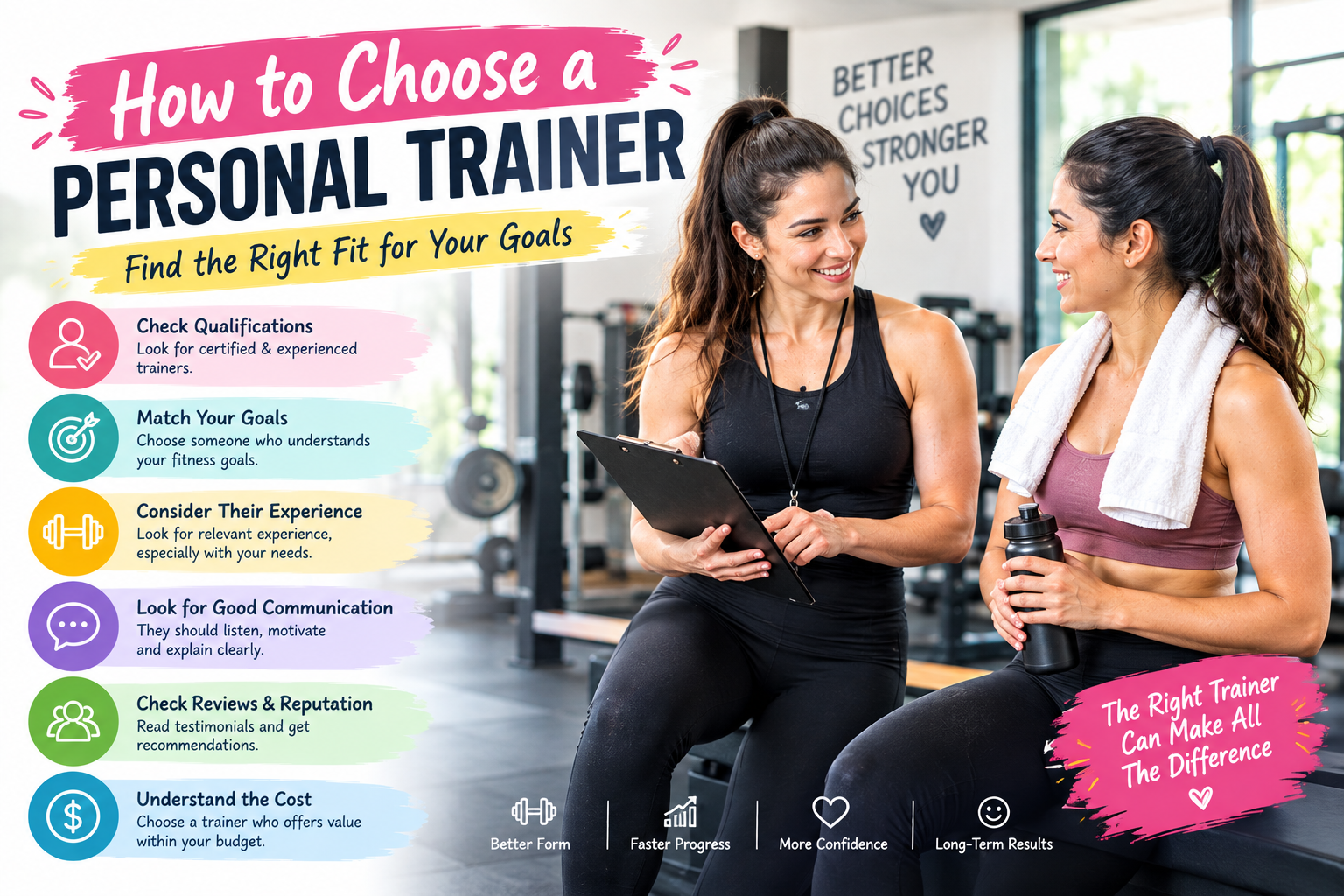
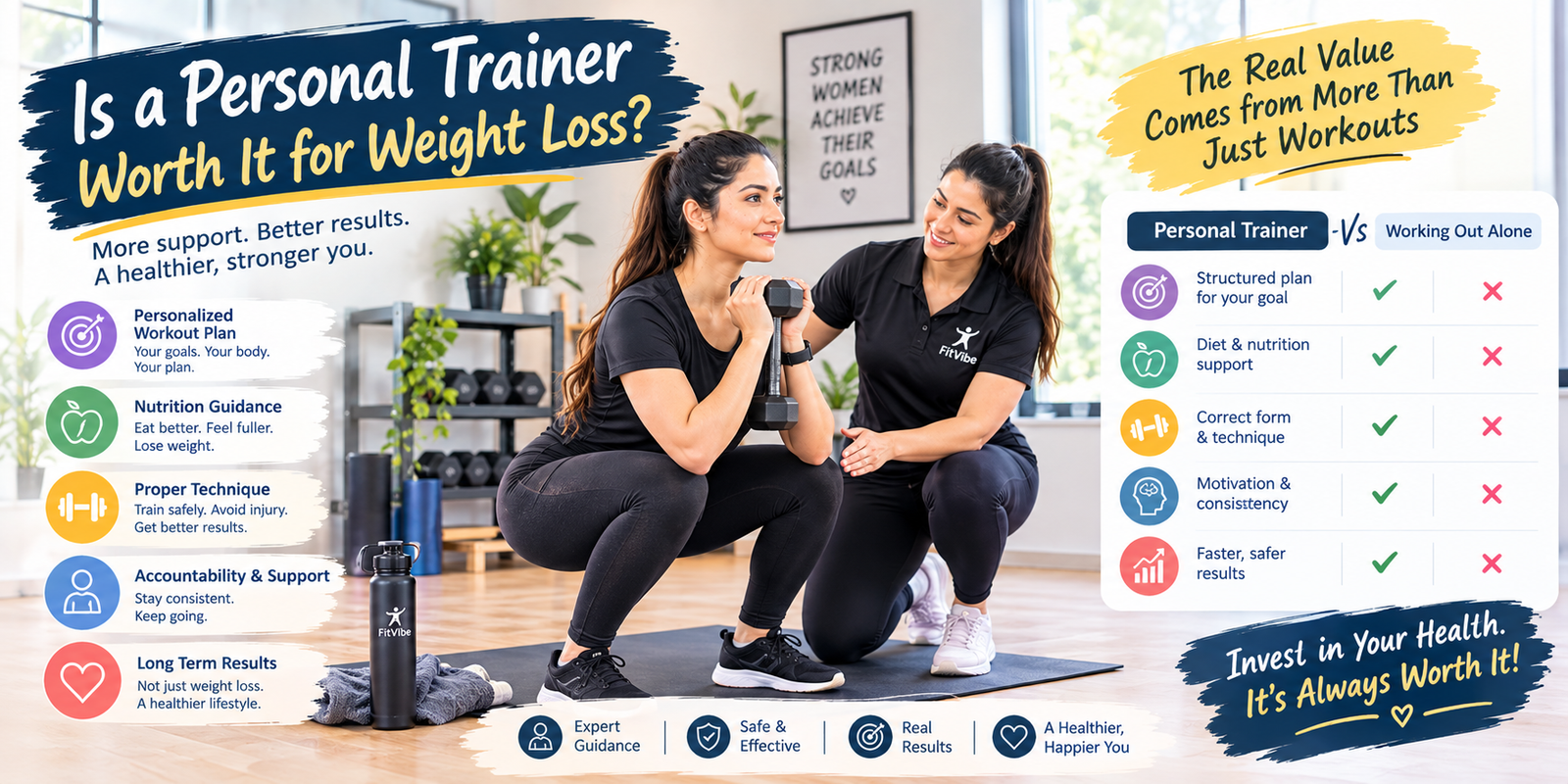
Many women begin exercise successfully using guides like this one. A qualified female trainer adds value that a guide cannot replicate: real-time observation of your movement quality, immediate form correction, progressive programme design that responds to how your body is actually adapting, and accountability that significantly improves consistency over time.
The specific circumstances where working with a qualified trainer from the beginning is particularly valuable rather than optional include: managing PCOS, insulin resistance, thyroid conditions, or other hormonal health factors that require programme modification from the start; starting exercise in the postnatal period, where deep core and pelvic floor assessment is essential before conventional exercise loading begins; managing joint pain, back pain, or previous injuries that require corrective exercise alongside general conditioning; and any situation where previous attempts to start exercise independently have consistently not lasted beyond the first few weeks.
At Fit Vibe Trainer, every new client begins with a thorough assessment before any exercise is designed. Our ACE certified coach holds qualifications spanning GGS Women's Coaching Specialist, Pre and Postnatal Coaching Certification, Diploma in Nutrition and Diet Planning, Physical Fitness and Exercise Science, Functional Training and Conditioning, and Postpartum Fitness and Recovery. We offer in home sessions across Lahore, studio sessions at Dream Gardens, and live online coaching for women in Pakistan and internationally.
For the complete explanation of what your first session with a qualified trainer actually includes, read: what to expect from your first personal training session.
For why strength training specifically is the most important form of exercise for women to prioritise from the very beginning, read: why strength training is important for women.
For the complete guide to what your first month with a female trainer looks like, read: hiring a female personal trainer as a complete beginner: what your first month actually looks like.
For how to build the sustainable weekly routine that your beginner exercise foundation leads into, read: how women in Lahore can build a sustainable weight loss routine.
For a full overview of our services for women in Lahore and internationally, visit: female personal trainer in Lahore.
Book a free consultation today and start your first month of exercise with a programme built specifically for where you are right now.
Find us on Google and read genuine reviews from women who started from exactly where you are and built lasting exercise habits.
Frequently Asked Questions
How do I start exercising when I have never worked out before?
Begin with two to three sessions per week of thirty to forty minutes each, using foundational bodyweight movements: squats, glute bridges, lunges, wall push-ups, and core exercises like dead bugs. Add daily walking of twenty to thirty minutes at a brisk pace. Progress slowly across the first four weeks by adding repetitions, then adding rounds, then adding light resistance as each progression becomes manageable. Focus on movement quality over effort, rest adequately between sessions, and expect neural adaptation and energy improvement before any visible physical change occurs.
How many days a week should a complete beginner exercise?
Two to three sessions per week is the most effective frequency for a complete beginner. This provides sufficient training stimulus for adaptation while allowing adequate recovery between sessions. More frequent training does not produce better results at the beginner stage and can produce soreness severe enough to interrupt the following sessions. Daily walking of twenty to thirty minutes is appropriate alongside the two to three structured sessions.
How long does it take to see results from exercise as a beginner?
Most beginners notice improved energy, better sleep, and reduced daily stiffness within the first two weeks. Measurable improvements in strength and movement quality appear within four weeks as neural adaptation consolidates. Visible changes in body composition, including reduced measurements and improved muscle definition, typically appear between weeks six and twelve with consistent training two to three times per week and adequate nutrition. Scale weight may show little change in the first four to eight weeks due to simultaneous fat loss and muscle gain, which is a positive outcome rather than a sign of programme failure.
Can I start exercising at home in Lahore without any equipment?
Yes. Every foundational exercise needed for beginner training can be performed with bodyweight alone in a space of approximately two metres by two metres. Squats, glute bridges, lunges, wall push-ups, and core exercises require no equipment. As strength increases, water bottles, filled bags, or resistance bands provide sufficient progressive overload for several months of continued training. A qualified female trainer can coach you through effective home sessions either in person through home visits across Lahore or via live online video sessions.
What should I eat when I start exercising for the first time?
Eat a light meal containing protein and carbohydrates one to two hours before your session. Good options include eggs with roti, yogurt with fruit, or a small serving of daal with rice. Avoid training on a completely empty stomach as it reduces energy and performance quality. After training, eat a protein-containing meal within one to two hours to support muscle recovery. Increase daily water intake to compensate for fluid lost during exercise, particularly in Lahore's warmer months. Total dietary changes at the beginner stage should be gradual rather than dramatic, as adding both new exercise habits and major dietary changes simultaneously is the most common cause of early programme abandonment.
Is it normal to feel very sore after starting to exercise?
Mild to moderate muscle soreness in the twenty-four to forty-eight hours following a new exercise session is normal and expected for beginners. This is called delayed onset muscle soreness and it indicates that the muscles have experienced a new stimulus and are adapting to it. It typically reduces significantly after the second and third session of the same type as the nervous system adapts. The best response to normal soreness is light movement such as walking, adequate hydration, and rest rather than complete inactivity. Sharp, localised, or joint-related pain is different from normal soreness and requires rest and medical assessment if it does not resolve within forty-eight hours.
Should I do cardio or strength training first as a beginner woman?
For most women, strength training is the more important priority from the start, even as a beginner. Strength training builds lean muscle that raises resting metabolic rate, directly improves insulin sensitivity, protects bone density, and produces the body composition changes that cardiovascular exercise alone cannot. Daily walking provides the cardiovascular complement to strength training without adding significant recovery demands. The beginner programme structure of two to three strength sessions per week plus daily walking covers both needs without requiring either to be sacrificed for the other.
What is the difference between normal beginner soreness and injury?
Normal beginner soreness is diffuse, muscular, spread across a broad area of a muscle group, and improves with light movement. It typically peaks twenty-four to forty-eight hours after a session and resolves within forty-eight to seventy-two hours. It does not get worse when you move gently. Injury pain is sharp, localised, often joint-related, may occur during the session rather than only afterward, does not improve with light movement, and may persist or worsen. If you are unsure which you are experiencing, rest and observe for forty-eight hours. If the sensation worsens, is joint-located, or does not improve within forty-eight hours of rest, seek assessment before continuing training.
Ready to put this into action?
Train 1-on-1 or in a group with Amna — your first discovery call is completely free. Female-only, fully online, results you can see.
Book My Free Call on WhatsApp →