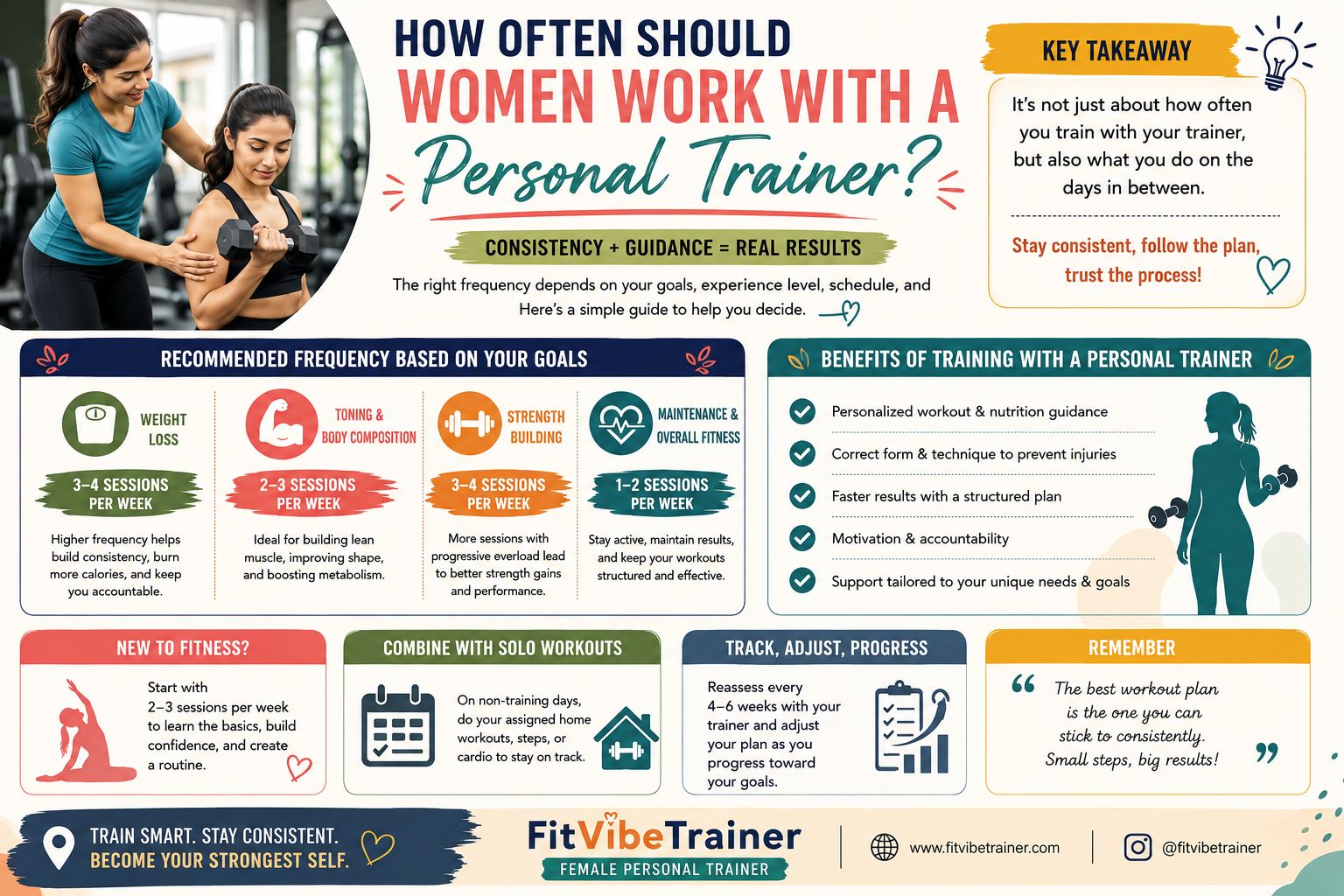
The most common answer to how often women should work with a personal trainer is two to three times per week, and for most women that answer is correct. But it is correct in the same way that saying an adult should sleep seven to nine hours is correct: it is the right range for most people under most conditions, and it becomes significantly less useful the moment your conditions differ from the average. Understanding why two sessions per week is typically the right starting point, when three sessions is better, when one is sufficient, and how hormonal health, life stage, and training goals change all of these answers is what this guide covers in full.
What the Research Actually Says About Training Frequency
The science on training frequency is clear enough to give women a confident starting recommendation without having to rely on gym marketing claims or intuition alone.
A 2023 Bayesian network meta-analysis examining 119 studies involving over three thousand participants, nearly half of whom were women, published in the British Journal of Sports Medicine, found that training twice per week ranked highest for muscle hypertrophy among all frequency conditions tested. The standardised mean difference between twice-weekly and three-times-weekly training was 0.01, which is statistically negligible. Two sessions per week and three sessions per week produce essentially equivalent muscle and strength gains when total weekly volume is comparable.
A 2019 meta-analysis of twenty-five studies found no significant difference in muscle growth between training once, twice, or three times per week when total weekly volume was equated. Frequency is not the primary driver of results. Training volume, progressive overload, technique quality, and consistency are.
A randomised controlled trial in older women over twenty-four weeks found that twice-weekly training produced approximately 19.5 percent strength gains compared to 22.2 percent for three-times-weekly training, with no statistically significant difference between the groups despite the three-times group lifting 58 percent more total volume.
What these findings mean practically for women: you do not need to train three, four, or five times per week with a personal trainer to produce meaningful strength and body composition results. Two well-structured, supervised sessions per week at appropriate intensity with consistent progressive overload produces results that are statistically equivalent to training more frequently for the majority of women in the majority of circumstances. The extra sessions add marginal benefit to results while adding meaningful demands to recovery, time, and budget.
Why Two Supervised Sessions Per Week Is the Right Starting Point for Most Women
Two supervised sessions per week is the optimal starting recommendation for most women for reasons that go beyond the research on frequency alone.
Supervised training produces dramatically higher adherence than unsupervised training. A 2025 randomised controlled trial by Gavanda and colleagues comparing supervised, app-guided, and self-directed training found supervised adherence of 88.2 percent compared to 52.2 percent for self-guided training. Significant fat-free mass gains and muscle growth occurred in the supervised group only. Two excellent supervised sessions with genuine adherence produce better results than four mediocre unsupervised sessions across every meaningful outcome measure.
Two sessions per week also provides the recovery time that training adaptation actually requires. Muscle does not grow during training sessions. It grows during recovery. The physiological processes of muscle protein synthesis, hormonal adaptation, neural consolidation, and connective tissue repair all occur in the forty-eight to seventy-two hours between sessions. Cramming sessions together without adequate recovery does not accelerate these processes. It interrupts them.
For women specifically, recovery is more variable than for men due to hormonal cycle fluctuations, and this variability means that a training schedule allowing for adequate recovery between sessions is not just convenient. It is mechanistically important for producing the adaptation that training is supposed to generate.
When One Session Per Week With a Trainer Is Sufficient
One supervised session per week is appropriate and effective in specific circumstances, and it is not the compromise it might appear to be when those circumstances genuinely apply.
One session per week works well when you are an intermediate or experienced trainee who can execute your programme independently with good form and appropriate progressive overload. The supervised session functions as a technique check, programme progression review, and accountability anchor. The trainer adjusts the programme, corrects any form drift, and programmes the following week, which you then execute in two to three independent sessions without supervision. This model is cost-effective, sustainable, and produces excellent results for women with sufficient movement vocabulary and training discipline.
One session per week also works for women who are maintaining rather than building. A woman who has achieved her target body composition and strength level through a more intensive coaching relationship can transition to once-weekly sessions as a maintenance and accountability structure while managing her programme with increasing independence.
One session per week is not sufficient when you are a complete beginner who cannot safely perform exercises independently. It is not sufficient when the single session is your only physical activity of the week. And it is not sufficient when you do not yet have the technique foundation to train alone without the risk of reinforcing poor movement patterns.
When Two Sessions Per Week With a Trainer Is the Right Answer
Two supervised sessions per week is the optimal frequency for the largest group of women across the widest range of goals and circumstances. It covers the following situations effectively.
- Women who are beginning strength training for the first time and need the neuromuscular coaching, technique correction, and programme structure that the early phases of training require.
- Women who can supplement supervised sessions with independent activity including daily walking, mobility work, or one to two independent strength sessions per week using the programme designed by their trainer.
- Women managing PCOS, perimenopause, or hormonal conditions where cortisol management is important. Two sessions per week provides adequate training stimulus without the cortisol elevation risk that higher-frequency supervised training adds to an already hormonally complex environment.
- Women with moderate to busy schedules in Lahore who are managing household responsibilities, family commitments, or professional work alongside their training. Two sessions per week is practically sustainable across the scheduling realities of most women's lives in ways that three or four sessions per week often is not.
- Women pursuing fat loss or body composition goals who complement their two supervised sessions with daily walking of thirty or more minutes. This combination, two strength sessions plus daily Zone 2 walking, produces the most effective balance of metabolic benefit, cortisol management, and recovery for the majority of women in this goal category.
When Three Sessions Per Week With a Trainer Is Worth the Additional Investment
Three supervised sessions per week is appropriate in a smaller but meaningful set of circumstances where the additional session provides genuine measurable benefit rather than simply more of what two sessions already delivers.
- Women in a dedicated twelve to sixteen week programme phase with a specific goal and adequate recovery capacity for the increased training frequency. This might be a postnatal client who has cleared the rehabilitation phase and is building strength aggressively, or a woman preparing for a specific physical challenge or event.
- Women who need high-frequency accountability to maintain consistency and who genuinely train more reliably with three scheduled appointments than with two. If a woman's attendance pattern shows that two sessions per week leads to gradual erosion of training consistency, and three sessions maintains it, the third session is providing value through accountability that justifies its cost.
- Beginners with significant available time and budget who want to accelerate the learning curve of the first eight to twelve weeks. Three sessions in the initial phase produces faster neuromuscular adaptation and technique development, which then allows the frequency to be reduced to two sessions as independence increases.
- Women with athletic or performance goals requiring higher training volumes than two sessions per week can accommodate while also managing independent training and recovery.
The critical caveat for three sessions per week is recovery capacity. Adding a third supervised session to a schedule already under significant lifestyle stress, poor sleep, or elevated cortisol from other sources does not add proportionate benefit. For many women, particularly those in perimenopause or managing chronic stress, three supervised sessions per week tips the training load into cortisol-elevating territory where the additional session actively impairs rather than supports results.
The Cortisol Factor: Why More Training Is Not Always Better for Women
This is the consideration that most generic training frequency guides miss entirely, and it is one of the most important factors determining the right session frequency for women specifically.
Exercise is a physiological stressor. Moderate-intensity training elevates cortisol during and immediately after sessions, which is a normal and necessary part of adaptation. But when training-induced cortisol elevation is added to an already elevated baseline cortisol from lifestyle stress, sleep deprivation, or hormonal conditions, the cumulative effect works against fat loss rather than supporting it.
Elevated cortisol promotes abdominal fat storage, suppresses fat mobilisation, increases appetite for high-calorie foods, disrupts sleep, and impairs the muscle protein synthesis that strength training is supposed to produce. Women who are chronically stressed and who add high-frequency supervised training to their schedule in response to plateauing results typically make the plateau worse, not better.
For women in perimenopause, declining oestrogen and progesterone dysregulate the HPA axis, making the body more sensitive to physical and emotional stress. This means that the cortisol response to the same training stimulus is greater in perimenopausal women than in pre-menopausal women, which is one of the strongest physiological arguments for maintaining training at two supervised sessions per week rather than escalating to three or more in this life stage.
For women in Lahore managing significant household and family stress alongside professional responsibilities, the baseline cortisol load is often already elevated before training begins. This makes cortisol-aware frequency decisions more important for this population than for women in contexts with lower chronic stress loads.
Training Frequency for Specific Situations
How Often Should Beginners Train With a Personal Trainer?
Most beginners benefit from two supervised sessions per week for the first eight to twelve weeks. This frequency provides enough teaching contact to build a solid movement vocabulary and enough recovery time between sessions for the neuromuscular adaptation of early-stage training to consolidate. After eight to twelve weeks, if the beginner can perform the foundational exercises with good form independently, the model can transition to one to two supervised sessions per week supplemented by one to two independent sessions.
Beginners who have the budget and schedule for three sessions per week in the first four to eight weeks will build technique and confidence faster, which is a legitimate advantage. But the transition to two sessions per week should still happen once that technical foundation is established, rather than maintaining three supervised sessions indefinitely as a substitute for developing training independence.
How Often Should Women With PCOS Train With a Personal Trainer?
Two supervised sessions per week is typically the right frequency for women managing PCOS, and the reasoning is specifically hormonal. PCOS is associated with insulin resistance and elevated cortisol sensitivity in many cases. High-frequency training increases cortisol, which can worsen the hormonal environment of PCOS and impair the very insulin sensitivity improvements that strength training is supposed to produce.
Two supervised sessions targeting progressive strength loading, supplemented by daily Zone 2 walking rather than high-intensity cardio on additional days, provides the optimal training stimulus for PCOS management without the cortisol escalation risk. Between-session activity should be low-intensity rather than additional high-intensity sessions when PCOS is a factor.
How Often Should Postnatal Women Train With a Personal Trainer?
Postnatal training frequency needs to account for a recovery timeline that is entirely different from standard training contexts. In the first six to twelve weeks after delivery, the appropriate supervised training frequency is typically one session per week or less, focused on deep core rehabilitation, pelvic floor activation, and basic movement restoration rather than conventional strength programming. The recovery demands of the postnatal period, combined with the sleep deprivation most new mothers experience, mean that very low training frequency with high coaching quality is appropriate for this phase.
After twelve weeks, when pelvic floor and deep core function have been assessed and cleared by a postnatal-specialist trainer, the transition to two supervised sessions per week typically produces excellent results in postnatal fat loss, muscle rebuilding, and energy improvement. For postnatal women managing young children and household demands, two supervised sessions per week is almost always more practically sustainable than three, regardless of fitness goals.
How Often Should Women Over Forty Train With a Personal Trainer?
Two supervised sessions per week is the research-supported recommendation for women over forty, and the cortisol consideration above makes it particularly appropriate for perimenopausal and postmenopausal women. The additional cortisol load of a third supervised session per week is more likely to impair results in this hormonal environment than to improve them. The two supervised sessions should be complemented by daily walking and, where schedule allows, one independent strength session using the programme designed by the trainer.
What to Do Between Supervised Sessions
How you structure the days between supervised sessions matters almost as much as the supervised sessions themselves for determining what your overall programme produces. The ideal between-session structure for most women pursuing fat loss or body composition goals looks like the following.
- Daily Zone 2 walking of thirty or more minutes. Zone 2 walking reduces cortisol through parasympathetic nervous system activation, improves insulin sensitivity, burns additional calories, and supports cardiovascular health without adding to recovery demands from the strength sessions.
- One independent strength session per week using a programme written by your trainer, executed with the technique she has coached in supervised sessions. This session should be lighter in load than your supervised sessions and focused on technique reinforcement rather than maximal effort.
- Adequate sleep of seven to eight hours. Sleep is when muscle protein synthesis, growth hormone secretion, and cortisol regulation occur. Poor sleep between training sessions directly reduces what those sessions produce. This is not a lifestyle suggestion. It is a training variable with measurable impact on results.
- Protein intake distributed across meals. Consuming 1.6 to 2.0 grams of protein per kilogram of bodyweight per day, distributed across three to four meals, provides the amino acid availability that muscle repair and growth between sessions requires.
When to Reduce Session Frequency and When to Increase It
Your training frequency with a personal trainer is not a fixed commitment that should remain unchanged regardless of what is happening in your life and body. These are the signals worth paying attention to.
Consider reducing frequency if: you are consistently arriving at sessions fatigued rather than recovered; your strength performance is declining rather than progressing across multiple weeks; your sleep quality is poor and worsening; you are managing a period of elevated life stress that is adding significantly to your cortisol baseline; or your schedule has changed such that two sessions per week is producing attendance stress that is undermining the benefit of the sessions themselves.
Consider increasing frequency if: you have a specific time-limited goal requiring faster progress; your recovery from current sessions is consistently excellent by the following session; your schedule and budget allow an additional session without causing life stress; or your independent training sessions are not being completed and a third supervised session would replace rather than add to the training volume.
How Fit Vibe Trainer Determines the Right Frequency for Each Client
At Fit Vibe Trainer, session frequency is determined during the initial assessment and reviewed at every programme phase transition, not set once and left unchanged. The assessment covers your health history, hormonal context, current recovery capacity, schedule constraints, budget, and training goals. The frequency recommendation that comes from this assessment is built around your specific physiological and lifestyle context rather than a standard package.
For most new clients in Lahore, we recommend beginning with two supervised sessions per week supplemented by daily walking. For clients managing PCOS, postnatal recovery, or perimenopausal changes, this recommendation includes specific adjustments to between-session activity and intensity that account for the hormonal factors affecting their training response. For complete beginners, the first four to eight weeks may involve a third session if schedule and budget allow, transitioning to two sessions once the technical foundation is established.
Our ACE certified coach holds qualifications spanning GGS Women's Coaching Specialist, Pre and Postnatal Coaching Certification, Diploma in Nutrition and Diet Planning, Physical Fitness and Exercise Science, Functional Training and Conditioning, and Postpartum Fitness and Recovery. We offer in-home sessions across Lahore, studio sessions at Dream Gardens, and live online coaching for women in Pakistan and internationally.
To understand what happens in your first supervised session and how the programme is designed around your specific starting point, read: what to expect from your first personal training session.
For the complete guide to what your first month with a female trainer actually looks like week by week, read: hiring a female personal trainer as a complete beginner: what your first month actually looks like.
To understand whether home or gym training is the right format for your supervised sessions, read: personal training at home vs gym: which is better for women.
For the complete guide to how to build the sustainable weekly structure that your supervised sessions anchor, read: how women in Lahore can build a sustainable weight loss routine.
For a full overview of our services for women in Lahore and internationally, visit: female personal trainer in Lahore.
Book a free consultation today and get a specific frequency recommendation based on your goals, your hormonal health, your schedule, and your recovery capacity.
Find us on Google and read genuine reviews from women who found the right training frequency and finally started seeing results.
Frequently Asked Questions
How often should women work with a personal trainer?
For most women, two supervised sessions per week is the research-backed optimal starting frequency. A 2023 meta-analysis of 119 studies found twice-weekly training ranked highest for muscle hypertrophy, with no statistically significant difference between two and three sessions per week. Two sessions provides adequate training stimulus, allows sufficient recovery between sessions, and is practically sustainable for most women's schedules without the cortisol escalation risk that higher frequencies can add for women managing hormonal conditions or significant life stress.
Is two personal training sessions per week enough to see results?
Yes. Research consistently shows that two supervised sessions per week produces muscle and strength gains equivalent to three sessions when total weekly volume is comparable. Two sessions per week fully satisfies WHO guidelines for muscle-strengthening activity and is sufficient to produce meaningful fat loss, body composition improvement, and strength gains when complemented by daily walking and adequate protein intake between sessions.
Should women with PCOS train with a personal trainer more or less frequently?
Two sessions per week is typically the right frequency for women with PCOS, and more is not necessarily better. PCOS is associated with elevated cortisol sensitivity and insulin resistance, both of which are worsened by high-frequency high-intensity training. Two supervised strength sessions per week supplemented by daily Zone 2 walking, rather than additional high-intensity sessions, provides the optimal combination of insulin sensitivity improvement and cortisol management for this population.
How often should postnatal women train with a personal trainer?
In the first six to twelve weeks after delivery, one session per week or less focused on deep core and pelvic floor rehabilitation is the appropriate frequency. After twelve weeks, with specialist postnatal assessment confirming readiness, transitioning to two supervised sessions per week typically produces excellent results in postnatal recovery and body composition. Three sessions per week is rarely appropriate in the postnatal period due to the sleep deprivation and recovery demands most new mothers are managing simultaneously.
How often should beginners see a personal trainer?
Two sessions per week for the first eight to twelve weeks is the optimal frequency for most beginners. This provides enough teaching contact to build movement quality and technique while allowing adequate recovery between sessions for neuromuscular adaptation to consolidate. Beginners with the budget and schedule for three sessions in the initial phase will build technique faster, but should transition to two sessions once the technical foundation is established rather than maintaining three sessions indefinitely.
Can I see a personal trainer once a week and still get results?
Yes, in the right circumstances. One supervised session per week works effectively for intermediate or experienced women who can execute their programme independently with good form, who complete two to three additional independent sessions between appointments, and who understand how to apply progressive overload without supervision. It is less effective for complete beginners and for women who do not train independently between sessions, for whom the single weekly appointment becomes the only physical activity rather than the anchor of a broader programme.
How often should women over forty train with a personal trainer?
Two sessions per week is specifically appropriate for women over forty and in perimenopause. Declining oestrogen dysregulates the body's stress response system, making women in this life stage more sensitive to the cortisol effects of high-frequency training. Three sessions per week can tip perimenopausal women into cortisol overload that impairs results rather than improving them. Two sessions supplemented by daily walking and one independent strength session per week provides the optimal training stimulus with appropriate cortisol management for this hormonal context.
What should I do between personal training sessions?
Daily Zone 2 walking of thirty or more minutes is the most important between-session activity for most women pursuing fat loss or body composition goals. It reduces cortisol, improves insulin sensitivity, burns additional calories, and supports cardiovascular health without adding to strength-session recovery demands. One independent strength session using the programme written by your trainer, prioritising sleep of seven to eight hours, and consuming 1.6 to 2.0 grams of protein per kilogram of bodyweight daily complete the between-session structure that produces optimal results from your supervised sessions.
Ready to put this into action?
Train 1-on-1 or in a group with Amna — your first discovery call is completely free. Female-only, fully online, results you can see.
Book My Free Call on WhatsApp →