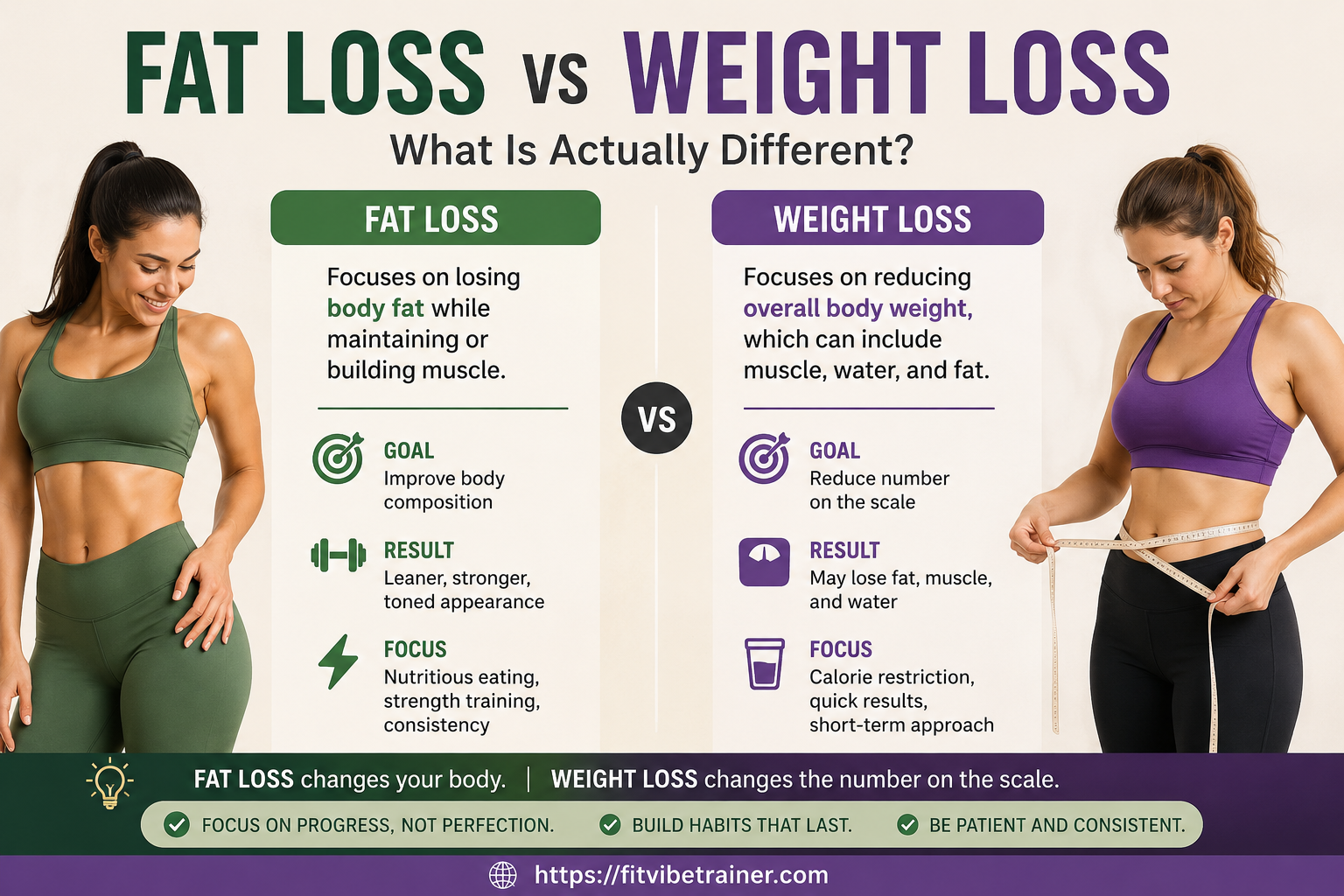
Fat loss and weight loss are not the same thing. Most people in Lahore use the two terms interchangeably, and that single confusion is one of the biggest reasons women spend months training hard and eating less without getting the results they came for. Understanding the difference is not just academic. It changes how you train, how you eat, how you measure progress, and what kind of coaching you actually need.
Here is exactly what separates fat loss from weight loss, why one produces lasting results and the other often does not, and what a qualified fat loss trainer in Lahore looks for when building a program around your body specifically.
What Weight Loss Actually Means
Weight loss simply means the number on the scale goes down. That sounds straightforward, but the scale measures everything in your body at once. Muscle. Fat. Bone. Water. Food in your digestive system. Glycogen stored in your muscles. All of it shows up as one number.
When that number drops, it could mean any of the following happened.
- You lost body fat
- You lost muscle tissue
- You lost water weight from dehydration or reduced carbohydrate intake
- You ate less food than usual and your digestive system is simply holding less at the time of weighing
- You lost a combination of all of the above
Some of these outcomes are beneficial. Some actively work against you. When a crash diet produces rapid weight loss in the first two weeks, most of that loss is water and glycogen, not fat. When severe calorie restriction causes the scale to drop over months, a significant portion of that loss can be muscle tissue, especially without structured resistance training. Losing muscle is one of the most counterproductive outcomes for anyone trying to change their body composition, because muscle is the primary driver of your resting metabolic rate.
Weight loss, defined only by the scale, does not distinguish between these outcomes. Fat loss does.
What Fat Loss Actually Means
Fat loss means specifically reducing the amount of stored body fat while preserving or building lean muscle tissue. It is a change in your body composition, not just your body weight.
Two women can weigh exactly the same on a scale and look and feel completely different. One may carry thirty five percent body fat with low muscle mass. The other may carry twenty two percent body fat with strong, dense muscle tissue. Both weigh the same. One is in a far healthier metabolic and physical state than the other.
This is why a qualified fat loss coach in Lahore does not base your entire program on a scale number. She tracks body measurements, body fat percentage where possible, how your clothes fit, your strength levels in training, your energy, and your hormonal health. These markers tell a far more accurate story of what your body is actually doing than a single number ever can.
Why Losing Muscle Destroys Long Term Fat Loss Results
This is the part most people miss, and it is the reason so many women in Lahore go through repeated cycles of losing weight, regaining it, losing it again, and ending up feeling worse each time.
Muscle tissue is metabolically expensive. Your body burns calories simply to maintain muscle. The more lean muscle you carry, the higher your resting metabolic rate, meaning the more calories you burn at rest, during daily activity, and during exercise. When you lose muscle through crash dieting, excessive cardio with no resistance training, or severe caloric restriction, your metabolic rate drops. Your body becomes more efficient at surviving on fewer calories, which is the opposite of what you need for sustained fat loss.
This is why women who repeatedly lose weight through extreme calorie cuts often find that each subsequent attempt requires eating even less to produce the same result. They have progressively eroded their metabolic capacity by losing muscle along with fat.
A structured fat loss program protects muscle while creating a caloric deficit that forces the body to draw energy from stored fat. This is the fundamental principle that separates genuine fat loss coaching from generic diet advice.
The Role of Strength Training in Fat Loss Specifically for Women
One of the most persistent misconceptions among women in Lahore is that cardio burns fat and weights build bulk. This belief leads thousands of women into daily treadmill sessions with minimal results when what their body actually needs is resistance training.
Here is what the evidence shows. Resistance training, meaning exercises that challenge your muscles against load, whether bodyweight, dumbbells, resistance bands, or barbells, does several things that are specifically valuable for fat loss in women.
- It builds and preserves lean muscle. More muscle means a higher resting metabolic rate, which means more fat burned at rest around the clock, not just during the session.
- It creates an afterburn effect. High intensity resistance training elevates your metabolism for hours after the session ends, a phenomenon called excess post exercise oxygen consumption. Steady state cardio does not produce the same effect at comparable intensities.
- It reshapes body composition without necessarily changing scale weight. A woman who adds three kilograms of muscle while losing three kilograms of fat will weigh the same but look and feel dramatically different, with a tighter, stronger, more defined physique.
- It supports hormonal health in women. Resistance training helps regulate cortisol, improves insulin sensitivity, and supports oestrogen balance, all of which are directly connected to where and how your body stores fat. This matters especially for women managing PCOS, hormonal imbalance, or postpartum recovery.
This is why every fat loss program at Fit Vibe Trainer includes structured resistance training as the foundation, not an optional add on. Cardio has its place, but it is a supplement to strength work, not a replacement for it.
How Nutrition Differs Between Fat Loss and Weight Loss Goals
The nutritional strategy for fat loss is meaningfully different from a generic calorie cut.
For weight loss on the scale, almost any sustained calorie deficit will work in the short term. Eat less than you burn and you lose weight. This is technically true. The problem is that without a sufficient protein intake and a training stimulus to signal muscle retention, your body will break down muscle alongside fat to meet its energy needs.
For fat loss specifically, the nutritional priorities shift as follows.
- Protein becomes the most important macronutrient. Adequate protein intake, generally between 1.6 and 2.2 grams per kilogram of bodyweight depending on your training volume and goals, preserves lean muscle while your body burns fat for energy. Women in a calorie deficit who do not eat enough protein almost always lose muscle alongside fat, which produces suboptimal body composition results.
- The calorie deficit is moderate, not extreme. A deficit of roughly 300 to 500 calories per day is the range most effective for preserving muscle while producing consistent fat loss. Deficits larger than this accelerate muscle loss and hormonal disruption, particularly in women.
- Carbohydrates are timed strategically. Rather than eliminating carbohydrates entirely, a well designed fat loss nutrition plan places most carbohydrate intake around training sessions where it can be used most effectively as fuel and recovery support.
- Food quality matters for hormonal reasons specific to women. Blood sugar stability, inflammation levels, and hormonal balance are all influenced by food quality, not just calorie quantity. These factors directly affect where your body stores fat and how easily it releases it.
How a Fat Loss Trainer in Lahore Structures Your Program Differently
Working with a certified fat loss coach in Lahore who understands body composition is a fundamentally different experience from working with a general fitness trainer or following a diet plan from social media.
Here is what a qualified fat loss trainer assesses and designs for you specifically.
- Your current body composition, not just your weight. Where you are carrying fat, your muscle mass, your fitness baseline, and your health history all determine the structure of your program.
- Your hormonal context. Women with PCOS, hypothyroidism, insulin resistance, or postpartum hormonal shifts lose fat differently from women without these conditions. A qualified coach accounts for this from the start rather than applying a generic template.
- Your training history. A woman who has been training consistently for two years needs a different stimulus for fat loss than a complete beginner. Resistance, volume, frequency, and exercise selection are all calibrated to your specific starting point.
- Your lifestyle outside the gym. Sleep quality, daily movement, stress levels, and eating patterns outside of structured meals all influence the rate and pattern of fat loss. A thorough fat loss coach addresses these factors as part of the program, not as afterthoughts.
- Your measurements over time, not just scale weight. Progress is tracked through waist, hip, and limb measurements, strength improvements, and how you feel and function, giving a complete picture of what your body is actually doing.
Common Fat Loss Mistakes Women in Lahore Make Without a Coach
These are the patterns that appear most frequently when women try to pursue fat loss without structured professional guidance.
- Eating too little and doing too much cardio. This combination is the fastest route to muscle loss, hormonal disruption, fatigue, and a slowed metabolism that makes fat loss progressively harder.
- Weighing themselves daily and adjusting based on fluctuations. Daily weight can fluctuate by one to three kilograms based on water retention, salt intake, hormonal cycles, and digestive content. Making training or nutrition decisions based on daily scale readings causes unnecessary panic and poor adjustments.
- Eliminating entire food groups. Cutting carbohydrates entirely, eliminating fats, or following extreme elimination diets produces rapid initial scale drops from water loss, followed by muscle breakdown, hormonal disruption, and intense cravings that lead to rebound weight gain.
- Doing only cardio with no resistance training. This produces some weight loss but does not improve body composition. Women who lose weight this way often feel soft and tired rather than strong and lean because they have lost muscle alongside fat.
- Expecting linear progress. Fat loss does not happen in a straight line. Weeks of no visible change are normal and are often followed by noticeable progress. A coach provides the context and reassurance that prevents abandoning a program that is actually working.
What Makes Fit Vibe Trainer Different for Fat Loss in Lahore
At Fit Vibe Trainer, our fat loss programs are designed specifically for women, with full understanding of female physiology, hormonal patterns, and the specific challenges women in Lahore navigate around diet culture, family schedules, and body image.
Our ACE certified coaches hold qualifications spanning nutrition, women's coaching, functional training, postnatal fitness, PCOS management, and exercise science. Every fat loss program begins with a thorough assessment, is built around your specific body and lifestyle, and is tracked through meaningful markers of progress rather than a single number on a scale.
We offer fat loss coaching through in home sessions across Lahore and live online sessions for women internationally. You do not need a gym membership, special equipment, or hours of free time to start. You need a structured, science based plan designed for your body specifically.
Book your free fat loss consultation today and find out exactly what your body needs to start losing fat, not just weight.
You can also find us on Google Maps and read what our clients say about their results.
Frequently Asked Questions
What is the difference between a fat loss trainer and a weight loss trainer in Lahore?
A fat loss trainer focuses specifically on reducing body fat while preserving lean muscle through structured resistance training, calibrated nutrition, and body composition tracking. A generic weight loss approach typically focuses on reducing the scale number without distinguishing between fat, muscle, and water loss. The difference in long term results is significant.
How long does it take to see fat loss results with a coach in Lahore?
Most women working consistently with a qualified fat loss coach notice measurable changes in body measurements and strength within four to six weeks. Visible physical changes typically become apparent between weeks six and twelve depending on your starting point, consistency, nutrition, and any underlying hormonal factors.
Is it possible to lose fat without losing weight on the scale?
Yes. This is one of the most common and positive outcomes of a well designed fat loss program. When a woman simultaneously loses body fat and builds lean muscle, her scale weight may stay the same or change very little while her body composition, measurements, strength, and appearance change significantly. The scale is one data point, not the whole picture.
Do I need to go to a gym for fat loss coaching in Lahore?
No. Fit Vibe Trainer offers in home fat loss training across Lahore and live online fat loss coaching for women worldwide. Effective fat loss programs can be delivered with minimal equipment, and many of our clients achieve significant results training entirely at home under live coaching supervision.
Is cardio necessary for fat loss?
Cardio is useful but not the primary driver of fat loss. Structured resistance training builds the lean muscle that elevates your resting metabolism and drives fat loss around the clock. Cardio complements this by increasing your overall calorie expenditure. A program that relies on cardio alone without resistance training typically produces poor body composition results in the medium and long term.
Can women with PCOS or hormonal imbalance successfully lose fat in Lahore?
Yes. Women with PCOS and hormonal imbalances can absolutely achieve consistent fat loss with the right approach. The program needs to account for insulin resistance, inflammation patterns, and cortisol sensitivity that are common in these conditions. Our coaches hold specialist certifications in women's hormonal health and design fat loss programs specifically for this population.
What should I look for when choosing a fat loss coach in Lahore?
Look for verified certifications from recognised bodies such as ACE, a specialism in women's health or body composition, evidence of working with clients who have similar goals and challenges to yours, and a coaching approach that tracks body composition rather than scale weight alone. Be cautious of coaches who promise very rapid results through extreme calorie restriction or excessive cardio without addressing nutrition, muscle retention, and hormonal health.
Ready to put this into action?
Train 1-on-1 or in a group with Amna — your first discovery call is completely free. Female-only, fully online, results you can see.
Book My Free Call on WhatsApp →