The most common workout mistakes women make are not the obvious ones. Most women who plateau or never quite get the results they are working toward are not making huge errors. They are making a collection of smaller, systematic mistakes that compound over time into a programme that works at effort without working at results. Understanding each one specifically, why it happens, what it costs you, and how to fix it, is the difference between training harder and training smarter.
This guide covers twelve of the most common workout mistakes women make, explained in full so you can identify which ones apply to your current programme and correct them specifically. You can also read additional perspectives on this topic at WhatsOn Plus and in the community discussion on Good and Bad People.
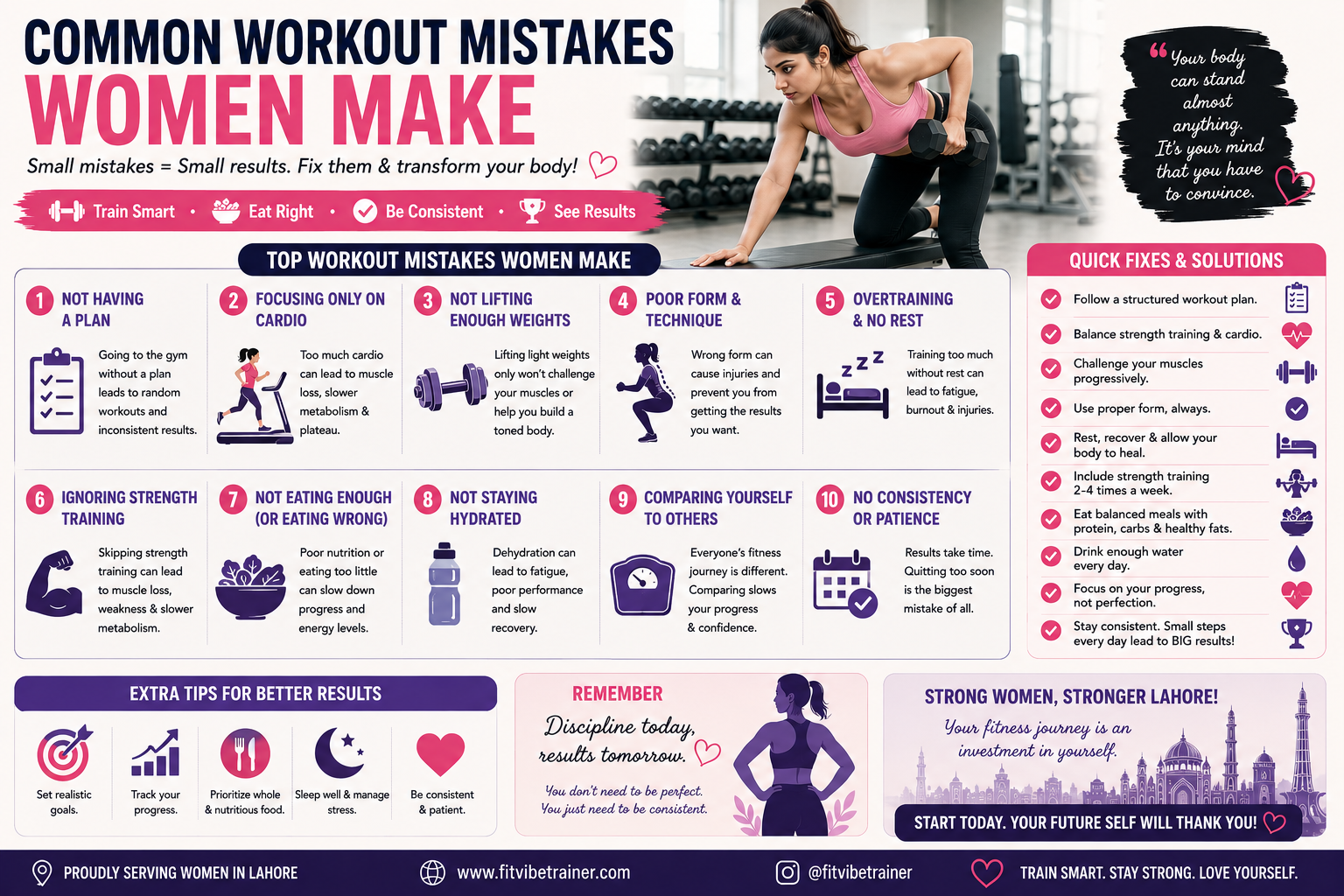
Mistake One: Doing Too Much Cardio and Not Enough Strength Training
This is the single most common pattern in women's training, and it is the one that most reliably produces the outcome women are trying to avoid: consistent effort with no meaningful change in body composition.
The misconception driving this mistake is that cardio burns fat and weights build bulk. Neither is accurate in the way most women understand it. Cardio burns calories during the session. Once it ends, the metabolic return largely ends with it. Strength training builds lean muscle that raises your resting metabolic rate permanently, produces an afterburn effect lasting up to thirty-eight hours, directly improves insulin sensitivity, and reshapes body composition in ways that cardio cannot produce regardless of volume.
Women who do primarily cardio without strength training often lose weight in the early weeks as the body adapts to a new stimulus, then plateau as that adaptation completes. Without lean muscle mass to elevate their resting metabolic rate, there is no structural change to how their body burns energy at rest. The same workout that produced results in month one produces diminishing returns by month three.
The fix: Shift to two to three strength training sessions per week as the foundation of your programme. Keep cardio as a daily complement, specifically Zone 2 intensity walking of thirty minutes or more rather than high-intensity sessions that elevate cortisol. The strength sessions are the engine. The walking is the daily fuel management.
Mistake Two: Not Lifting Heavy Enough
Walking into the weights area and reaching for the lightest dumbbells on the rack is one of the most common sights in women's training environments, and it is one of the most significant limiters of results. The fear of bulking, combined with a fitness culture that historically steered women toward light weights and high repetitions, has produced a generation of women who are chronically under-stimulating their muscles.
Lifting a weight that does not challenge your muscles does not produce meaningful adaptation. Your body adapts to the demands placed on it. If the demand is insufficient, no adaptation occurs. You go through the motions, you burn some calories, and your body stays exactly as it is.
The load that produces results is the one that makes the final two to three repetitions of a set genuinely difficult to complete with good form. Not painful, not compromised, but challenging. If you can complete fifteen repetitions of an exercise and feel like you could easily do fifteen more, the weight is not heavy enough to produce the adaptation that changes your body.
And the bulking concern is not supported by women's physiology. Women do not have sufficient testosterone to build large muscle mass through conventional training. What progressive loading produces in women is lean, defined muscle that reduces body fat percentage and changes body shape in ways most describe as toned rather than bulky.
The fix: Select a weight that makes the last two to three repetitions of your target rep range genuinely difficult with maintained form. Increase load or progression regularly as each weight becomes manageable. Progressive overload is not optional. It is the mechanism by which training produces results.
Mistake Three: No Progressive Overload in the Programme
Related to but distinct from lifting too light, this mistake refers to doing the same exercises at the same weights with the same sets and reps for weeks or months without systematic progression. This is one of the most common causes of training plateaus for women who are training consistently and have done so for some time.
Your body adapts to the demands placed on it. Once it has adapted to a specific set of exercises at a specific load and volume, it no longer needs to change. The metabolic cost of the session drops. The muscle-building stimulus diminishes. You are working, but your body is not adapting because the demand is no longer new to it.
Progressive overload means making each training cycle slightly more demanding than the last. This can mean adding weight, adding a set, reducing rest time, increasing the tempo of the movement, or progressing to a more challenging variation of the same exercise. The specific form of progression matters less than its consistent application.
The fix: Track your training. Write down what you do each session: exercises, weights, sets, and repetitions. At the start of each new training week, identify where you can progress at least one variable. A programme that does not evolve does not produce results that evolve.
Mistake Four: Skipping the Warm-Up or Making It Insufficient
Walking from the car to the gym and picking up a weight is not a warm-up. Neither is five minutes on the treadmill at a casual pace. A sufficient warm-up for women who strength train addresses three things that directly determine both the safety and the quality of the session: tissue preparation, joint mobility, and neuromuscular activation.
An insufficient warm-up means your muscles enter the working sets cold, your joints have not been taken through their functional range of motion, and your nervous system has not established the movement patterns that quality technique depends on. The result is reduced performance, compromised form, and a significantly elevated injury risk.
For women specifically, a dynamic warm-up that includes glute activation exercises is particularly important because glute inhibition from prolonged sitting is one of the most common contributors to knee pain, lower back pain, and poor squat mechanics. If your glutes are not firing before your working sets, other structures compensate, and that compensation pattern is where injuries begin.
The fix: Spend ten minutes on a structured dynamic warm-up before every session. This should include light aerobic movement to raise core temperature, mobility work targeting the hips and thoracic spine, and activation exercises for the glutes and deep core. The warm-up is not an optional addition. It is part of the session.
Mistake Five: Resting Too Little Between Sets
The belief that minimising rest between sets maximises results is one of the most persistent and most counterproductive myths in women's training. It comes from a confusion between cardiovascular exercise and strength training, and it consistently undermines the quality and effectiveness of strength sessions.
Adequate rest between sets allows the phosphocreatine energy system and the neuromuscular system to partially recover so that you can perform the next set at a quality that produces the adaptation you are training for. When rest is cut too short on compound movements, the subsequent sets are performed with significantly reduced load capacity or compromised form, or both. You are no longer strength training. You are performing metabolic conditioning at a reduced load, which is a different stimulus that produces different and generally inferior body composition outcomes.
For compound movements like squats, deadlifts, push-ups, and rows, two to three minutes of rest between sets is appropriate for most women. For accessory exercises targeting smaller muscle groups, sixty to ninety seconds is usually sufficient.
The fix: Time your rest periods rather than estimating them. Set a timer and respect it. Use the rest time to breathe intentionally, review your form for the previous set, and prepare mentally for the next one. Rest is not wasted time. It is a structural component of effective strength training.
Mistake Six: Tracking Progress Only by Scale Weight
This mistake costs women months of motivation and causes them to abandon programmes that are working at precisely the moment they are working most effectively. Scale weight is the least informative progress indicator available to a woman in a strength training programme, and relying on it exclusively produces persistent discouragement regardless of actual results.
Scale weight fluctuates by one to three kilograms on a daily basis in response to water retention, hormonal cycles, digestive content, salt intake, and glycogen storage. It cannot distinguish between fat loss and muscle gain. A woman who loses two kilograms of fat and builds two kilograms of lean muscle over eight weeks of training will show zero change on the scale while her body composition, measurements, strength, and appearance have changed significantly. If she tracks only scale weight, she concludes her programme is failing. She stops. She was at the inflection point of visible results.
The fix: Track body measurements at the waist, hips, thighs, and upper arms every four weeks alongside scale weight. Track strength performance in key exercises. Track how clothing fits. Track energy levels and sleep quality. The combination of these markers gives an accurate, multi-dimensional picture of what your body is actually doing. The scale is one data point, not the verdict.
Mistake Seven: Eating Too Little to Support Training
This is the nutritional mistake most women do not identify as a workout mistake, but it is one of the most significant limiters of training results. The belief that eating less produces better fat loss regardless of training context is widespread, and it is wrong in the specific context of women who strength train.
When you strength train, your muscles experience micro-damage that requires protein and sufficient overall energy intake for repair and growth. If your calorie intake is too low to support this repair, your body does not build new muscle from the training stimulus. Without new muscle, your resting metabolic rate does not rise. Without a rising metabolic rate, your calorie deficit narrows progressively as metabolic adaptation proceeds. And without adequate protein specifically, more of the weight you lose comes from lean muscle rather than fat, which worsens your body composition outcome.
Women who combine aggressive calorie restriction with strength training often feel perpetually fatigued, see poor performance improvements, and eventually plateau entirely despite significant effort. They are under-fuelling the adaptation their training is supposed to produce.
The fix: Ensure you are eating sufficient protein to support muscle repair, a general target of 1.6 to 2.0 grams per kilogram of bodyweight per day. Do not combine strength training with a calorie deficit so extreme that it prevents recovery. A moderate deficit of three hundred to five hundred calories below maintenance produces steady fat loss without the muscle breakdown and hormonal disruption that aggressive restriction causes.
Mistake Eight: Not Eating Enough Protein Specifically
Even women who eat sufficient total calories often consume protein at levels that are significantly inadequate for the demands of strength training. Cultural dietary patterns in Pakistan, including those common in Lahore, tend to centre carbohydrates and fats in meals with protein as a side element rather than the foundation. Combined with the persistent myth that protein builds excessive muscle in women, this produces protein intakes that undermine training results regardless of how consistent the training is.
Protein is the macronutrient that provides the amino acids your muscles need to repair after training and grow stronger. Without it, the training stimulus is present but the building material is not. You are consistently breaking down muscle without consistently rebuilding it.
The fix: Build every main meal around a protein source: chicken, beef, mutton, eggs, daal, chickpeas, paneer, or fish. These are all foods central to Pakistani cuisine that provide the protein levels strength training requires. Target 1.6 to 2.0 grams of protein per kilogram of bodyweight per day and distribute this intake across three to four meals rather than concentrating it in one sitting.
Mistake Nine: Training Through Illness, Severe Fatigue, or Significant Hormonal Days Without Modification
Showing up is valuable. Showing up regardless of how your body is presenting and performing the same session you would do on a good day is a mistake with compounding costs. Women's bodies are more variable than men's across the monthly hormonal cycle, and that variability directly affects training capacity, recovery speed, and appropriate session design.
In the late luteal phase, the week before menstruation, many women experience reduced strength capacity, increased perceived effort at the same loads, reduced recovery speed, and heightened fatigue. Training through this phase at the same intensity and load as your follicular phase sessions produces poorer results, higher perceived difficulty, and increased injury risk without any compensating benefit. The session produces the same effort perception at lower actual output.
Similarly, training at the same intensity when significantly fatigued, unwell, or under acute high stress elevates cortisol without the anabolic recovery that follows a well-recovered session. You incur the stress cost without the adaptation benefit.
The fix: Modify your sessions rather than cancelling them when your body is not presenting at full capacity. Reduce load by ten to twenty percent. Reduce volume. Focus on technique over intensity. A well-modified session on a difficult day produces better long-term outcomes than either cancelling entirely or grinding through at full intensity regardless of how your body is responding.
Mistake Ten: Training with PCOS or Hormonal Conditions Without Programme Modification
This is the mistake that most generic workout advice completely ignores, and for women in Lahore where PCOS is highly prevalent, it is one of the most significant barriers between consistent training and meaningful results.
Women with PCOS have insulin resistance in the majority of cases, which directly affects how their body stores and releases fat, how it responds to different types of exercise, and how the hormonal environment of training interacts with the already-disrupted hormonal context of the condition. A generic training programme designed for a woman without PCOS applied to a woman with PCOS produces inferior results and can worsen the hormonal environment if it emphasises high-intensity cardio over strength training, does not account for cortisol sensitivity, or does not address the nutritional component of insulin resistance management.
Women managing hypothyroidism, perimenopause, and other hormonal conditions face similar gaps between generic programming and what their specific physiology requires.
The fix: If you are managing PCOS, hypothyroidism, insulin resistance, or perimenopausal hormonal changes, work with a trainer who holds specialist qualifications in women's hormonal health and who designs your programme around your specific physiological context rather than applying a standard template. The programme adjustments required are specific and evidence-based, and they make a significant difference to outcomes in this population.
Mistake Eleven: Loading the Postnatal Core Before It Is Ready
This is a safety-critical mistake specific to postnatal women that causes significant physical harm and is committed routinely in fitness environments that lack specialist postnatal knowledge. After pregnancy, a significant proportion of women have diastasis recti, a separation of the abdominal muscles that requires progressive rehabilitation before conventional abdominal exercises are appropriate. Many also have pelvic floor weakness that requires specific assessment and graduated loading before the demands of conventional strength training are applied.
Women who return to standard abdominal exercises, sit-ups, crunches, leg raises, and heavy loaded compound movements, before deep core function is assessed and rehabilitated risk worsening diastasis recti, experiencing or worsening pelvic floor dysfunction including incontinence and prolapse, and causing structural damage that takes significantly longer to resolve than it would have taken to rehabilitate correctly from the start.
The fix: Any postnatal woman beginning or returning to exercise should be assessed by a trainer with Pre and Postnatal Coaching Certification, ideally also working alongside a pelvic floor physiotherapist, before conventional core loading begins. The correct starting point is deep core breathing mechanics and pelvic floor activation, progressing through a graduated rehabilitation sequence before any surface-level abdominal loading or heavy compound movement is introduced.
Mistake Twelve: Adding More Exercise When a Programme Is Plateauing
When results stop coming, the instinct is to do more. More sessions, more cardio, longer workouts, fewer rest days. For most women, this is the opposite of what their plateaued programme needs, and it reliably makes the plateau worse.
A plateau caused by metabolic adaptation, cortisol overload, insufficient progressive overload, or programme familiarity is not solved by adding volume. Adding more exercise to a cortisol-elevated system elevates cortisol further, disrupts sleep more severely, increases appetite, accelerates muscle breakdown, and deepens metabolic adaptation. The body becomes increasingly resistant to the stimulus that is not producing results, and the additional volume adds to the damage without providing a new solution.
The correct response to a plateau is almost always to change the stimulus, not to increase its volume. Add progressive overload if the programme has stagnated. Change the exercise selection. Add strength training if cardio has been the primary tool. Address sleep and cortisol if stress is elevated. Take a structured diet break if metabolic adaptation is driving the plateau. But do not simply do more of what has stopped working.
The fix: When you plateau, diagnose the cause rather than defaulting to more volume. The most common plateau causes in women are programme adaptation, cortisol overload, insufficient lean muscle from cardio dominance, hormonal conditions, inadequate protein, and poor sleep. Each has a specific fix. Increasing overall exercise volume addresses none of them.
How Fit Vibe Trainer Addresses Every One of These Mistakes
At Fit Vibe Trainer, every programme is built specifically to avoid the mistakes in this guide from the start rather than discovering them through months of wasted effort. Our ACE certified coach holds qualifications spanning GGS Women's Coaching Specialist, Pre and Postnatal Coaching Certification, Diploma in Nutrition and Diet Planning, Physical Fitness and Exercise Science, Functional Training and Conditioning, and Postpartum Fitness and Recovery including diastasis recti management and pelvic floor rehabilitation.
Every programme begins with a full assessment that identifies which of these mistakes your current approach is making, designs a structured, progressively overloaded programme that avoids them, and tracks progress through multiple markers of body composition, strength, and wellbeing rather than scale weight alone.
We offer in home sessions across Lahore, studio sessions at Dream Gardens, and live online coaching for women in Pakistan and internationally.
To understand why the balance of strength training and cardio matters so much for avoiding the most common mistakes, read: strength training vs cardio for women: which should you choose.
For the complete explanation of why women plateau despite consistent training and how to break through it, read: why women stop losing weight even when they exercise.
For a deep understanding of what strength training specifically produces that makes it the most important tool for correcting most of these mistakes, read: why strength training is important for women.
To understand how fat loss actually works mechanistically and why some of these mistakes directly prevent it, read: fat loss vs weight loss: what is actually different.
For a full overview of our services for women in Lahore and internationally, visit: female personal trainer in Lahore.
Book a free consultation today and find out which of these mistakes your current programme is making and exactly how to correct them for your body specifically.
Find us on Google and read genuine reviews from women who corrected these mistakes and started seeing the results their effort deserved.
Frequently Asked Questions
What are the most common workout mistakes women make?
The most common workout mistakes women make include doing too much cardio without sufficient strength training, not lifting heavy enough to produce meaningful muscle adaptation, failing to apply progressive overload so the programme stops producing results, skipping or rushing the warm-up, resting too little between compound sets, tracking progress only by scale weight, eating too little to support training recovery, not consuming adequate protein, training through hormonal variability without modification, training with PCOS or other hormonal conditions without specialist programme adjustments, loading the postnatal core before deep core function is restored, and adding more exercise volume when a plateau occurs rather than changing the stimulus.
Why do women plateau even when training consistently?
Consistent training without progressive overload produces adaptation followed by plateau, because the body has learned the stimulus and no longer needs to change. Other common causes of plateau in women include metabolic adaptation from sustained calorie restriction, cortisol overload from excessive high-intensity exercise, insufficient lean muscle mass from cardio-dominant programmes, inadequate protein preventing muscle repair and growth, poor sleep disrupting fat-loss hormones, and unaddressed hormonal conditions including PCOS and hypothyroidism. The fix is almost always to change the stimulus or address the underlying cause, not to add more exercise volume.
Why are women afraid to lift heavy weights?
The fear of bulking is the most common reason, driven by decades of fitness marketing that told women to use light weights and high repetitions. This fear is not supported by female physiology. Women do not produce sufficient testosterone to build large muscle mass through conventional strength training. Progressive loading in women produces lean, defined muscle that reduces body fat percentage and changes body shape. The muscular physiques seen in competitive bodybuilders require years of very specific training protocols, strict dietary regimes, and often supplementation that bears no resemblance to standard strength programming.
Is it a mistake to do only cardio as a woman?
For most women with fat loss or body composition goals, yes. Cardio burns calories during the session but does not build the lean muscle that raises resting metabolic rate, does not produce a significant afterburn effect, and does not directly address insulin resistance in the way strength training does. Women who do only cardio often see initial results that plateau as the body adapts to the stimulus, followed by diminishing returns regardless of how much cardio they add. Strength training as the foundation with cardio as the complement produces significantly better and more sustainable results for most women.
What workout mistakes do women with PCOS commonly make?
Women with PCOS most commonly apply generic training programmes that prioritise high-intensity cardio over strength training, which does not adequately address the insulin resistance driving their weight accumulation. They often eat insufficient protein, which prevents the muscle building that improves insulin sensitivity. They sometimes train through cortisol-elevating high-intensity sessions that worsen the hormonal environment of PCOS. And they often do not receive guidance on cycle-aware training, blood sugar-stabilising nutrition, and the specific exercise parameters that produce results in a PCOS physiology. A qualified trainer with specialist women's hormonal health knowledge produces significantly better results for this population than a standard programme.
What is the biggest nutrition mistake women make with their workouts?
The biggest nutrition mistake is under-eating relative to the demands of training, specifically consuming insufficient protein to support muscle repair and growth. Women who combine strength training with aggressive calorie restriction lose muscle alongside fat, which reduces their resting metabolic rate and produces progressively worse body composition outcomes despite significant effort. A moderate calorie deficit of three hundred to five hundred calories below maintenance, combined with protein intake of 1.6 to 2.0 grams per kilogram of bodyweight, produces steady fat loss while preserving the lean muscle that makes fat loss self-sustaining.
How do I know if I am resting too little between sets?
Signs of insufficient rest between sets include significantly reduced performance in later sets compared to the first, compromised form in sets two and three that was not present in set one, inability to complete the target repetitions at the working weight, and excessive breathlessness that does not relate to cardiovascular demand of the exercise. For compound movements like squats, deadlifts, and rows, two to three minutes between sets is appropriate for most women. Reducing this significantly produces metabolic conditioning rather than strength training, which is a different stimulus with different and generally inferior body composition outcomes.
Is it a mistake to train every day as a woman?
Training every day with high intensity is a mistake for most women because it does not allow sufficient recovery for the muscle repair and hormonal adaptations that produce results. Strength training specifically produces adaptation during rest, not during the session itself. Without adequate recovery between sessions, muscle does not fully repair, cortisol remains chronically elevated, sleep quality deteriorates, and the body cannot produce the adaptations that the training is designed to stimulate. Two to three strength training sessions per week with active recovery through daily walking is more effective for most women than daily high-intensity training.
Ready to put this into action?
Train 1-on-1 or in a group with Amna — your first discovery call is completely free. Female-only, fully online, results you can see.
Book My Free Call on WhatsApp →